In the past few years, public attention in the US has increasingly focused on the issue of so-called
“illegal immigration”. In April 2005, a vigilante group called the Minuteman Project undertook armed patrols of
the Arizona- New Mexico border, allegedly to help capture undocumented migrants. A year later, the mainstream was shaken when
millions of immigrants and their supporters (one million in Los Angeles alone) took to the streets in protest of new bills
that would further criminalize immigrants and militarize the US-Mexico border. Liberal pundits declared the birth of a new
civil rights movement, while those on the right began to mutter about the possibility of a coming culture or race war.
Liberal solutions have predictably failed to address the root causes of migration or the sources of
racist injustice. Amnesty and legalization will undeniable make life better for migrants currently living in the US, but they
will do nothing to prevent yet more indigenas and latinos from being driven from their homes, and they will
do nothing to change the US economy's dependence on cheap migrant labor.
A truly radical analysis of migration must acknowledge that most migrants would prefer to stay home,
but desperate circumstances force them to risk their lives in the hopes of finding work in the US. It must recognize the effect
of treaties like the North American Free Trade Agreement (NAFTA), which forces hundreds of thousands of campesin@s off their
land every year by dumping cheap, subsidized, US corn on the Mexican market (according to some estimates, migration across
the US's southern border has tripled since NAFTA went into effect in 1994). It must take into account the way that the Central
American Free Trade Agreement (CAFTA) will exacerbate the problem, and it must acknowledge the role of infrastructure projects like the PPP in facilitating these trade agreements.
Infrastructure projects, in and of themselves, also dislocate millions of people every year. The World
Trade Commission on Dams estimates that those directly displaced by dam construction in the last 60 years number 40-80 million
worldwide. In Latin America, these dislocations inevitably feed northward migration.
A truly radical solution to the plight of migrants in the US society must address the underlying causes
of this migration. It must not only defend the safety of those who choose to migrate, it also must defend the right of the
indigenous and campesino (subsistence farmer) peoples to preserve their lands and cultures—to live at home, with dignity, if that is their wish. It must address
the racist, colonialist economy that demands cheap labor and forces migrants and people of color into these roles. Attacking
the infrastructure of this colonialism might be a good place to start
Ten Ways to Celebrate Diversity
Ten Ways to Celebrate Diversity
1. Respect Everyone
We're all human beings, and we're all equal too. Treat others the way you want them to treat you.
2. Make the connection
We are much more alike than at first it seems. We all have hearts and minds and dreams.
3. Be Proud of Your Heritage
You are special - don't keep it inside. Share your culture backgroup with pride.
4. Keep an Open Mind
Listen to what others have to say. You're sure to learn something new that way.
5. Learn About Other Cultures
Explore the world that we all share. It's you world, too, so show you care.
6. Avoid Sterotyping
Don't judge others based on their looks. It's what's inside that matters - just like with books.
7. Enjoy Multicultural Activities
Go to cultural festivals, concerts, and more. The world's full of interesting things to explore.
8. Study Another Language
You discover other cultures as you learn what people speak, whether it's Japanese, Spanish, Swahili, or Greek.
9. Reach Out
Friends of all backgrounds bring something new. Get to know people different from you.
10. Build Peace
Kind actions and words help spread peace with ease. Tolerance, love, and trust are the keys.
The Center for Intercultural Organizing was originally
created to combat widespread anti-Muslim sentiment after 9/11/2001. Today, the Center has grown into a diverse, grassroots
organization working to build a multi-racial, multicultural movement for immigrant and refugee rights through education, policy
advocacy, community organizing and mobilization, and intergenerational leadership development.Read more ...
.
# 1
The men on the corner
Day
laborers struggle to provide for their loved ones
The men gather everyday at 4 a.m. at Newark,
New Jersey’s busy Five Corners intersection. Some are teenagers; others
could be grandfathers. Regardless of the weather, anywhere from 20 to 100 men stand and wait for hours, each one hoping he’ll
find work that day.
Jorge Flores (not his real name) is a day laborer, one of
the regulars at Five Corners. He came from Ecuador
in 2001 without documentation and considers himself an economic refugee. Following Ecuador’s economic collapse in the late 1990s, the value of money there plummeted.
Scene from
a workplace safety training for day laborers in Newark, New Jersey.
“Everything we had in the bank disappeared, so people
had to find other horizons,” Jorge says in Spanish. “Now there’s no work, no way to feed our families, no
medical care or education for the kids. I looked to the U.S.
because here there’s the American dream.”
When he can get work, it varies from construction to cleaning
to selling flowers or ices from mobile street carts. “We live day to day,” Jorge says. “If we don’t
work, we don’t eat.”
Meanwhile, Jorge hasn’t seen his family since he left
Ecuador, which has put a tremendous strain
on his marriage. He sends money home when he can, but it’s never much because his wages—typically $60 to $80 a
day—have not kept pace with his cost of living.
Do these hardships make him long for home?
“Yes, I would like to return,” Jorge says. “But
what would I do? How would I support my family? At least by being here, I can send some money home.”
*
Jorge’s story is all too familiar to Esther Chavez.
“Almost all the day laborers we work with have left
families in their countries of origin, and they’ve all left for economic reasons,” says Esther, who until recently
was the community organizer for AFSC’s Immigrant Rights Program in Newark.
“We live
day to day,” Jorge says. “If we don’t work, we don’t eat.”
The program’s work with day laborers includes providing
information about workers’ rights, organizing workplace safety trainings in conjunction with the U.S. Occupational Health
and Safety Administration, and helping some workers file cases in small claims court for unpaid wages.
Esther notes that U.S. immigration rules are so restrictive that those who have come seeking economic
security have almost no way to obtain legal status. Yet she and other immigrant rights advocates say the laborers are often
vilified because most are undocumented.
“There’s no intent to violate the law, there’s
intent to feed their families,” says Amy Gottlieb, director of the Newark
program. “It’s very easy to scapegoat undocumented immigrants for everything from increased crime to depressed
wages, but the data just doesn’t support any of that.”
Unfortunately, research that shows immigration has little
to no effect on wages and employment for U.S.-born workers, for example, has a hard time competing with public perception.
In Miami,
Florida, that perception has led to a crackdown by local authorities.
Herman Martinez is the community social activist for AFSC’s
American Friends Immigrant Services in Miami. He began organizing
day laborers in several neighborhoods when he heard stories about community members pressuring police to arrest workers and
conduct immigration sweeps with Immigration and Customs Enforcement units.
To help ease tensions, AFSC is one of the groups trying to
establish a nonprofit worker center where day laborers can seek employment in a safe and healthy environment, and contractors
can find short-term workers in an organized way.
Together with other immigrant rights, labor, and faith-based
groups, Herman also has offered a variety of community education workshops and helped forge agreements with local police that
benefit both the day laborers and the neighborhoods where they wait for work.
*
While some see the workers as threats, others see them as
inspiration. In Washington, D.C., Peta Ikambana, director
of AFSC’s Peace and Economic Justice Program, is moved by the sacrifices many immigrants have made to come to the United States.
As part of a coalition of immigrant rights groups, Peta has helped day
laborers organize a union, understand their legal rights when confronted by law enforcement and immigration authorities, and
obtain warm winter clothes.
He knows one day laborer from El
Salvador who raised $3,000 to go to Mexico and then
cross the U.S. border to find a job. The
man regularly sends money home to his wife and three children.
“When I see this gentleman and reflect on everything
I hear about immigrants, I can’t stop thinking about my own people back in Africa who
would have done the same thing to honestly provide for their families,” says Peta, who’s originally from the Democratic
Republic of Congo. “This is an honest, hard-working person. He is my daily motivation to keep working for immigrant
rights.”
More information
about AFSC’s immigrant rights work is available online at www.afsc.org/ immigrants-rights/. To learn about nationwide efforts to improve the lives of day laborers, see the
web site of the National Day Laborer Organizing Network at www.ndlon.org.
“We live day to day, If we don’t work, we don’t eat.”
# 2
Suspending
Civil Liberties in Our Own Backyard
3--01-07
The story of 9-year-old
Kevin, a Canadian boy held in a Texas lockup, drove home the fact that the U.S. is now imprisoning immigrant children and
their families in its detention centers at a prolific rate. On the February 23 edition of Democracy Now!, Amy Goodman interviewed Kevin and his father, who were on their way from Guyana to Canada, when an emergency
stop in Puerto Rico detoured their family to the T. Don Hutto Residential Facility. Kevin told Amy,
"I want to be free. I want to go outside, and I want to go to school!" (Read also Amy Goodman's article on Truthdig.)
Grassroots Responses in Texas: BORDC groups throughout Texas were outraged at the treatment of this family, and
asked how they could help. Two groups are working in the Taylor, Texas area to provide advocacy,
support and legal help to detainees. Texans United for Freedom (TUFF) and the American Civil Liberties
Union of Texas.
Meanwhile,
On February 28 in nearby San Marcos, the San Marcos Committee wore bright orange "Shut Down Guantánamo/Stop
Torture" t-shirts to protest an appearance of Karl Rove. They also carried signs referring to Rove's
reputation as a spin doctor.
Orange County, North Carolina, Resolution: The Orange County Bill of Rights Defense Committee is asking the Chapel
Hill town council to pass a resolution to protect immigrants from being detained when the national database shows they may
have a minor civil infraction.
My point to her and her readers on May 23 2007 was this:
Well when slavery was OK to do ...some seen through
it and made changes. Other said blindly "it is The Law"
-if you want to march to Mexico and demand then do it ....
I live here, was born here and I am marching in my "own country" for ..ummmmm "Justice For All"
-yes let them fix their
problems or maybe you and I could go down there and HELP (I would) ...no not with guns killing the ones we are "claiming to
help" (insert Iraq here as an example)
-obey the law? Heck 1/2 the Republicans in office these days are heading
for jail or getting booted out, ...and you want to demand poor immigrants to follow the law, probably like all these under
the table employer's who were "following the law" ....man that is a high horse you hoist your ass up on.
-you mean
the Saudi hijackers? or did you mean the hijackers who were said to be "the hijackers and then it turns out some are alive
and they are not at all the ones we were told were "the hijackers"
-my rant hit the people who are calling on walls
and jails for brown people, right on the true word, that describes their intentions. (Note rise in hate groups and KKK groups
to help with the Mexican border etc,)
-thanks for reminding me it was another "war" (Mexican American War)...The US
is good about having "just wars" I notice how you excluded the Native American reference?
-rally..., real men do the
work? what are you talking about ... I am taking a Vacation Day to go down there and support peace love human rights and
compassion, you stay the course your on .... for I know where that road is leading already!
-I know the mirror comment
brings it home....but really, hatred for humans can be abolished by looking in a mirror and marveling on how well the person
in the mirror needs it all for himself and how much you deserve this land for your self, and your family "and your kind" ...you
earned it or deserve it or some other selfish excuse. That man in the mirror is all great and the true owner, it is "those
others" that need to leave.
-racism is blind its fueled from hate...its hard to see when your proud of your righteousness
and authority over others, to a point where your decisions can be that people will die from your point of view.... must be
a "tough love" which, I am calling .... HATE.
I DIDNT GET A CARD ?
FROM THE NATIVE AMERICANS
TO LIVE HERE IN THE US
- WE STOLE THE LAND -
NOW WE ARE ASKING
OTHERS FOR A CARD?
An Aquaintence over the internet
and a fellow left Journalist that I respect allot had this commnet on his website on June 24th
I couldnt help but comment
my two cents worth, which is posted below Roberts article found at this link:
The latest death
toll figures from Hurricane Katrina can be seen on this website here.
I have a friend who would like very much to come to the US
and visit this country. She lives in the Philippines. She is 28 years old, single, owns her own home in Manila, works full-time
and makes about $150/month (typical wage over there). She doesn't have enough in the bank to come to the US yet, but there
is a serious question of whether or not she can even come here even if she had the money.
You really do not need to
know much more about her other than that I know her and have known her for 2 1/2 years.
I do not believe that she intends
to illegal if and when she comes here. She just wants to visit, stay for a while and then go home.
Easier said than
done.
As I said, there is a serious possibility that her application for a tourist visa may be turned down by the US
Embassy.
It seems kind of silly to be turning down tourists who want to visit the US but the Embassy does it all the
time. This did not use to be the case. The reason they turn down so many Filipinos is apparently because so many of them go
illegal once they come there. There is also a serious problem of fraudulent marriage.
In any sane country, this would not really be a problem. Most sane countries make it kind of hard for you to invade
and then roam around the country as an illegal alien, working anyplace you want to, using government services and so on.
Many rational countries
will not let you send your kids to their schools or utilize their hospitals or any other public services if you are there
illegally. I am not advocating that the US ban illegal aliens from our hospitals and K-12 schools. But I am pointing out that
the US is far from the global norm in this regard.
The reason my friend is going to have a hard time getting a Visa
is due to the ridiculous flood of illegal immigration into America, which has been aided and abetted by the elites of both
parties.
The advocates of illegals are always asking who gets hurt by illegals.
I will tell you who gets hurt:
Those
who wish to visit America on tourist visas or become legal immigrants to the US. Since the illegal flood, it has become harder
to apply for legal immigration and tourist visas, since so many such applicants simply go illegal once they get to the US.
As
an example, I recently met a fellow who works in a local grocery store where the vast majority of the customers speak Spanish
and many don't speak much English. He's a great guy, especially with the 1970's bushy hairdo. He came to the US as a legal
immigrant in 1977. Since then he has become a US citizen. He was not happy at all about illegal
aliens. He did it the right way, waiting in line, paying money, learning English.
The illegals just shine on
all that and get in anyway. Illegals are a gross insult to everyone, even every Hispanic, who played by the rules, waited
in line up to 15 years, filled out endless forms, paid lots of money, and did it the legal way. Why should anyone immigrate
legally as long as they can just sneak in illegally with a lot less hassle?
Once they have gone illegal, they are pretty
much lost to the system. There are over 500,000 illegal immigrants who were apprehended by US Immigration, let go on bail,
and then disappeared. They are presently roaming around our country as fugitives.
Forget Right and Left, forget Democrats
and Republicans.
Does any sane person think that what I just described above makes any sense in any sane society? Of
course it doesn't. Maybe it makes sense in some ruined failed state like Iraq or Afghanistan.
Which begs the question.
Is
America, as far as immigration goes anyway, a failed state?
JOE-ANYBODY's RESPONSE FOLLOWS
I question the relativeness
of:
"I will tell you who gets
hurt"
Your friend, who I seriouslywish and think she should be able to visit the US, "is not hurt" in the sense of those
being jailed, dieing in the deserts, jailed, starving at home, and who are just trying to somehow ...somewhere have a better
life. Many die trying to get to America...some are even children.
"That is who gets hurt."
Hi there Robbert!
Its me Joe-Anybody, obviously
we see this issue from different standpoints, but that isn't surprising most of the US are not agreeing on..... this "divide".
It is a good diversion that
turns Americans against each other and fingers start pointing at "brown people" when the neo cons continue to kill thousands
through war, they steal our treasury and constitution, and manipulate the press, when NAFTA crosses all borders ...but the
poor Mexican people cant cross the same border to preserve a life and earn a modest living, while corporations can and do,
all the time.
Your friend should be able
to visit. I blame not, the illegal, (for lack of better word) I blame our administration(sic) and the Immigration Department.
When I hear people complain that the illegals are taking our health care .... I blame the health care industry ...not the
poor man or woman needing medical help.
Yes, laws and prisons for
those that cant follow the laws are needed. I just want no part of the prison industry. In retrospect I want nothing to do
with this border enforcement issue.
I simply want to support
"people" I want to support "humanity" I want to have compassion, regardless if you have the USA card of approval inyour wallet.
I tried to briefly help a
poor Mexican woman downtown last week. She had only a clear plastic bag with her "stuff in it" and was crying and alone in
downtown on a corner. Everybody was walking by her. Yes it broke my heart I tried to help her by giving her a few bucks and
a list of homeless shelters I had ironically in my hand. I made a few calls for her on my cell standing on that corner. Another
lady stopped by and offered to take her in for the night. The lady that took her indidn't ask if she had "the card" .... in doing all this we were not trying to ruin it for your friend to visit here.
I like to see these as two separate issues.
It is a real struggle out
hear in the streets, people are barley getting by, on both sides of the border. I don't even care in the slightest what country
they are from or what their origin is. I care about them personally, and from a humanitarian standpoint. I care about their
civil rights and their human rights...... period!
And when I do think back
to my (born in the USA) "card" .... to
"my USA papers" ... (?)
I am mot so sure the Native
Americans gave me one...?
Or that I ever got one in
the first place?...
I think the US just took the land from the indigenous people!!!
Oh! that made me think about
how we took Texas etc, from the Spanish back then too.
How cynical for us to get
so possessive of land we stole.
I see this as hypocrisy.
The shear gall we have to
allow our Government to chain, in-prison, steal, rendition, torture, and lie the whole time its a NSA security .... all in
the name of USA Patriotism, Nationalism, or "stopping terrorism" is massively disturbing and extremely saddening to me.
I enjoy reading your website,
keep up the Frontline information. I am dedicated to being a "peacemaker" and want so bad in my ignorant Utopian way for us
all to get along.
Peace ~ joe-anybody.com
is found on:
<July 9 2007>
Immigrating to U.S. becomes much costlier
July 19 2007
Many fees to skyrocket by end of the
month — $1,010 for a green card
Telemundo and MSNBC.com
Updated: 4:42 p.m. PT July
20, 2007
Immigrants could end up paying thousands of dollars more to enter and stay in the country after July
30, when dozens of application fees will double or even triple, sparking opposition from a broad coalition of activists and
a rush by immigrants to submit their paperwork before the little-publicized changes take effect.
Altogether, 39 fees will rise an average of 66 percent, but some of the largest increases will come
in charges for the most basic documents immigrants must seek. Most notably, the fee to apply for a green card, establishing
legal residence in the United States, will almost triple, from $395 to $1,010.
Applying for citizenship will rise from $400 to $675.
It cost $90 as recently as 1991.
The increases are expected to raise an extra
$1.1 billion a year for U.S. Citizenship and Immigration Services, or USCIS, which is required to cover its costs with the
fees it collects from the hundreds of thousands of foreigners who seek residency and citizenship each year.
Simply put, “we need the money,” USCIS Director Emilio Gonzalez said. “To do nothing
is to invite organizational disaster, because we are just not covering the cost of doing business.”
Heavy burden on
poorer immigrants
But immigration activists said the higher fees would be a permanent obstacle
for many immigrants, many of whom take minimum-wage day labor jobs paying $5.15 an hour. They calculated that a worker would
have to save every penny he or she earned for five weeks just to apply for a green card.
The National Association of Latino Elected Officials said it “strongly
condemns” the higher fees, which it said will “put the dream of U.S. citizenship beyond the reach of many of our
nation’s newcomers.” It urged all eligible legal residents to apply for naturalization before July 30.
“The USCIS does need to make major investments to enhance the delivery of its services, and it
does face serious fiscal challenges,” the association said in a statement. “However, placing the full costs of
these investments on the back of hardworking newcomers is driving fees to a level that immigrants simply cannot afford.”
Some Democrats in Congress pressured USCIS to abandon the increases. They said much of the agency’s
budget pays for enforcement, which legal applicants should not be responsible for.
Sen. Barack Obama and Rep. Luis Gutierrez, both D-Ill., have introduced
legislation to lessen the burden by shifting funding from USCIS fees to the federal budget, while Rep. Loretta Sanchez, D-Calif.,
sent a letter to President Bush calling for a fairer system.
Sen. Edward Kennedy, D-Mass., chairman of the Judiciary subcommittee on
immigration, border security and citizenship, criticized the hefty fee hikes when they were first proposed in January, saying
they would “price the American dream out of reach for qualified immigrants” seeking to become citizens.
Opposition from variety of sources The new fee schedule also drew opposition from
a spectrum of groups representing business, education and the arts.
Business groups, led by the trucking industry, criticized higher fees for
waivers allowing foreigners with criminal records into the country on business. The new fee, $545, will sharply raise costs
for commercial cross-border trucking and shipping, they said, costs that would inevitably be passed on to consumers.
International students applying for a practical training or employment authorization
form will pay $340, nearly double the $180 they pay now. Fees for several other documents important to international students
will also rise by $100 or more, including applications for non-immigrant arrival and departure records, petitions for non-immigrant
workers and applications for extended stays as a non-immigrant.
The American Arts Alliance, meanwhile, complained that higher fees would
make it harder for artists, especially those affiliated with nonprofit enterprises, to travel to American audiences.
“Delays and unpredictability in visa processing have made it increasingly difficult for international
artists to appear in the United States,” the alliance said.
Immigrants rush to file papers As awareness of the new fees courses through immigrant
communities, tens of thousands were streaming to local immigration offices to avoid the surcharges.
Immigration activists in Miami opened Centro de Orientación dell Inmigrante, a temporary service, to
help speed applicants through the process before July 30. Telemundo affiliate WSCV-TV reported that organizers hoped to secure
funding from national immigration groups to make the center permanent.
In Union City, N.J., Mayor Brian Stack and city commissioners scheduled a “citizenship drive”
for Saturday to help residents complete their forms in time. Meanwhile, the surge in applications spurred USCIS to temporarily
transfer 32 workers to Los Angeles to help handle the load.
Alex Johnson of MSNBC.com and The Associated Press contributed to this report.
NEW HAVEN, Connecticut (Reuters) - New Haven, Connecticut, on Tuesday became the first U.S. city to issue identification
cards to illegal immigrants, as opponents of the controversial cards booed the mayor and its backers cheered.
About 250 people gathered at the city hall as New Haven started issuing the cards that grant access to services such as
libraries and parks, and give illegal immigrants a chance to open bank accounts.
Supporters say the ID cards, which are offered to all New Haven's 124,000 residents, will improve public safety and give
protections to its estimated 10,000 to 15,000 undocumented workers. Critics say they will invite illegal immigration, strain
services and waste taxpayer money.
Shouting matches erupted as the two sides argued over the legality of the program, which comes as immigration reform is
stalled in the U.S. Congress, leaving many cities to struggle with how to deal with a growing undocumented population.
Inside city hall, more than 100 residents, legal and illegal, waited in line to pick up or apply for the card.
"We are here for a long time and we need something to show that we are not bad people," said a man who identified himself
as Marvin from Honduras who has lived in New Haven for 15 years. "We need something to show to check our records and show
that nobody is running from anything."
About two dozen protesters from Southern Connecticut Citizens for Immigration Reform booed New Haven Mayor John DeStefano
as he entered city hall, yelling: "Arrest him, arrest him. You're breaking the law, Johnny Boy."
The mayor did not acknowledge the crowd.
FEDERAL DEADLOCK
Later, when asked about the opposition, DeStefano said the city is dealing with an issue that the federal government has
refused to address. "They don't have the will to pass a coherent immigration and border security program," he said.
"If we're going to be the safest place we can be, we need to acknowledge who lives here."
DeStefano said he doubted a plastic card in itself would spark an influx of illegal immigration.
"Immigration is largely driven by the desire of individuals to do better for themselves and for their children to have
greater opportunity. That's what creates immigration patterns: work and opportunity. Not a piece of plastic."
Nadia Minor of Mexico, who came to New Haven with her family 12 years ago, said the cards were long overdue.
"I don't see what the big deal is. It's not giving us permanent resident status. I mean opening a bank account and being
able to present an ID, is that something that is really wrong?" she said.
Two banks have agreed to accept the new card as identification sufficient for opening an account.
The Southern Connecticut Citizens for Immigration Reform hopes to block the program with a complaint filed with the U.S.
Attorney's office in Connecticut, saying the program violates federal law, said Dustin Gold, a member of the group.
"Just because our fed officials will not enforce it, it does not give a municipal politician the right to bend and break
the rules. The mayor has to be held accountable for this," he said.
Linda Hartman of Branford, Connecticut, said the program is wrong. "This should be done on a national level. I don't believe
it should be done locally," she said.
20,000 Sign SPLC Petition Urging Congress,
President to
Stop Guestworker Abuse
Oct. 9, 2007
Dear Friend,
Earlier this year, we told you about the release and distribution of our groundbreaking report, "Close to Slavery." The report details the disgraceful abuse of guestworkers, lured here by unscrupulous employers who
reap enormous profits from widespread human suffering.
Our report documents the rampant wage violations, recruitment abuses, seizure of identity documents, squalid
living conditions and other injustices faced by these workers. But the Bush Administration simply looks the other way.
With your help we're taking action.
We've sued and won major settlements from some of the worst abusers
of the guestworker system — forcing them to reimburse wages to workers who were cheated and
to reform their employment practices. And we're currently representing guestworkers in seven more class action suits.
But we can't sue every employer separately. We need Congress to pass legislation with strong, enforceable labor
protections for guestworkers. That's why we started a petition, challenging President Bush and our senators and representatives
to stop these shameful abuses.
Now there is movement in Congress.
We've been working closely with Senator Bernie Sanders of Vermont, and he's just introduced the "Increasing
American Wages and Benefits Act" to reform the guestworker program. To support this reform, we are submitting to Congress and President Bush the names of the 20,000 caring individuals who signed our petition demanding justice for these exploited
workers.
You can help by contacting your senators and telling them you are also behind this new legislation to stop guestworker abuse.
We still have a long way to go to educate members of Congress and the American people about these abuses —
and how they threaten to drive down wages and workplace standards for U.S. workers as well. But we are gaining momentum.
I'd like to personally thank each of you who signed our petition and invite you all to join in this fight for
justice. Under this flawed program, many employers treat guestworkers like commodities instead of human beings. We desperately
need reform that is rooted in our most basic ideals of fairness and human dignity. Thank you for taking a stand.
Sincerly.......
Sept.
26, 2007 – The Southern Poverty Law Center (SPLC) today submitted to Congress and President Bush the names of more than
20,000 people who signed a petition demanding an end to the shameful exploitation of foreign guestworkers lured to this country
by U.S. companies.
Every state in America is represented on the petition urging an overhaul
of the guestworker program to ensure that strong labor protections are enacted and enforced.
In letters sent to lawmakers and Bush, the SPLC is also encouraging
support for the "Increasing American Wages and Benefits Act," guestworker reform legislation introduced today by U.S. Sen.
Bernie Sanders, I-Vt.
"This inherently abusive program gives unscrupulous corporations a
license to profit from broken promises made to guestworkers who are lured to United States to do some of the most difficult
and dangerous work in our economy for the least amount of pay," said SPLC President Richard Cohen. "Providing strong labor
protections to these workers would give them the fundamental human rights and decency they deserve."
Currently, the SPLC is representing guestworkers in seven class action
lawsuits alleging that workers were cheated out of wages and not reimbursed for exorbitant fees associated with their recruitment
and travel.
This past March, the SPLC issued a groundbreaking report, Close to Slavery, about the widespread, systematic abuses faced by guestworkers. Based primarily on thousands of interviews with guestworkers,
the report shows the systematic abuse in a program that places these workers at the mercy of a single employer with little,
if any, legal recourse if they are cheated out of wages or abused in other ways.
The report documents rampant wage violations, recruitment abuses, seizure
of identity documents and squalid living conditions.
"Unlike U.S. citizens, guestworkers can't simply change jobs if they
are mistreated," said Mary Bauer, director of the SPLC's Immigrant Justice Project. "They are bound to their employer, much
like indentured servants of old – but they must return home when the work is finished."
The "Increasing American Wages and Benefits Act" sponsored by Sanders
would substantially improve the legal protections available to H-2B workers, who come to the United States for low-skilled,
nonagricultural jobs. It would also improve protections for American workers laboring in industries that rely heavily on guestworkers.
The legislation would:
Provide the
Department of Labor with explicit authority to enforce labor law violations pertaining to the H-2B program. Allow workers
who have been directly and adversely affected by the H-2B program to have their day in court against their employers.
Allow the Legal
Services Corporation to provide the same legal services to H-2B workers as it provides to agricultural guestworkers in the
H-2A program.
Require employers
to do a better job of recruiting American workers at higher wages before allowing them to hire H-2B guestworkers.
Prohibit companies
that have announced mass lay-offs within the past year from hiring H-2B guestworkers.
Require employers
to pay for the transportation expenses for H-2B guest workers both to the United States and back to their country of origin
once the employment period ends.
"Under this program, many employers treat
guestworkers like commodities instead of human beings," Cohen said. "Reform rooted in our basic ideals of human dignity and
democracy is desperately needed."
SPLC client and forestry guestworker Armenio Pablo-Calmo (with
his granddaughter) was cheated out of wages by a company that imported workers from Latin America. As the result of our lawsuits,
many forestry workers will receive the money they're owed, and companies are reforming their labor practices.
The Northwest Detention Center is a private immigration prison facility
located on the tide flats of Tacoma, Washington. The detention center opened in 2004 under a contract with The US Department
of Homeland Security, Though owners have changed over time, the facility is now owned by the GEO Group Which operates prison
facilities in Australia, The UK, South Africa, the US and Guantanamo Bay, Cuba.
A contract with Immigration and Customs
Enforcement, or ICE, the largest and primary investigative branch of Homeland Security, expanded the facility's housing capacity
1,000 detainees, making it the largest detention center owned by GEO Group on the West Coast of the United States. (more)
This videois an Info Comercial for the Immigration Department
A job oppurtunity and spin on ...
Protecting America & Stopping Terrorism
This video and more information can be found here on an unr4elated site
It was about the ballot measure
now on the ballot in Oregon for 2008
They are ... #19 &
#112 …its not good!
That said, I was reflecting
on this video from the event they organized at PCC campus in Nov 2007 here in PortlandOregon and it
was at this forum where we were listening to these very issue of these bad laws being discussed …. Here is my video
from that event
Oregon's 2008 Anti-Immigrant Ballot Measures - #19 and #112
#19: Prohibits
TeachingPublic School
Student In Language Other Than English For More Than Two Years
Filed By: Alan
Grosso, Bill Sizemore, and Russell Walker
Summary
of Initiative
Non-English
speaking students who enter the public school system will be limited to not more than two years of English Immersion classes.
The
amount of time for ESL classes depends on the grade of non-English speaking student enter the public
school system.
“Yes” statement:
“Yes” vote prohibits teaching public school student in language other than English for more than two years (exception
for teaching foreign language to English speakers).
“No” statement:
“No” vote retains requiring English courses for students unable to profit from classes taught in English, permitting
Multilanguage instruction to assist transition to English.
Significant
Impact/Concerns
This
initiative does not consider individual learning levels or students with special needs.
What
are the consequences for non-English speaking students who are prematurely forced into English only classes?
How
will this affect refugee children who have come directly from refugee camps with little formal education?
How
will this affect ESL funding, school funding, and curriculum?
#112:
Allows state cooperation with Immigration Enforcement; Requires “Legal Presence”/Citizenship for Specified States
Rights/Privileges
Filed By: Mehran
Smith and Shahriyar Smith
Summary
of Initiative
No
Statute, regulation, or agency/instrumentality of the state can prohibit public employees from cooperating with federal agencies
in the enforcement of federal immigration law.
First
time Oregon voters must provide proof of citizenship when
registering to vote.
Proof
of legal residence is required for driver license applicants.
“Yes”
Statement: “Yes”
vote allow state/local cooperation and resources for immigration enforcement; requires certain documentation of citizenship for voter registration, “legal presence” for driver/identification
documents.
“No”
Statement:
“No” vote retains current state/local limits on cooperation and
resources to enforce immigration laws, current requirements for voter registration, and grant of driver/identification documents.
Significant
Concerns/Impacts
Would
state and local police have the ability to arrest undocumented immigrants on a regular basis? Would state and local police
receive proper training, funding and support to carry out federal immigration enforcement?
Would
this initiative require all government workers (hospitals, schools, etc.) to report undocumented immigrants? Would this initiative
promote racial profiling?
Would
this eliminate the ability to hold street-side voter registration drives?
How
long will it take to verify a voter’s status under the new system?
A new video released from the Southern Poverty Law Center reveals what now is an undeniable
link between anti-immigrant organization and white supremacists
A new video released from the Southern Poverty Law Center reveals what now is an undeniable
link between anti-immigrant organization and white supremacists.
The video titled, Behind The Veil: America's Anti-Immigration
Network, starts by asking the question, "What if all the leading anti-immigration
groups were founded by the same man, funded by the same organization, and [had] ties to White supremacy?" John Tanton,
as the video discusses in the link above.
July 27, 2008
After Iowa Raid, Immigrants Fuel Labor Inquiries
The New York Times
Printer Friendly Format Sponsored By
July 27, 2008
After Iowa Raid, Immigrants Fuel Labor Inquiries
By JULIA PRESTON
POSTVILLE, Iowa — When federal immigration agents raided the kosher meatpacking plant here in May and rounded
up 389 illegal immigrants, they found more than 20 under-age workers, some as young as 13.
Now those young immigrants have begun to tell investigators about their jobs. Some said they worked shifts of 12 hours
or more, wielding razor-edged knives and saws to slice freshly killed beef. Some worked through the night, sometimes six nights
a week.
One, a Guatemalan named Elmer L. who said he was 16 when he started working on the plant’s killing floors, said
he worked 17-hour shifts, six days a week. In an affidavit, he said he was constantly tired and did not have time to do anything
but work and sleep. “I was very sad,” he said, “and I felt like I was a slave.”
At first, labor officials said the raid had disrupted federal and state investigations already under way at Agriprocessors
Inc., the nation’s largest kosher plant. The raid has drawn criticism for what some see as harsh tactics against
the immigrants, with little action taken against their employers.
But in the aftermath of the arrests, labor investigators have reaped a bounty of new evidence from the testimony of illegal
immigrants, teenagers and adults, who were caught in the raid. In formal declarations, immigrants have described pervasive
labor violations at the plant, testimony that could result in criminal charges for Agriprocessors executives, labor law experts
said.
Out of work and facing deportation proceedings, many of the immigrants say they now have nothing to lose in speaking up
about the conditions in the plant. They have told investigators that they were routinely put to work without safety training
and were forced to work long shifts without overtime or rest time. Under-age workers said their bosses knew how young they
were.
Because of the dangers of the work, it is illegal in Iowa for a company to employ anyone under 18 on the floor of a meatpacking
plant.
In a statement, Agriprocessors said it did not employ workers under 18, and would fire any under-age worker found to have
presented false documents to obtain work.
To investigate the child labor accusations, the federal Labor Department has joined with the Iowa Division of Labor Services
in cooperation with the state attorney general’s office, officials for the three agencies said.
Sonia Parras Konrad, an immigration lawyer in private practice in Des Moines, is representing many of the young workers.
She said she had so far identified 27 workers under 18 who were employed in the packing areas of the plant, most of them illegal
immigrants from Guatemala, including some who were not arrested in the raid.
“Some of these boys don’t even shave,” Ms. Parras Konrad said. “They’re
goofy. They’re teenagers.”
At a meeting here Saturday, three members of the House Hispanic Caucus — including its chairman, Representative
Luis V. Gutierrez, Democrat of Illinois — heard seven immigrant minors describe working in the Agriprocessors plant.
Iowa labor officials said they rarely encounter child labor cases even though the state has many meatpacking plants.
“We don’t normally have many under-age folks working in our state,” said Gail Sheridan-Lucht,
a lawyer for the state labor department, who said she could not comment specifically on the Agriprocessors investigation.
Other investigations are also under way. The Equal Employment Opportunity Commission is examining accusations of sexual
harassment of women at the plant. Lawyers for the immigrants are preparing a suit under the federal Fair Labor Standards Act
for wage and hour violations.
Federal justice and immigration officials, speaking on Thursday at a hearing in Washington of the House Judiciary immigration
subcommittee, said their investigations were continuing. A federal grand jury in Cedar Rapids is hearing evidence.
While federal prosecutors are primarily focusing on immigration charges, they may also be looking into labor violations.
Search warrant documents filed in court before the raid, which was May 12, cited a report by an anonymous immigrant who was
sent to work in the plant by immigration authorities as an undercover informant. The immigrant saw “a rabbi who
was calling employees derogatory names and throwing meat at employees.” Jewish managers oversee the slaughtering
and processing of meat at Agriprocessors to ensure kosher standards.
In another episode, the informant said a floor supervisor had blindfolded an immigrant with duct tape. “The
floor supervisor then took one of the meat hooks and hit the Guatemalan with it,” the informant said, adding that
the blow did not cause “serious injuries.”
So far, 297 illegal immigrants from the May raid have been convicted of document fraud and other criminal charges, and
most were sentenced to five months in prison, after which they will be deported.
A spokesman for Agriprocessors, Menachem Lubinsky, said the company could not comment on an active investigation.
“The company has two objectives in mind: to restore its production to meet the demands of the kosher food market
and to be in full compliance with all local, state and federal laws,” Mr. Lubinsky said. Reports of labor violations
at the plant “remain allegations only, that no agency has charged the company with,” he said.
The Agriprocessors kosher plant here has been owned and operated since 1987 by Aaron Rubashkin and his family. His son
Sholom was the plant’s top manager until he was removed by his father in May after the raid. The plant’s
products are distributed across the country under brands including Aaron’s Best and Aaron’s Choice.
Most of the young immigrants were hired at Agriprocessors after they presented false Social Security cards or other documents
saying they were older than they were.
But in an interview here, Elmer L. said he had told floor supervisors that he was under 18. He asked that his last name
not be published on advice of his lawyer, Ms. Parras Konrad, because he is a minor in deportation proceedings.
“They asked me how old I was,” Elmer L. said. “They could see that sometimes I could not
keep up with the work.”
Elmer L. said that he regularly worked 17 hours a day at the plant and was paid $7.25 an hour. He said he was not paid
overtime consistently.
“My work was very hard, because they didn’t give me my breaks, and I wasn’t getting very
much sleep,” he said. “They told us they were going to call immigration if we complained.”
Elmer L. said that he was clearing cow innards from the slaughter floor last Aug. 26 when a supervisor he described as
a rabbi began yelling at him, then kicked him from behind. The blow caused a freshly-sharpened knife to fly up and cut his
elbow.
He was sent to a hospital where doctors closed the laceration with eight stitches. But he said that when he returned,
his elbow still stinging, to ask for some time off, his supervisor ordered him back to work.
The next day, as he was lifting a cow’s tongue, the stitches ruptured, Elmer L. said, and the wound bled again.
He said he was given a bandage at the plant and sent back to work. The incident is confirmed in a worker’s injury
report filed on Aug. 31, 2007, by Agriprocessors with the Iowa labor department.
Gilda O., a Guatemalan who said she was 16, said she worked the night shift plucking chickens. She said she was working
to help her parents pay off debts.
Another Guatemalan, Joel R., who gave his age as 15, said he dropped out of school in Postville after the eighth grade
and took a job at Agriprocessors because his mother became ill. He said he worked from 5.30 p.m. to 6.30 a.m. in a section
called “quality control,” a job he described as relatively easy that he got because he speaks English.
But he said he and other workers were under constant pressure from supervisors. “They yell at us when we don’t
hurry up, when we don’t work fast enough for them,” said Joel R. He and Gilda O. did not want their last
names published because they are illegal immigrants and they were not arrested in the raid.
Most of the young immigrants have been released from detention but remain in deportation proceedings. Ms. Parras Konrad
said she will ask immigration authorities to grant them special four-year temporary visas, known as U visas, which are offered
to immigrants who assist in law enforcement investigations. Iowa labor officials are considering supporting some of those
requests, Ms. Sheridan-Lucht said.
Agriprocessors executives said they had begun an overhaul of hiring and labor practices, starting with hiring a compliance
officer, James G. Martin, a former United States attorney in Missouri. In an interview, Mr. Martin said the company had contracted
with an outside firm, the Jacobson Staffing Company, to handle its hiring, and new safety officers, including one former federal
work safety inspector.
Mark Lauritsen, a vice president for the International Food and Commercial Workers Union, which has tried to organize
the plant, said he remained skeptical. “They are the poster child for how a rogue company can exploit a broken immigration
system,” Mr. Lauritsen said.
Home
http://www.nytimes.com/2008/07/27/us/27immig.html?_r=1&ref=us&pagewanted=print&oref=slogin
Both of My Grandfathers Were Illegal Immigrants (and Lou Dobbs' Would
Be Today)
By Steven Wishnia, AlterNet Posted on August 5, 2008, Printed on August
5, 2008 http://www.alternet.org/story/92656/
Both my grandfathers were illegal immigrants.
Morris Passoff, my mother's father, came here from what is now Belarus in 1910, when he was 14. As
he was by himself, he got a woman on the ship to pretend she was his aunt so he wouldn't be turned back at Ellis Island as
an unaccompanied minor.
Avram Wishnia and Hinde Greenberg Wishnia, my father's parents, came here from Paris around 1929, about
five years after they had emigrated there from Poland. My grandmother was able to enter the country as an immigrant, as her
father was already a U.S. citizen, but my grandfather had to come in as a tourist. In early 1932, he was expelled because
his visa had expired -- even though he had an 8-month-old Brooklyn-born son, my father. My grandmother went to work in an
overcoat factory while her parents took care of my father -- who was what the contemporary anti-immigrant movement calls an
"anchor baby."
My family history belies the central beliefs of that anti-immigrant movement: the argument that "our
ancestors all came here legally"; the racist attitudes that immigrants are alien scum; and the idea that immigrants, especially
illegal ones, drive down wages. Both my grandfathers became union activists, part of the movement that ushered in the greatest
period of working-class prosperity in the history of the industrialized world. "In our organizing, we talk about the work
immigrants did in the 1930s to create the good jobs we have today," says Annemarie Strassel, a Chicago-based organizer for
UNITE HERE. "We want to revive that for the 21st century."
Morris Passoff got a job as a copy boy for the New York World, driving a horse cart to deliver
stories from reporters in the field. On March 25, 1911, when he was 15, he was at work when a fire broke out in the Triangle
Shirtwaist Factory. He watched as screaming workers jumped from ninth-floor windows with their hair and clothing ablaze, as
the World reported. He moved up to the mailroom, bundling and mailing the newspapers, and eventually worked at two
Yiddish-language dailies. He served on the executive board of Mailers Local 6 of the International Typographers Union.
"He had a real sense of himself as working-class," my mother recalls. "He always said, 'I am a worker.'
Not 'middle class,' like they say today."
Avram Wishnia returned to Brooklyn in 1934 and worked as a presser in a clothing factory. He also served
on the executive board of his International Ladies Garment Workers Union local. He stood up to Murder Inc. goons and corrupt
business agents but was purged at the beginning of the Cold War for his communist sympathies.
Union wages and security, affordable (rent-controlled) housing and cheap college tuition were the tripod
that supported my parents' generation as they moved into the middle class and beyond. But there are formidable obstacles to
the current generation of immigrants doing the same. Changes in our immigration laws mean that most of the Ellis Island generation
would not now be able to enter the country legally. The union movement is much weaker than it was in the post-World War II
period. The post-Reagan economy has redistributed wealth from America to Richistan to the point that if Manhattan were an
independent nation, it would have the most unequal economy in the world. And the illegal status of many immigrant workers
is another weapon employers can use to intimidate them when they try to organize.
War on Workers
"Employers violate workers' rights every time we try to organize," says Eddie Acosta, worker center
coordinator for the AFL-CIO. "It's the fear of being deported that makes people afraid."
Two of the largest recent roundups of illegal immigrants -- in which the federal Bureau of Immigration
and Customs Enforcement charged hundreds of workers with identity theft for using false Social Security numbers -- took place
at companies with histories of union-management conflict. The United Food and Commercial Workers were trying to organize at
the Agriprocessors kosher meatpacking plant in Postville, Iowa, where 389 people were arrested and 270 jailed in an ICE raid
May 12. And the United Steelworkers were beginning a drive to expand the union at the Chattanooga chicken factory that was
one of five Pilgrim's Pride plants raided in April, with more than 300 people arrested.
Agriprocessors' owners "have resisted any effort" to unionize, says UFCW spokesperson Gonzalo Salvador.
The UFCW had complained to state and federal officials that the company was shorting workers on their paychecks and hiring
underage workers, and Pilgrim's Pride in 2004 refused to renew UFCW contracts at several plants. Both companies cooperated
with ICE in the raids, and Pilgrim's Pride issued a statement saying it had set off the investigation by informing ICE that
workers at its Batesville, Ark., plant were using false Social Security numbers. However, Salvador says he can't say for sure
that the raids were linked to attempts to undermine the union. A more subtle tactic, says Milan Bhatt of the New York Immigration
Coalition, is for companies facing a union campaign to dismiss employees because of the sudden discovery that their Social
Security number doesn't match any listed in the government's E-Verify database. In 2006, the Cintas laundry chain fired more
than 400 workers after it received no-match letters. UNITE HERE was trying to organize workers there.
"We see it around the country," says Acosta. "Workers are being fired for no-match, but there hasn't
been a no-match letter sent in at least a year and a half."
The E-Verify database has at least 17,000 errors, he says, and the Department of Homeland Security's
database is also flawed. Though E-Verify is supposed to be used only to screen newly hired employees, a General Accounting
Office study found that employers are using it on current workers, he adds. The Swift meatpacking company, where ICE seized
almost 1,300 workers in December 2006, was using E-Verify. "The workers are terrorized, both immigrant and non-immigrant,
and the employer gets off scot-free."
Others say the practice is less common. Jo Marie Agriesti, Midwest organizing director for UNITE HERE,
says she's heard rumors but hasn't seen employers using no-match letters against workers in her area.
Fear Factor
Being deported is a much harsher consequence than being fired. But organizers say fear is the primary
obstacle to unionization even among native-born citizens, so workers' immigration status is not as big a roadblock as it seems.
"Immigration is serious, but it's not that different from other things people are afraid of," says Brenda Carter of UNITE
HERE. "People's biggest fear is of losing their jobs," explains Agriesti. "If you're a 50-year-old white woman or a 50-year-old
black woman, it's really hard to get a new job." That applies equally to immigrant workers who have risen above the lowest-paying
jobs, she adds.
To form a union, she continues, "people have to be willing to lose their jobs. We don't lie to people.
We don't say the law is going to protect you." The laws have been too "decimated" to do much, says Acosta. And in a 2002 case
involving Hoffman Plastic Compounds Inc., the Supreme Court ruled that undocumented workers were covered by the National Labor
Relations Act -- but that employers who fired them illegally didn't have to pay back wages or reinstate them, because that
would violate the laws against knowingly hiring illegal immigrants. Another disadvantage of filing unfair-labor-practice complaints,
he adds, is that it "takes power away from the workers and gives it to the legal process, which takes forever."
Acosta outlines a three-part strategy for successful organizing: Convince employers that the union
is not going away, get workers to overcome their fear, and enlist community support "so workers feel they're not alone."
Others say that simply talking to workers about the advantages of a union is the best strategy. "Better
wages, better benefits, fewer injuries, more rights and respect," says the UFCW's Salvador. "Word of mouth is very helpful
-- the facts speak for themselves. They see, 'This guy is making $5 an hour more than I am.'"
In Chicago, says UNITE HERE's Strassel, immigrants have helped bring "a major turnaround in the militancy
of the union in the last decade." Though a strike at the Congress Hotel remains unsettled after five years, housekeepers'
wages have risen from $8.83 to $13.90 an hour since 2002, and they've also won health care benefits.
"For immigrants, organizing a union is the only way to have a better life -- other than winning the
lottery," says Agriesti. Being treated with respect is often a bigger issue than money, she adds.
Union organizers say they never ask workers about their immigration status. "We do not believe there
should be any difference. Everyone deserves the same rights and respect at work," says Salvador. Another problem is dealing
with tension within the union itself over immigration. In Chicago, according to Strassel, hotels have hired almost exclusively
Latinos in the last 10 years, and many of the older Afro-American workers resent that. On the other hand, she tells the story
of an event center that brought in Latino temporary workers to supplant the Afro-American staff, giving the newer workers
supervisory positions and telling them the black workers were lazy. But once the temps made it into permanent jobs, they were
demoted and replaced with other temps. When that happened, she says, the black workers realized that "management was trying
to play them off against each other."
"Everybody gets mistreated," says Agriesti. "In organizing nonunion workers, it's easier to point that
out. It doesn't matter if the Mexican workers are cleaning rooms with a toothbrush or the Chinese workers are faster. We're
all in the same boat.
"There is tension among different ethnic groups, but with good organizing, it goes away. If management
is winning, the work force is divided. If the union is winning, the work force is united."
Organizing the Shadow Economy
Unions are also moving into organizing day laborers, the most subterranean sector of the job market.
"On the Corner," a 2006 study by urban-planning professors Abel Valenzuela and Nik Theodore, estimated a daily average of
117,600 day laborers, the overwhelming majority of them men from Mexico and Central America, with 60 percent of them in the
country for less than five years and three-fourths undocumented. They wait for potential employers at more than 700 sites
around the country, from urban street corners to Home Depot parking lots, and get painting, landscaping and construction work
that generally pays around $10 an hour.
Day laborers are the most visible and controversial part of the illegal-immigrant work force -- and
among the most vulnerable. Among the 2,600 day laborers interviewed for the study, half reported having been cheated out of
their pay by at least one employer, and one-fifth reported being injured on the job.
As they are hired informally by contractors and homeowners, a formal union structure wouldn't work.
"It's impossible to negotiate with one contractor," says Pablo Alvarado, head of the Los Angeles-based National Day Labor
Organizing Network. So the main method of organizing day laborers is by establishing "worker centers."
There are now about 180 around the country, says Acosta. They function as hiring halls and offer legal
services and English classes. They also create a venue for collective action, such as workers agreeing on minimum wages for
certain jobs, easing community concerns about laborers being on the street, and organizing or litigating against local laws
aimed at suppressing day laborers.
NDLON, founded in 2001, comprises 41 community organizations in the West, Southwest, Northeast, Illinois
and Florida. The AFL-CIO set up a formal partnership with it in 2006.
Some centers serve all day laborers in a certain area. Others cover specific jobs such as taxi drivers
or domestic workers -- job categories that have a high number of immigrants and are not covered by the National Labor Relations
Act, says Acosta. In Los Angeles, the United Steelworkers are using the worker-center model in a campaign to organize the
area's 10,000 car-wash workers, some of whom work only for tips.
NDLON will picket employers if they stiff more than five workers, says Alvarado; one Los Angeles construction
contractor cheated 100 workers out of their pay. But he believes the most effective technique for getting day laborers fair
pay is educating them about their rights, teaching them how to present a wage and hour complaint and to write down the employer's
license plate number and the pay rate they've been promised.
"We're Not for Open Borders, and We're Not for Building Walls"
The AFL-CIO supports legalizing the estimated 12 million illegal immigrants in the United States. The
current system, says Acosta, forces undocumented workers into a dungeon economy where they have no practical way to assert
their rights to a minimum wage, fair labor conditions or workers' compensation.
"We're not for open borders, and we're not for building walls," he says. "We're for immigration laws
that protect the rights of workers, both U.S. workers and immigrants as they come in. That's not an easy position to explain."
Highest on labor's political agenda is the Employee Free Choice Act, which would enable workers to
form a union simply if a majority of them signed cards saying that they wanted to join one. The current law requires a majority
vote, which gives employers time to intimidate workers, union activists say. With "card check," notes Acosta, the Communications
Workers of America was able to organize 50,000 workers at AT&T's wireless division -- most of them in the South, historically
the most anti-union region of the country.
Unions are also firmly against "guest worker" programs. The UFCW says that approach "inherently provides
employers with the opportunity to abuse and exploit workers" and would "create an underclass." Acosta points out that the
Indian shipyard workers at Signal International's Gulf Coast facilities -- who paid $20,000 each to come here, were paid far
less than American workers would have been, were charged $1,050 a month to live 24 to a trailer in company labor camps, got
only temporary visas instead of the green cards they were promised, and were threatened with deportation when they objected
-- were legal guest workers, not undocumented immigrants.
"Enforcement is only going to make it worse," says Alvarado. "It gives employers the element of fear
in their favor -- they say, 'I'm risking myself to give you a job, so you better stay quiet.'
"It is impossible to seal the border," he continues. "As long as there's extreme poverty in Latin America
and other places, people will go where the jobs are." Although day laborers face increased hostility from the anti-immigration
movement and the recession has reduced the amount of construction and landscaping work, "people are not packing up and going
back to their home countries" -- not when they can make $60 a day here instead of $5 a day there.
The solution is complex, he says, but any immigration policy "must ensure that the human rights of
people who migrate are protected.
"It's a new population of workers. Unions have to understand that their future is tied to immigrants.
When you protect the most vulnerable workers, you protect everyone."
Acosta sees a conflict between two models of unionism: one opposed to immigration because it believes
that having more workers on the market drives down wages, and the other organizing to "take wages and benefits out of the
market." That conflict goes back to the beginning of the U.S. labor movement, with the original AFL focusing on winning higher
wages for its constituency of skilled workers, and the CIO emerging in the 1930s by organizing factory workers en masse and
campaigning for New Deal social benefits like Social Security and unemployment compensation.
He favors the latter model, arguing that having a strong labor movement can create a society that serves
all workers' interests, not just on wages but on issues such as trade policy, the environment and health care.
With 88 percent of the U.S. work force nonunion, Acosta says, "we can't focus just on the interests
of our members. It's just not sustainable anymore."
Steven Wishnia is a New York-based journalist and musician. The author of Exit 25 Utopia and The
Cannabis Companion, he has won two New York City Independent Press Association awards for his coverage of housing issues.
He is looking for a job.
Two presentations on the subject of Day Labor Work Centers, This
event was held in Portland Oregon where a work center is currently being established. The first speaker is Nik Theodore, Director
of the Center for Urban Economic Development at the University of Illinois. His presentation is entitled, "New Approaches
to Protecting Labor Standards in the Informal Economy." This study is based on extensive interviews with 60 senior staff of
Worker Centers in 15 states focused on the impact of these centers to improve working conditions, wages, safety, and the day
labor market. The second speaker is Pablo Alvarado, Director of the National Day Laborer Organizing Network Organized by VOZ,
www.portlandvoz.org; and the National Day Laborer Network, www.ndlon.org. This video is about one hour in length, including
about 1/2 hour of questions and answers from the audience
A self righteous resident of Columbia County had two anti-immigrant measures added to the ballot out
here. One would have required signs proclaiming Columbia County to be an "illegal worker-free zone." That one failed, thank
goodness. A second measure, however, mandates a fine of $10,000 for anyone who hires a so-called "illegal alien." Apparently,
it could also mandate that the sheriff's office check people's papers. This one passed.
Wayne Mayo owns a construction business, but is far too racist to employ people of color. He therefore
felt threatened by the "unfair advantage" he perceived that other construction businesses received when they hired Mexican
laborers for lower wages. Now, if Mayo's issue had simply been that it's not right to hire some workers for less than other
workers, I would have agreed with him. But that is not his issue. His issue is that he's too racist to hire a Mexican worker,
so he thinks no one else should be able to either. He is a member of the Constitution Party, and believes that "America is
for Americans." (But not Native Americans. He means white, male, Christian Americans who are not gay.)(Mr. Mayo also had a
very public tantrum at a public school because he perceived a school play to be promoting homosexuality.) Here is some history
from this very site on the issue: http://portland.indymedia.org/en/2007/07/362425.shtml?discuss
If anyone is interested in having a really racist contractor do
your construction work, or if you would just like to talk to him about why he would want to promote racial hatred, here is
where you can contact him:
(He posted that to the article in the above link. He likes to read about himself too,
I guess.)
Columbiana
Replies:
To respond
to the two comments above:
1. One of the measures did pass. (See the first paragraph in the original article.)
2.
Regarding the assertion that opening the borders lowers everyone's wages:
You make an important point... if only you
had made it when NAFTA and GATT were being passed. When we open the borders to capital, as we do with so-called "free trade,"
we allow unregulated corporations to take our money and our jobs wherever the wages are lowest, wherever environmental regulations
are weakest, wherever worker-safety and anti-exploitation regulations are non-existent. This creates a race to the bottom,
in which nations are expected to climb over the top of each other trying to reduce wages and eradicate safety, health, and
environmental regulations in a blind effort to keep or attract corporate cash. This is especially egregious when we open the
borders to capital but close them to labor, as "free trade" has done. (Or, in plain language, we open the borders to super-rich,
elite corporate heads and their cash, but we close them to human beings.)
Our borders are not "open" to human beings,
not by a long shot. The suggestion that Mr. Mayo's pathetic measure has any impact on opening or closing our borders is to
give that sick little man far too much credit.
Regarding what life would be like if all borders were open to human
beings? I do not think you have any idea. It's never been attempted. But here's my scenario on how such a thing would impact
the economy, and your job prospects: If workers were allowed to migrate to places where wages are high, then all corporations
everywhere would be forced to compete with each other to attract good workers. So wages would rise everywhere. Corporations
that could not compete by offering fair wages and health benefits would dry up and die, because they make their fortunes on
the backs of workers.
The reason you could not initially see that is that you have been co-opted by the elite to believe
that whatever is in their self-interest must be in your best interest as well. They use the corporate media top convince you
that "scary brown people" are after "our" jobs. In this way, they keep us all fighting over the crumbs dropped from their
table. I say we all get up off the floor and take the feast off the top of the table. There's enough for us all up there.
WE are the ones who earned it. Not those currently stuffing their faces there.
Hatewatch Headlines
[USA]
Hispanic Activists Report Surge In Violent Threats
Washington Post
November 6, 2008
Hispanic activists on the front line of the immigration debate are reporting a recent increase in attempts at intimidation,
including death threats and posting their home addresses and the names of their children on the Internet. Read full article
That's the name of a new reality TV show starring none other than Sheriff Joe Arpaio of the Maricopa County Sheriff's Office (MCSO). Yet Maricopa County citizens aren't smiling as Arpaio's tactics have wreaked a lot of havoc, and fought little crime.
Arpaio has transformed his police department into an immigration-enforcement agency, gaining international notoriety in
the process. Armed with a 287(g) agreement with Immigration and Customs Enforcement (ICE) and a mandate to enforce immigration law, Arpaio has taken the pursuit of
undocumented immigrants to "unconstitutional extremes
Voices from across the political spectrum - elected officials, media outlets, religious leaders, and community leaders
-- have been critical of Sheriff Joe, his tactics, and his impact. A July 2008 East Valley Tribune series of articles chronicling its investigation of the MCSO found that immigration-enforcement activities have been expensive, resulting in
few key arrests and drawing law enforcement personnel away from investigating non-immigration-related crimes. The Sheriff's
Office created a $1.3 million deficit in just three months, much of it due to overtime. To staff the immigration team, Sheriff Arpaio pulled deputies off patrol
beats and used them to run the human-smuggling unit. Tactics include racial profiling, sweeps of Hispanic neighborhoods, and stops for minor traffic offenses.
While MCSO has diverted resources to immigration enforcement, response times to 911 calls have increased, arrest rates have dropped, and thousands of felony warrants have not been served. Despite the time and energy
spent on immigration enforcement, the Tribune found that MCSO has had little success building cases against violent immigrant
offenders or those at the top of the smuggling rings. In 2006-2007, sheriff deputies arrested 578 illegal immigrants in the
course of traffic stops, and of those, 498 faced a single charge of conspiracy to smuggle themselves.
Last week, the conservativeGoldwater Institute has published a report documenting how the Maricopa County Sheriff's Office, under the leadership of Sheriff Arpaio, has
failed to serve and protect his community. Building on the East Valley Tribune investigation, the Goldwater Institute found
that, though the MCSO budget has increased at four times the rate of the county's population, violent crimes increased nearly
70%, and homicides increased 166% between 2004 and 2007 (excluding 2005 because MCSO did not provide data).
The Goldwater Institute also found that the MCSO has a bad habit of refusing to share crime statistics and other data, and in 2007, the county had to pay $38,000 in legal fees to a newspaper for withholding
press releases. Perhaps most disturbing, despite reporting a high crime clearance rate, the MCSO reported that relatively
few of the cleared cases - 18% -- ended with an arrest. In contrast, Phoenix had a 78% of cleared cases ending in arrest.
What does this mean for the people of Maricopa County? In April 2008 Phoenix Mayor Gordon stated that Sheriff Arpaio has created a "sanctuary county for felons" by focusing on immigration and failing to pursue felony
warrants. The Goldwater Institute concludes that "MCSO has lost sight of its most essential priorities," because while while
the Sheriff has succeeded in increasing his immigration-enforcement profile, he and his deputies have failed to provide their
community with effective law-enforcement tactics and essential law-enforcement support services.
It's becoming clear that the self-proclaimed "America's Toughest Sheriff" and his over-the-top, media-grabbing immigration-enforcement methods are harmful to the people of Maricopa County and that
local anti-immigrant policies are no substitute for comprehensive and substantive immigration reform at the national level.
At the time of its formation in 2003, U.S. Immigration and Customs Enforcement (ICE) faced many challenges in meeting its mandate to restore integrity to America’s immigration system. Perhaps chief
among these challenges were the growing number of fugitive aliens residing in the United States and the need to reinforce
the relevance of removal orders issued by immigration judges. Fugitive aliens are those who have been ordered removed from
the country but have failed to comply with that order. The 9/11 Commission recognized that this growing population represented
a vulnerability to our national security and reported that abuse of America's immigration system and a lack of interior enforcement
were among the many problems exposed by the 9/11 hijackers. ICE's Fugitive Operations Program was created in response to Congress’ mandate that this population be identified, arrested and removed from the United
States.
And the fugitive operations teams have done just that. In 2007, ICE's efforts to aggressively target fugitive
aliens resulted in the first-ever reduction in the population of fugitive aliens residing in the United States. In fact, over
the last 18 months, that population has declined more than 80,000 or 12 percent.
In addition, the fugitive operations
teams are targeting the most dangerous fugitive aliens and so far this fiscal year, have arrested 179% more criminal fugitive
aliens than at the same point in time last fiscal year. Roughly 20% of immigration fugitives have been convicted of a crime
in the United States, but all have proven their refusal to comply with immigration law. While ICE prioritizes our efforts
by targeting fugitives who have demonstrated a threat to national security or public safety, we have a clear mandate to pursue
all immigration fugitives – even those with no documented criminal history in the United States. History has proven
that is a wise strategy.
In 2001, Marvin Gutierrez-Palma was ordered removed from the United States to El Salvador.
Gutierrez-Palma had no criminal history at the time and was not detained during his removal proceedings. Like many others,
rather than comply with the removal order issued by the immigration judge, he absconded and became an immigration fugitive.
Today’s New York Timesarticle regarding the Migration Policy Institute’s report on the ICE National Fugitive Program suggests that his sole status
as an immigration fugitive would not have justified efforts to locate, arrest and remove him from the United States. In fact,
the Times article would have you believe that targeting fugitives like Gutierrez-Palma represents a waste of taxpayer
resources. We wholeheartedly disagree. As for Gutierrez-Palma, he was located through another of ICE’s enforcement programs
– the Criminal Alien Program – after his 2007 arrest and conviction for rape, child molestation and forced imprisonment.
It is not good
public safety policy to wait until immigration fugitives--who have already defied U.S. laws--commit a violent crime before
we target them for arrest and removal. The risk-based model that ICE uses places the highest priority on the dangerous criminal
fugitives who pose a potential threat to the community but it also ensures that we continue to pursue and arrest all fugitive
aliens. Increased public safety through immigration enforcement can only be achieved through such proactive efforts. The goal
is to prevent crime rather than simply to respond to it.
ICE's success in targeting fugitive aliens and reversing the
upward trend is the result of strengthened investigations, improved case management and more efficient management of data
on fugitives through upgraded information technology. Moreover, these operations are sending a clear message to fugitive aliens
that their days in the United States are numbered, and thereby serve as a strong deterrent against future growth in the fugitive
population.
The men and women of ICE work hard to execute the agency's law enforcement mission, and their work is
having a real effect in improving public safety.
Please inform your readers why your agents in the San Jose office assured the owners of a company
in Santa Clara that has many illegal workers that they would do nothing. They just had to take a look because the directive
came from the managers. They did tell the owners the truth, they did NOTHING. Now is that enforcement? or turning a blind
eye? What do you say to Citizen standing in the unemployment line?
If you are interested the illegal workers are still
there. If you correct the oversight by your department, we will praise your action in this forum to inform the public.
Fully agree on the below. Please inform your agents at the San Jose ICE office of the below
"It
is not good public safety policy to wait until immigration fugitives--who have already defied U.S. laws--commit a violent
crime before we target them for arrest and removal."
The ones they ignored have already committed crimes.
As you know, there are more than 11 million unemployed Americans and the number is increasing by the hour. It is vital
to the stability and well being of our nation that you protect employment opportunities for American workers
Mr. Torre, ICE has repeatedly misrepresented the Fugitive Operations Program to Congress. You have sold Congress and the
public on the idea that these teams - on which hundreds of millions of taxpayer dollars have been spent - were focused on
picking up dangerous criminal aliens. And they used to do that. No one is challenging that picking up criminal aliens is a
laudable goal.
However.
Under your direction and leadership, the Fugitive teams have instead been picking up
thousands of aliens who do not have criminal records, and selling their detentions and deportations to the public as removal
of "dangerous" aliens. You offer the straw man of a person who did not adhere to his removal order, then went on to commit
a heinous crime as "proof" that removing individuals who skipped out on removal orders is an effective defense to crime. Do
you honestly believe that every person who doesn't follow a deportation order goes on to commit major felonies? Despite the
fact that numerous studies have shown that aliens (both legal and illegal) are LESS likely to commit crimes than US citizens?
Again,
no one questions the merits of removing criminals, or even picking up persons who have a removal order outstanding. What the
NY Times is questioning, and what I am questioning as a taxpayer and citizen, is why we are spending millions of dollars to
arrest only a handful of dangerous people - the vast majority of people your teams are picking up have NO criminal records,
have NO outstanding deportation orders, and have been bullied or tricked by ICE agents who come to their homes on the premise
of finding a person who has an outstanding deportation order.
We need less grandstanding by ICE, and more smart policework
by ICE, as well as compassion and consideration for the individuals and families your agency has targeted.
see the linked press release below http://www.ice.gov/pi/nr/0901/090123seattle.htm
so why is Visa
Fraud committing owners of the Santa Clara business still walking free and Laughing at your department.
A quote from
the above article states "Conspiracy to commit visa fraud is punishable by a maximum term of imprisonment of five years
in prison; visa fraud is punishable by a maximum term of imprisonment of fifteen years in prison; conspiracy to commit money
laundering and money laundering are punishable by a maximum term of twenty years in prison; and concealing an illegal alien
is punishable by a maximum term of five years in prison."
You delayed the E-Verify Rule once agian, showing us you are NOT serious about Homeland Security! HOW COULD YOU?! You
are supposed to be enforcing our current immigration laws, not looking for ways to turn a "blind-eye" to what citizens are
demanding from you! ENFORCE THE LAW! CRACK DOWN ON ILLEGAL IMMIGRATION! YOUR GIVING OUR JOBS AWAY TO ILLEGAL ALIENS!
ICE should be enforcing g the law wherever it is broken! All illegal aliens have broken our laws, by the sheer fact they
are indeed VERY “illegal!” They don’t belong here for any reason.
When ICE does their job by arresting
all illegal aliens that sends a message that the United States will not put up with “Law breaking”! Americans
expects YOU, Homeland Security, to keep using ICE raids to enforce our laws. It’s a good thing! Keep it up.
YOU
NEED TO ENFORCE THE LAW, EVERYWHERE.
I live at the border, and I want more raids! It helps!
We US citizens keep hunting for work, the illegal Alien workers are GLEEFULLY openly STILL working
at the Santa Clara company. (At this very moment as well) This is the company to whose owners your AGENT’s assured they
would do nothing for breaking US law and continuing to break US laws.
When can we see the picture of them like the
one above? When a person is killed?
Waiting for your leadership to correct this matter
Illegal aliens are lawbreakers and make a mockery of the U.S. government. ICE should be allowed to uphold the law! Illegal
aliens should be returned to their home countries NOT just felon illegal aliens!
Just for clarification, many people don't realize that there are two types of illegal immigrants: one, those who crossed
the border illegally, and are thus breaking criminal laws by being here; the other, however, is of people who came to the
country legally but overstayed their visas. This latter group is also breaking the law, but it's administrative law, not criminal
law.
Separately, you can't blame illegal immigrants for being unemployed, no matter how easy a target they are. Calm
down, please.
Enforcement is down we hear - but still we see our communities filled to the brim with Mexicans who don't speak English.
Why is that? Could it be more likely that ICE and the Border Patrol are just CATCHING less illegal aliens? That would also
reflect "less apprehensions" but it would reflect a failure of this department and this government.
I fully support ICE, I want to see the raids continue. These people are in our country illegally and needs to be prosecueted
to the fullest extent of the law. They are not above the law and should be treated like any other criminal that chooses to
break the law.
I expect you, the DHS, to enforce the E-Verify Rule, and to aggressively enforce all immigration laws!
We are seeing
increased violence and mayhem here at the border, and it will spread further to the interior of the United States I have no
doubt in this world.
It scares me everyday, living near the border; I have to look over my shoulder because I do not
feel my own government does enough to keep me safe from the violence that is spilling over.
You must crackdown and
get tougher on illegal aliens and you must become more vocal about doing so to discourage illegal aliens from entering this
country and taking our jobs!
E-Verify has now been stripped from the Stimulus Bill; this despite President Obama's campaign promise that he was going
to vigorously pursue employers who hire undocumented immigrants.
Mayday 2009 is coming up, so for
Indymedia Presents episode #350 we reach into our archive for mayday-related pieces we made in years past, to build interest
and participation in the Mayday actions that will happen this year. We first feature our coverage of the 2006 April 10th immigrant
march in Seattle. (This piece was an official selection in the compilation Gigante Despierta.) That year immigrants marched
in April as a build-up to the largest general strike in the history of the United States. Millions stayed off the job on Mayday
that year in Day without a Mexican actions. The idea was that if folks dont like immigrants picking strawberries and washing
dishes, then they could try those activities themselves, and see how they liked it then. The Seattle April 10th march, and
the Mayday march that followed, stretched for as far as the eye could see, as the immigrant community burst forth in political
life. This is a growing portion of the US population and a group with the potential to wield more political power as time
goes on. Our piece speaks of the pressures (such as NAFTA) to come to the US, and also of the history of Mayday, which was
born in the fight for the 8-hour day almost a century and a half ago. Then we reprise coverage of a great Seattle Mayday in
2003, replete with interviews of Central American immigrants who speak to what Mayday means to people in their countries.
On March 26th 2009, the "Development, Relief, and Education for Alien Minors (DREAM) Act" was introduced in both the House
and the Senate. The DREAM Act would restore states' rights to determine residency requirements for in-state tuition and establish
a path to legal status and eventual citizenship for undocumented youth. These measures would address significant barriers
to the success of hardworking immigrant students who were brought to this country at a young age and desire to fully contribute
to American society.
April 13, 2009 -- St. Helens Oregon -- A Columbia
County judge today overturned an anti-immigrant ballot measure approved last fall because it conflicts with federal immigration
law and would have required the county to take enforcement actions beyond its authority.
The ruling on Ballot Measure 5-190 came in two cases that were filed in Columbia County Circuit Court last fall. County
Commissioners had requested a ruling on the measure’s validity and a separate challenge was filed by a coalition of
Columbia County business owners and voters who have been represented by attorneys for the ACLU of Oregon and the Northwest
Workers’ Justice Project.
Columbia County Commissioners approved amendments to the initiative in December which were also at issue in the court challenge.
Judge Ted Grove had heard oral arguments in the consolidated cases in January and had approved a preliminary injunction at
that time to prevent the measure from taking effect.
The coalition challenging the measure includes Rural Organizing Project, Columbia County Citizens for Human Dignity, 28
individual residents of Columbia County, CAUSA Immigrant Rights Coalition and others.
“Columbia County has a lot of challenges ahead and Measure 5-190 wasn’t going to help,” said Columbia
County business owner Gary Liao, one of the plaintiffs in the challenge. “The measure and ordinance were deeply flawed
and confusing. At a time when our economy is reeling, it would have imposed additional burdens on both the county and on employers
who have been following the law.”
Other members of the coalition said they hope the court decision will allow communities that have been deeply divided over
the immigration issue to find common ground and work together.
“It’s time to direct our frustrations about the immigration issue where it belongs: on the federal government’s
responsibility to carry out meaningful immigration reform,” said Marcy Westerling, Director of the Rural Organizing
Project in Scappoose. “Having a patchwork of local laws seeking to usurp federal authority on this issue would only
create more frustration with federal policy.”
In his opinion, Judge Grove addressed many portions of Measure 5-190 and held that they were either preempted by federal
law or went beyond the authority of Columbia County under state laws. Among his findings were:
The measure’s $10,000 mandatory fine “clearly violates” the preemption of immigration enforcement by
federal law;
The measure’s provision that violations would be reviewed according to state law but would be appealed to Justice
Court, violated state law that requires that such appeals be heard by the Oregon Court of Appeals;
The many enforcement provisions of the measure rose to the level of criminal or civil sanctions which are also preempted
by federal law.
Finally, Judge Grove wrote that while he “recognizes the serious issue the initiative was seeking to address, existing
Federal preemption and statutory provisions cannot be ignored.”
Similar measures in Hazelton, Pa.; Farmers Branch, Texas; Escondido, Calif; and other jurisdictions had previously been
struck down.
Attorneys handling the case for the coalition have been: D. Michael Dale, Steven Goldberg and Meg Heaton for Northwest
Workers' Justice Project; ACLU Cooperating Attorneys Bruce L. Campbell and Elisa J. Dozono, both of Miller Nash LLP; Stephen
W. Manning of the Immigrant Law Group; and Chin See Ming, Legal Director for the ACLU of Oregon.
Dallas police gave tickets for not speaking English
(AFP) 10.24.09
CHICAGO — A Texas police chief apologized Friday after
at least 39 people received traffic tickets because they couldn't speak English.
"I was surprised and stunned that that would happen in the
city of Dallas because we are a very, very diverse city," Dallas police chief David Kunkle said at a press conference.
"I apologize to the Spanish speaking, Hispanic community."
The incident came to light after a woman went to court to
challenge a ticket issued by a young officer which cited her for being a "non English speaking driver."
Kunkle said his department reviewed its records and found
that 38 similar tickets had been written in the past three years by six different officers.
All fees will be refunded and the police will ask for all
convictions to be reversed, he said.
The department is also considering dereliction of duty charges
against the officers involved and the sergeants who reviewed the citations.
Kunkle said the misunderstanding of state law could have
stemmed from an effort to shift to an electronic citation system.
Lists of citations were distributed which included a federal
statute which requires drivers of commercial vehicles to have sufficient proficiency in English to operate the vehicle safely.
"As far as I know with our commercial vehicle enforcement
we've never written any citation according to the federal statutes," Kunkle said, adding that the police department does not
have the capacity or desire to test English proficiency.
Last month, President Obama authorized the admission of 80,000 refugees into the U.S. in fiscal year 2010, something every President
has done annually since passage of the Refugee Act of 1980. The United States has long recognized the importance of providing
a safe haven for refugees. Beginning with laws granting refugee status to displaced persons after World War II and culminating
with the comprehensive Refugee Act of 1980, the U.S. has sought to safeguard those who are unwilling or unable to return to
their homeland based on a "well-founded fear of persecution on account of race, religion, nationality, membership in a particular
social group, or political opinion."
Despite this commitment to helping refugees resettle in the U.S. permanently,
the Department of Homeland Security (DHS) and its sub-agency, Immigration and Customs Enforcement (ICE), have adopted a policy
of incarcerating refugees who have not adjusted to permanent resident status after one year of residency in the U.S. (“unadjusted
refugees”). Often ICE comes in contact with unadjusted refugees who have had some contact with local law enforcement;
however ICE also has detained refugees who have no criminal charges pending against them. In recent months, advocates have
alerted DHS and ICE about such detained refugees in regions including Minneapolis, MN; Florence, AZ; Eloy, AZ; York, PA; Atlanta,
GA; Los Angeles, CA.
ICE defends this detention policy by citing section 209(a) of the Immigration and Nationality Act (INA) which states that refugees who have not acquired permanent resident status after one year
“shall return or be returned to the custody of the Department of Homeland Security for inspection and examination for
admission.” ICE says “return to custody” means that refugees who have not applied for permanent resident
status after one year may be detained and held while they complete their adjustment application and while ICE’s sister
organization, U.S. Citizenship and Immigration Services (USCIS), adjudicates it. This interpretation is particularly unfair
since the law prohibits refugees from applying for permanent residence until one year after they have been admitted to the
U.S. as refugees. In essence, ICE detains refugees for not doing what the law bars them from doing.
ICE’s interpretation of the law has particularly harsh consequences for refugees.
First, the refugee is not in removal proceedings, so he or she cannot request bond before an Immigration Judge. Without an
opportunity to be released, the refugee must complete the adjustment application process in detention -- for example, he or
she must appear for the required USCIS interview and obtain vaccinations while detained. In some cases, the process can take
over a year.
Second, even if USCIS denies the refugee’s application for adjustment and he or
she is placed in removal proceedings, ICE has charged the refugee as an "arriving alien." Under the relevant law, "arriving
aliens" may not ask an Immigration Judge for a bond hearing and are entirely dependant on ICE -- the prosecutor in the case—for
release from detention. The interpretation of refugees as “arriving aliens” is incorrect because refugees have
already been admitted to the U.S. as a refugee. Despite this, when the agency charges them as "arriving aliens," refugees
are unable to seek release from detention from a neutral decision-maker -- neither during the pendency of the adjustment application,
nor during removal proceedings.
In Arizona—where representatives of detained refugees recently filed a number of
habeas lawsuits challenging the detention of unadjusted refugees—ICE stated that it will release unadjusted refugees
or put them in removal proceedings within 48 hours. It also promised to stop charging refugees in removal proceedings as "arriving
aliens," which therefore enables refugees to seek bond from a neutral immigration judge. Yet in light of these changes, advocates
in Arizona report that unadjusted refugees continue to spend time in detention and cannot proceed with their immigration cases
until DHS adjudicates their adjustment applications. In addition, DHS has not officially committed to these changes or to
any widespread changes in policies related to detention of unadjusted refugees.
DHS’ policy of detaining unadjusted refugees is extremely problematic -- it is not
required by the language of the statute and is unsupported by the policies that drove lawmakers to pass laws protecting refugees.
The word “custody” in the statute does not require ICE to take physical custody of unadjusted refugees, something
ICE’s predecessor organization recognized. The former Immigration and Nationality Service reasoned that "custody" in
INA § 209(a) could be satisfied by simply requiring refugees to apply for adjustment of status and compelling them to appear
at the agency.
Organizations that work with detained refugees continue to urge DHS to reconsider its
policy of detaining unadjusted refugees and to this end, recently submitted a letter to DHS with policy suggestions. DHS acknowledged
receipt of the letter. Hopefully, in any new policy, DHS will cease using "custody" in INA 209(a) as another means to detain
refugees. This is not the purpose or intent of this statutory provision. Instead, the statute was designed to encourage refugees
to apply for adjustment and to lawfully remain in the United States. Let’s hope the agency acts quickly to issue fair
and humane new policy, so that future refugees will not have to suffer the unnecessary detention that current refugees face.
Ana Contreras would have been a competitor for the national tai kwon do championship team this year. She's 14. For six
years she's gone to practice instead of birthday parties, giving up the friendships most teenagers live for. Then two months
ago disaster struck. Her mother Dolores lost her job. The money for classes was gone, and not just that.
"I only bought clothes for her once a year, when my tax refund check came," Dolores Contreras explains. "Now she needs
shoes, and I had to tell her we didn't have any money. I stopped the cable and the internet she needs for school. When my
cell phone contract is up next month, I'll stop that too. I've never had enough money for a car, and now we've gone three
months without paying the light bill."
Contreras shares her misery with eighteen hundred other families. All lost their jobs when their employer, American Apparel,
fired them for lacking immigration status. {Her name was changed for this article.] She still has her letter from the Department
of Homeland Security (DHS), handed her two months ago by the company lawyer. It says the documents she provided when she was
hired are no good, and without work authorization, her work life is over.
Of course, it's not really over. Contreras still has to keep working if she and her daughter are to eat and pay rent. So
instead of a job that barely paid her bills, she had to find another one that won't even do that.
Contreras is a skilled sewing machine operator. She came to the U.S. thirteen years ago, after working many years in the
garment factories of Tehuacan, Puebla. There companies like Levis make so many pairs of stonewashed jeans that the town's
water has turned blue. In Los Angeles, Contreras hoped to find the money to send home for her sister's weekly dialysis treatments,
and to pay the living and school expenses for four other siblings. For five years she moved from shop to shop. Like most garment
workers, she didn't get paid for overtime, her paychecks were often short, and sometimes her employer disappeared overnight,
owing weeks in back pay.
Finally Contreras got a job at American Apparel, famous for its sexy clothing, made in Los Angeles instead of overseas.
She still had to work like a demon. Her team of ten experienced seamstresses turned out 30 dozen tee shirts an hour. After
dividing the piece rate evenly among them, she'd come home with $400 for a 4-day week, after taxes. She paid Social Security
too, although she'll never see a dime in benefits because her contributions were credited to an invented number.
Now Contreras's working again in a sweatshop at half what she earned before. Meanwhile, American Apparel is replacing those
who were fired. Contreras says they're mostly older women with documents, who can't work as fast. "Maybe they sew 10 dozen
a day apiece," she claims. "The only operators with papers are the older ones. Younger, faster workers either have no papers,
or if they have them, they find better-paying jobs doing something easier.
"President Obama is responsible for putting us in this situation," she charges angrily. "This is worse than an immigration
raid. They want to keep us from working at all."
Contreras may be angry, but she's not wrong. The White House website says "President Obama will remove incentives to enter
the country illegally by preventing employers from hiring undocumented workers and enforcing the law." On June 24 he told
Congress members that the government was "cracking down on employers who are using illegal workers in order to drive down
wages -- and oftentimes mistreat those workers." The law Obama is enforcing is the 1986 Immigration Reform and Control Act,
which requires employers to keep records of workers' immigration status, and prohibits them from hiring those who have no
legal documents, or "work authorization." In effect, the law made it a crime for undocumented immigrants to work. This provision,
employer sanctions, is the legal basis for all the workplace immigration raids and enforcement of the last 23 years. "Sanctions
pretend to punish employers," says Bill Ong Hing, law professor at the University of California at Davis. "In reality, they
punish workers." The Immigration and Customs Enforcement (ICE) division of DHS said early this year that it was auditing the
records of 654 companies nationwide. The audit at American Apparel actually began in 2007, under President Bush. In Minneapolis,
another Bush-era audit examined the records of janitors employed by American Building Maintenance. In May, the company and
ICE told 1200 workers that if they didn't provide new documents that showed that they could legally work, they'd be fired.
Weekly firings in groups of 300 began in October. The janitors belong to Service Employees Local 26, and work at union wages.
The terminations took place as the union was negotiating a new contract.
In Los Angeles 254 workers at Overhill Farms were fired in May. The company, with over 800 employees, was audited by the
Internal Revenue Service earlier this year. According to John Grant, packinghouse division director for Local 770 of the United
Food and Commercial Workers, which represents production employees at the food processing plant, "they found discrepancies
in the Social Security numbers of many workers. Overhill then sent a letter on April 6 to 254 people-- all members of our
union - giving them 30 days to reconcile their numbers."
On May 2 the company stopped the production lines and sent everyone home, saying, according to worker Isela Hernandez,
"there would be no work until they called us to come back." For 254 people that call never came. According to Alex Auerbach,
spokesperson for Overhill Farms, "the company was required by federal law to terminate these employees because they had invalid
Social Security numbers. To do otherwise would have exposed both the employees and the company to criminal and civil prosecution."
"We asked to see the IRS letter or any other documents related to this," Grant responds. "We've never heard of the IRS
demanding the termination of a worker. They never showed us any letter. The company doesn't have to terminate these people.
No document we know of says they do." Some of the terminated workers actually had valid Social Security numbers, and were
fired anyway.
Workers accuse the company of hiring replacements, classified as "part timers," who don't receive the benefits in the union
contract. "By getting rid of the regular workers, to whom they have to pay benefits, they're saving a lot of money," worker
Lucia Vasquez charges. Auerbach says the replacements are paid at the same rate, although he acknowledges they lack benefits.
The history of workplace immigration enforcement is filled with examples of employers who use audits and discrepancies
as pretexts to discharge union militants or discourage worker organization. The 16-year union drive at the Smithfield pork
plant in North Carolina, for instance, saw two raids, and the firing of 300 workers for bad Social Security numbers.
Nevertheless, whether or not they're motivated by economic gain or anti-union animus, the current firings highlight larger
questions of immigration enforcement policy. "These workers have not only done nothing wrong, they've spent years making the
company rich. No one ever called company profits illegal, or says they should give them back to the workers. So why are the
workers called illegal?" asks Nativo Lopez, director of the Hermandad Mexicana Latinoamericana. The Hermandad, with roots
in Los Angeles' immigrant rights movement going back to legendary activist Bert Corona, has organized protests against the
firings at Overhill Farms and American Apparel. "Any immigration policy that says these workers have no right to work and
feed their families is wrong and needs to be changed," he declares.
President Obama says sanctions enforcement targets employers "who are using illegal workers in order to drive down wages
-- and oftentimes mistreat those workers." This restates a common Bush administration rationale for workplace raids. Former
ICE Director Julie Meyers asserted that she was targeting "unscrupulous criminals who use illegal workers to cut costs and
gain a competitive advantage." An ICE Worksite Enforcement Advisory claims "unscrupulous employers are likely to pay illegal
workers substandard wages or force them to endure intolerable working conditions." Curing intolerable conditions by firing
or deporting the workers who endure them doesn't help the workers or change the conditions, however. But that's not who ICE
targets anyway. Workers at Smithfield were trying to organize a union to improve conditions. Overhill Farms has a union. American
Apparel pays better than most garment factories. In Minneapolis, the 1200 fired janitors at ABM get a higher wage than non-union
workers - and they had to strike to win it.
ICE's campaign of audits and firings, which SEIU Local 26 president Javier Murillo calls "the Obama enforcement policy,"
targets the same set of employers the Bush raids went after - union companies or those with organizing drives. If anything,
ICE seems intent on punishing undocumented workers who earn too much, or who become too visible by demanding higher wages
and organizing unions.
And despite Obama's notion that sanctions enforcement will punish those employers who exploit immigrants, at American Apparel
and ABM the employers were rewarded for cooperation by being immunized from prosecution. ICE threatened to fine Dov Charney,
American Apparel's owner, but then withdrew the threat, according to attorney Peter Schey. Murillo says, "the promise made
during the audit is that if the company cooperates and complies, they won't be fined. So this policy really only hurts workers."
And the justification for hurting workers is also implicit in the policy announced on the White House site: "remove incentives
to enter the country illegally." This was the original justification for employer sanctions in 1986 - if migrants can't work,
they won't come. Of course, people did come, because at the same time Congress passed the Immigration Reform and Control Act,
it also began debate on the North American Free Trade Agreement. That virtually guaranteed future migration. Since NAFTA went
into effect in 1994, over six million Mexicans, like Dolores Contreras, have been driven by poverty across the border. "The
real questions we need to ask are what uproots people in Mexico," Hing says, "and why U.S. employers rely so heavily on low-wage
workers."
No one in the Obama or Bush administrations, or the Clinton administration before them, wants to stop migration to the
U.S. or imagines that this could be done without catastrophic consequences. The very industries they target for enforcement
are so dependent on the labor of migrants they would collapse without it. Instead, immigration policy and enforcement consigns
those migrants to an "illegal" status, and undermines the price of their labor. Enforcement is a means for managing the flow
of migrants, and making their labor available to employers at a price they want to pay.
In 1998, the Clinton administration mounted the largest sanctions enforcement action to date, in which agents sifted through
the names of 24,310 workers in 40 Nebraska meatpacking plants. They then sent letters to 4,762 people, saying their documents
were bad, and over 3500 were forced from their jobs. Mark Reed, who directed "Operation Vanguard," claimed it was really intended
to pressure Congress and employer groups to support guest worker legislation. "We depend on foreign labor," he declared. "If
we don't have illegal immigration anymore, we'll have the political support for guest workers."
Bush's DHS Secretary Michael Chertoff said the same thing. "There's an obvious solution to the problem of illegal work,
which is you open the front door and you shut the back door." "Opening the front door" allows employers to recruit workers
to come to the U.S., giving them visas that tie their ability to stay to their employment. And to force workers to come through
this system, "closing the back door" criminalizes migrants who work without "work authorization." As Arizona governor, DHS
Secretary Janet Napolitano supported this arrangement, signing the state's own draconian employer sanctions bill, while supporting
guest worker programs.
In its final proposal to "shut the back door," the Bush administration announced a regulation requiring employers to fire
any worker whose Social Security number didn't match SSA's database. Social Security no-match letters don't currently require
employers to fire workers with mismatched numbers, although employers have nevertheless used them to terminate thousands of
people. Bush would have made such terminations mandatory. Unions, the ACLU and the National Immigration Law Center got an
injunction to stop the rule's implementation in the summer of 2008, arguing it would harm citizens and legal residents who
might be victims of clerical mistakes. In October 2009, the Obama administration decided not to contest the injunction. But
while dropping Bush's regulation, DHS announced it would beef up the use of the E-Verify electronic database, arguing that
it's more efficient in targeting the undocumented.
Social Security, however, continues to send no-match letters to employers, and the E-Verify database is compiled, in part,
by sifting through Social Security numbers, looking for mismatches. DHS Secretary Janet Napolitano called on employers to
screen new hires using E-Verify, and said those who do so will be entitled to put a special logo on their products stating
"I E-Verify."
John T. Morton, DHS assistant secretary for ICE, told the New York Times in November that the 654 companies audited in
2008 and early 2009 were just a beginning, and that audits would be expanded to an additional 1000 companies. "All manner
of companies face the very real possibility that the government ... is going to come knocking on the door," he warned. The
original 654 audits, Morton said, had already led to action at 328 employers, which presumably will include a demand to fire
workers identified as undocumented.
This growing wave of firings is provoking sharp debate in unions, especially those with large immigrant memberships. Many
of the food processing workers at Overhill Farms and ABM's janitors have been dues-paying members for years. They expect the
union to defend them when the company fires them for lack of status. "The union should try to stop people from losing their
jobs," demanded Erlinda Silerio, an Overhill Farms worker. "It should try to get the company to hire us back, and pay compensation
for the time we've been out."
At American Apparel, although there was no union, some workers had actively tried to form one in past years. Jose Covarrubias
got a job as a cleaner when the garment union was helping them organize. "I'd worked with the International Ladies' Garment
Workers and the Garment Workers Center before," he recalls, "in sweatshops where we sued the owners when they disappeared
without paying us. When I got to American Apparel I joined right away. I debated with the non-union workers, trying to convince
them the union would defend us."
The twelve million undocumented people in the U.S., spread in factories, fields and construction sites throughout the country,
encompass lots of workers like Covarrubias. Many are aware of their rights and anxious to improve their lives. National union
organizing campaigns, like Justice for Janitors and Hotel Workers Rising, depend on the determination and activism of these
immigrants, documented and undocumented alike.
That reality finally convinced the AFL-CIO in 1999 to reject the federation's former support for employer sanctions, and
call for repeal. Unions recognized that sanctions enforcement makes it much more difficult for workers to defend their rights,
organize unions, and raise wages.
Opposing sanctions, however, puts labor in opposition to the current administration, which it helped elect. Some Washington
DC lobbying groups have decided to support the administration policy of sanctions enforcement instead. One of them, Reform
Immigration for America, says, "any employment verification system should determine employment authorization accurately and
efficiently." Verification of authorization is exactly what happened at American Apparel and ABM, and inevitably leads to
firings. The AFL-CIO and the Change to Win labor federation this spring also agreed on a new immigration position that supports
a "secure and effective worker authorization mechanism ...one that determines employment authorization accurately while providing
maximum protection for workers." Covarrubias is left defenseless by such protection, however. Instead, he says, "we need the
unity of workers. There are 15 million people in the AFL-CIO. They have a lot of economic and political power. Why don't they
oppose these firings and defend us?" he asks. "We've contributed to this movement for 20 years, and we're not leaving. We're
going to stay and fight for a more just immigration reform." Nativo Lopez says he'll organize the workers being fired if unions
won't, although recently he also expressed a desire for greater cooperation with the UFCW in the defense of fired workers.
Last year the Hermandad began setting up workers' councils in southern California neighborhoods, to oppose employer sanctions
and help workers resist them. "If companies start firing people as they have here, this place will look like a war zone,"
he warns, "but if we fight to defend people, we can organize them."
Meanwhile, a mass deportation program often cited by enforcement-only advocates would
result in a loss of $2.6 trillion over ten years.
A new study by University of California at Los Angeles professor Raúl Hinojosa-Ojeda suggests that comprehensive immigration
reform, which includes an earned path to legalization for undocumented immigrants, could generate at least $1.5 trillion in added U.S. gross domestic product over 10 years. Hinojosa explains the data behind his immense calculation:
All immigrant workers in this scenario have full labor rights, which results in higher wages — and higher worker
productivity—for all workers in industries where large numbers of immigrants are employed. As wage and
productivity levels rise, the U.S. economy’s demand for new immigrant workers actually declines over time as the market
shrinks for easily exploited, low-wage, low-productivity workers. [...]
The higher earning power of newly legalized workers translates into an increase in net personal income of $30 to
$36 billion, which would generate $4.5 to $5.4 billion in additional net tax revenue. Moreover, an increase in personal income
of this scale would generate consumer spending sufficient to support 750,000 to 900,000 jobs…
According to Hinojosa, a mass deportation program often cited by right-wing enforcement-only advocates would actually result
in a loss of $2.6 trillion over ten years while a solution that only consists of a temporary worker program that labor unions vehemently oppose andsome moderate Republicans support would only yield $792 billion increase in GDP and also lead to a decrease in wages. More at the Wonk Room.
Youth trek from Miami to D.C. for immigrant rights
By LAURA WIDES-MUNOZ, AP Hispanic Affairs Writer 1/2010
MIAMI (AP) — While their fellow college students recovered from the night's revelry, four South Floridians celebrated
the New Year with a more active — and activist — approach.
The group set out Friday to begin a 1,500 mile
journey they are calling the "Trail of Dreams," from Miami's historic Freedom Tower to Washington, D.C. The goal is to raise
support for legislation that would include a path to citizenship for eligible illegal immigrants.
The four, all immigrants
themselves, plan to walk the entire distance, no matter the weather. They expect students and other supporters to join them
along the way and plan to arrive in the capital May 1, which has become a day of immigrant rights rallies in recent years.
All
are top students at local colleges and campus leaders. Some are now here legally, some are not. All say they are willing to
take the risks that come with bringing attention to the plight of students who, like themselves, were brought to the U.S.
as children and are now here illegally.
"I'm tired of coming back to school each semester and hearing about another
friend who was picked up and deported," Juan Rodriguez told a group of supporters during a recent gathering.
Rodriguez,
president of the student government at Miami Dade College's InterAmerican Campus, and the others say they were inspired by
the migrant farmworkers who walked the length of California in the 1970s, and by the civil rights marches of the 1960s.
On
a recent December morning, the group led a practice walk under pelting rain from downtown to a church in Miami's Little Haiti
neighborhood. Also in attendance was a group of immigrants from the farm community of Homestead, south of Miami, which plans
to begin a fast Jan. 1 to bring attention to immigration reform.
They, like Rodriguez, believe writing letters and
calling politicians is not enough. Rodriguez noted that U.S. Rep. Luis Gutierrez, D-Ill., recently introduced an immigration
bill in Congress but that such bills have been introduced many times before.
He and the others want comprehensive immigration
reform, meaning a path to citizenship for qualified immigrants here illegally as well as improvements in border security that
respect immigrant communities. They are also calling on President Barack Obama to halt the routine detention and deportation
of illegal immigrants who have children and spouses who are U.S. citizens. And they want him to halt the deportation of youths
brought to the U.S. as children, who are now here illegally but want to attend college or enter the military in exchange for
the chance of a green card through a so-called "Dream Act."
Rodriguez's family brought him to Florida on a tourist
visa from Colombia when Rodriguez was 6 because his father feared the surge in kidnappings in their homeland. He remembers
his father selling water on the side of the road during their early months in South Florida and living in a cramped apartment
with 12 relative, nearly all of whom have since been deported.
"I saw what my family was doing for me, and I thought
it was my job to do the best I could in school," he said.
He came in fourth in his high school's senior class. He would
have been valedictorian, but his grades dropped slightly after he realized that even with top honors, advance placement classes
and countless hours of community service, the best he could hope for was a job as a gardener. Even if he could scrape together
money for a state college, few would hire him because he lacked a social security number or work visa.
"You live your
life with one idea of what you think you can be, what it is to live in this country, and you wake up one morning and realize
my reality is that I can only be a janitor," he said of that period when he briefly contemplated suicide.
Rodriguez
said his life turned around when he started volunteering on behalf of several students facing deportation. He said he took
three-hour bus rides from South Miami to downtown to help them by passing out flyers and organizing rallies in hopes that
one day someone would aid him.
Rodriguez's stepmother eventually helped him become a U.S. resident last year. Now he
is studying to become an engineer.
The others in the group have similar stories. Carlos Roa, 22, Felipe Matos, 23,
and Gabby Pacheco, 24, all were brought to the U.S. as young children, excelled in school and have advocated on behalf of
immigrant teens. Pacheco is from Ecuador, Roa is from Venezuela and Matos is from Brazil.
An RV will follow them to
ensure they have shelter at night and a bathroom in remote locations, Rodriguez said. The nonprofit Florida Immigrant Coalition
is helping with logistics.
Still, Cheryl Little, executive director of the nonprofit Florida Immigrant Advocacy Center,
which is providing them legal counsel, said she is worried about their safety.
"These wonderful students believe so
much in the dream — in the American dream," she said. "They really believe they can make a difference and are willing
to put their lives on the line, but they are going to be walking through some very unfriendly places for immigrants."
Rodriguez
said after years of keeping his struggles to himself, he recently got up the nerve to talk about them with his mother, who
stayed behind in Colombia.
"Now I'm trying to convince her not to come. If you don't have to, then maybe you shouldn't
leave. There's value in staying in your country and helping to improve it," he said.
He paused, then answered the question
that hung in the air.
"I think sometimes I should go back to Colombia and try to help there," he said. "But it's not
my country anymore. This is my home. This is where I can help."
The myth of ...
the anti-immigrant majority
Supporters of immigrant rights can make a difference by organizing and activism.
Marching against Arizona's racist law SB 1070 in San Francisco (Josh On | SW)
ALL IT took was one glance at the headline of the Pew Research Center poll released last month--"Broad Approval for New
Arizona Immigration Law"--and the mainstream media had a new storyline ever since about the state's latest anti-immigrant
attack.
Sure, SB 1070 enshrined racial profiling into state law. Taken together with Arizona's ban on ethnic studies programs,
yes, it did seem like a throwback to the era of Jim Crow segregation. But what does that matter as long as SB 1070 is "broadly"
popular? The "American people" are okay with racism. End of story.
It's up to opponents of anti-immigrant bigotry to make sure that isn't the end of the story.
The survey results from Pew and other pollsters do reflect broad public sentiment in favor of immigration law enforcement.
But there are a lot of contradictions in that sentiment if you examine what people actually tell the pollsters. And more importantly,
supporters of immigrant rights have the opportunity to reshape the supposed consensus on this issue--but only if we organize
an energetic campaign to counter the anti-immigrant lies and make our case to a wider audience.
- - - - - - - - - - - - - - - -
THE PEW Center poll may have surprised supporters of immigrant rights, especially coming in the wake of the immediate activist
response to Arizona's racist law.
According to the survey, 59 percent of people nationally approved of SB 1070. Only 32 percent disapproved. Nearly three
in four respondents agreed with the core provision of the law--requiring people to have documents verifying their immigration
status when asked by a law enforcement official acting on "reasonable suspicion."
These findings are similar to other polls, both specifically about SB 1070 and on the question of enforcement. But a closer
look at the results undermines the media conclusion that people in the U.S. "broadly" support the policies pushed by the anti-immigrant
right.
For one thing, there's a substantial generation gap in attitudes about the Arizona law and immigration policy generally,
with people under 30 opposing SB 1070 in greater numbers. And, of course, Latinos, who have the most experience with the consequences
of anti-immigrant criminalization and discrimination, oppose SB 1070 by a strong majority.
The polarization is particularly sharp in Arizona as a result of the interplay of these two factors. According to William
Frey of the Brookings Institution, Arizona has the country's largest "cultural generation gap"--between older Americans who
are mostly white (83 percent) and children under 18 who are increasingly members of minorities (57 percent).
What's more, among people who say they support SB 1070, the picture is more mixed than the headlines let on.
Numerous surveys show that only a small minority--roughly one in five Americans--agrees with the right wing's preferred
"solution" of criminalization and deportation of the 12 million undocumented people in the U.S.
By contrast, an overwhelming majority of people say they would like to see national immigration reform legislation, including
a "path to citizenship" for the undocumented--a proposal that the anti-immigrant right rejects outright. For example, in an
America's Voice Education Fund poll, five out of six people who said they support SB 1070 also said they back comprehensive
reform.
Obviously, there's a contradiction in this. The harsh enforcement mechanisms that many people say they support alongside
"reform" are the prelude to the criminalization and deportation policies they say they oppose. Immigration crackdowns are
not only a violation of basic human rights, but they undermine the possibility of a genuine "path to legalization."
The reason these contradictory ideas can coexist in many people's heads is because the right wing has been able dominate
and disorient the debate on immigration in national politics.
The right's hysteria about a "crisis of illegal immigration" today is opportunistic. In reality, there were more undocumented
immigrants coming into the U.S. five years ago and getting low-wage jobs. The debate has sharpened today because the Great
Recession opened the way for the right to package its bigotry in a campaign of scapegoating immigrants for the crisis.
The small minority of people opposed to immigrant rights in any form has an influence far beyond its small size because,
first of all, it gets outsized access to the media--but also because the right wing makes its case without qualifications
or hedging.
On the other hand, genuine champions of immigrant rights--people who would make the case for legalization without punitive
enforcement policies--aren't actually represented in the national debate. Instead, the "left" end of the mainstream political
spectrum is occupied by the Democrats, who have given ground to the right at every step.
Consider how Barack Obama and his administration responded to the passage of SB 1070. When it was signed by Gov. Jan Brewer
at the end of April, Obama criticized the law for undermining "basic notions of fairness." Administration officials promised
that the Justice Department would consider taking federal action against it, which could lead to a court injunction before
SB 1070 goes into effect at the end of July.
At the same time, however, Obama said he sympathized with what he called "frustrations" with the current immigration system
that produced SB 1070. Standing next to Mexico's conservative President Felipe Calderón during a state visit last month, for
example, Obama was the more cautious of the two, insisting that the solution to laws like SB 1070 was federal legislation
with a "path to citizenship," but also toughened enforcement and punishment for both undocumented workers and businesses that
hire them.
Then, just a few days before the May 29 national day of action against SB 1070, Obama took a page out of George W. Bush's
playbook and announced he was sending 1,200 National Guard troops to the Southwest--the lion's share destined for Arizona--for
a renewed border crackdown.
That was good enough for Jan Brewer. She declared after a meeting at the White House that she and Obama were working together
to tighten border security.
The effect of Obama's qualified criticisms and actions has been to signal opposition to the letter of SB 1070, but to confirm
the claims of the law's supporters that there is a "crisis of illegal immigration" about which the federal government can't
or won't do anything.
- - - - - - - - - - - - - - - -
MAINSTREAM IMMIGRANT rights groups have signaled their disappointment in Obama's ramped-up enforcement and inaction on
reform legislation. These groups had greeted Obama's victory as a signal that their voices would finally be heard in Washington.
But immigrant rights advocates, however well connected to the party establishment, aren't foremost in shaping the Democrats'
position on immigration. Corporate America is.
Ever since the right wing's Sensenbrenner bill--which would have criminalized all 12 million undocumented immigrants, along
with anyone who aided them--was pushed back by the pro-immigrant mega-marches of spring 2006, Democrats leaders have supported
a series of pro-corporate immigration proposals masquerading as compassionate compromises.
The latest of these--the bipartisan "framework" for legislation from Sens. Charles Schumer and Lindsey Graham--is the worst
yet. It proposes a highly restrictive "path to citizenship" that ties the undocumented to employers through a guest worker
program and requires them to pay fines and perform "community service," with the threat of deportation for even minor violations
of the law still hanging over them.
And that's not to mention the sops to the right wing in the proposal--a national biometric ID card and, inevitably, more
money and personnel for border enforcement.
These proposals don't reflect the interests of immigrants--but they do reflect the interests of Corporate America.
U.S. businesses of all kinds depend on being able to employ immigrant workers at low wages, so they don't want to see the
anti-immigrant right succeed with its full program. But they also depend, in order to keep those wages low, on immigrants
being denied full legal rights, including the right to organize unions.
This two-faced position can be seen throughout U.S. history and the history of other counties. All other things being equal,
capitalists support the free movement across borders of every commodity but one--human labor. They seek to use the undocumented
twice over--as workers who can be super-exploited because they have no legal rights, and as a group that can be pitted against
other workers, whether native-born or immigrants themselves, to push down the wages of everybody.
In other words, Corporate America needs an immigration system that secures its access to cheap labor, but that also continues
to consign immigrants to second-class citizenship--just what Schumer-Graham does.
And this is what passes in national politics for the "liberal" position on immigration. As a consequence, the case
for legalization without punishing the undocumented and without tighter border controls never gets heard.
The contradictory public sentiment on immigration is the product of a national political debate that is taking place not
between left and right, but between the center and a bigoted right-wing fringe.
- - - - - - - - - - - - - - - -
THE ANSWER to polls that show public sentiment against equality for immigrants--however shallow and mixed that sentiment
may be--can't be to wait for the Democrats to take a stand or do the right thing.
Democratic Party politicians are, by nature, cowards. They hate taking a controversial position that might lose them votes.
Compromise and concession are second nature to them--which is why the Democrats are uniquely qualified to serve Corporate
America on an issue where it needs to steer between the fanatics of the right and the legitimate demands of immigrants.
It's up to immigrants themselves and everyone who supports social justice to take that stand, loud and proud. We need to
apply pressure from below to counter the relentless pressure on politicians from above. Our movement needs to become a pole
of attraction on the issue of immigration, so the debate isn't between the center and the right, but our side against theirs.
Such a movement can take heart when Obama and the Democrats feel compelled to criticize SB 1070 and even take legal action
against it. That can open space for a genuine immigrant rights position. But we can't depend on the Democrats to follow through.
The New York Times put its finger on an important connection between civil rights struggles past and present in
an editorial in support of four immigrant students who were arrested for sitting in at Sen. John McCain's Arizona office:
The fight for reform is stalled. It could be simple acts of protest that ignite a fire. Half a century ago, it was young
people, at lunch counters and aboard buses across the South, who helped galvanize the movement for civil rights, and wakened
more powerful elders to injustice.
One important lesson of the actions of those young people 50 years ago is that they weren't deterred by majority opinion.
As SocialistWorker.org columnist Sharon Smith pointed out, national polls in the late 1950s showed overwhelming support for the most vile elements of Jim Crow segregation. By 1964
and 1965, majority views had turned around 180 degrees. "There is no doubt," Smith concludes, "that the civil rights movement
challenged and ultimately changed prevailing opinion."
Supporters of immigrant rights are finding that they, too, can make a difference by organizing and activism.
The 50,000-plus people who turned out in Phoenix for the May 29 demonstration against SB 1070--not to mention other protests
around the country--dwarfed the size of anti-immigrant events. The spirit on the demonstrations was defiant--and the actions
marked the rejuvenation of a movement that emerged with the mass marches of 2006 that opposed anti-immigrant legislation on
the federal level.
Perhaps the racist right thought it could intimidate immigrants in Arizona and beyond with harsh new laws. But rather than
cement "broad popularity," the attacks are provoking a vigorous response.
Thus, when a Columbus, Ohio, radio station started promoting a contest to win a trip to Phoenix for "a weekend chasing
aliens," it took all of 24 hours and a campaign of phone calls to force an apology out of the station. The next target, as
the National Council of La Raza suggested, out to be Major League Baseball Commissioner Bud Selig, to get him to move the
2011 All-Star Game out of Phoenix.
The coming months will be important ones for the movement, whether activism comes in the form of protests and marches,
or boycott campaigns, or public forums in every part of the country, where people can hear the stories of immigrants themselves--and
the lies of the bigots exposed.
The Alto Arizona Web site that spearheaded the May 29 day of action against SB 1070 is promising a "Day of Non-Compliance"
on July 29, when SB 1070 is scheduled to go into effect. And more besides:
We will make this summer a Human Rights summer everywhere. Wherever the Diamondbacks play, protest. Wherever there are
new police/ICE collaborations, push back. Wherever Arizona companies do business, boycott. Wherever there is injustice, we
must shut it down.
The key to turning the tide against the anti-immigrant bigots is what our side does to counter the lies and stand up for
justice.
Virginia has long had localized tensions over immigration: places like Prince William County and towns like Herndon where
influxes of day laborers and other immigrant Latinos have been followed by police crackdowns, anti-solicitation ordinances
and laws empowering the police to check people’s immigration status.
But now that Arizona has gone to unconstitutional extremes in its anti-immigration
campaign, Virginia’s highest officials are trying to take their whole state farther down that dark road.
Gov. Robert McDonnell and the attorney general, Ken Cuccinelli, both Republicans, are leading the charge. Mr. McDonnell
is pushing to expand the authority of the state police to enforce federal immigration laws. Mr. Cuccinelli — who signed
on to an amicus brief supporting Arizona’s immigration law — recently said that Virginia’s law enforcement
officers may check the immigration status of anyone they stop for any reason.
The opinion does not say such checks are required, which the American Civil Liberties Union pointed out in a letter urging
local police departments to ignore it. The A.C.L.U. said the opinion cited no Virginia statute or any other state’s
law, and was an invitation to racial profiling and equal-protection violations by officers who should be doing what they were
trained to do — like catching criminals.
Leave aside the question of how a police officer is supposed to tell whether a person being questioned has committed a
crime (crossing the border without papers) or a civil violation (overstaying a legal visa) or is just an American citizen
without ID. A bigger question is why police departments would want to be roped into immigration enforcement with every stop
they make. A police officer’s job is not foreign policy or border control. It’s community safety.
Police chiefs and officers across the country, particularly those who work along the border, recognize that you can’t
easily protect a community that fears and shuns you. To fight crime, law enforcement needs help. It needs willing witnesses,
and victims who tell the truth. It needs time and resources, which it shouldn’t waste chasing peaceable immigration
violators and detaining brown-skinned citizens.
In Virginia — and in other states like Florida, where officials and candidates have been aping Arizona — creating
a local dragnet for illegal immigrants is a popular slogan. It is not a solution.
Guest: Arnoldo García, Program Director of the Immigrant Justice & Rights Program at the National Network for Immigrant and Refugee Rights.
President Obama has signed into law a $600 million bill to deploy some 1,500 new Border Patrol agents
and law enforcement officials along the border, as well as two aerial surveillance drones. The bill was quickly passed by
Congress in a rare display of bipartisanship. We speak to Arnoldo García of the National Network for Immigrant and Refugee
Rights.
Bark signs pledge to resist racism in the environmental movement
White nationalist groups have been co-opting the environmental movement to advocate for anti-immigration
agendas and Bark commits to finding solutions that do not include racism and bigotry
The Center for New Community has been bringing together people working in the environmental movement in order to update us on the ways that the environmental
movement is being both co-opted by and directly supportive of the anti-immigration movement. As a result of participating
in this conversation, we have signed a pledge with others to stop this corrosive involvement. Click here to read the pledge.
The involvement of environmental leaders in anti-immigration and racist, isolation agendas is very real. Many people know
about the efforts by anti-immigrant advocates to infiltrate the Sierra Club board, but it has gone much further than that
and with much more insidious effects. The Center for New Community has been tracking this very well and has a lot of resources
about what they are calling the John Tanton Network.
Some of the messaging points that anti-immigration groups are pushing includes fallacies about litter caused by human migration
and converting issues around world carrying capacity into xenophobic, nationalistic agendas. They have been running ads in
newspapers around the country to push racist, anti-immigration ideas that are sometimes barely recognizable. The misinformation
that they are using to present these opinions is staggering. We need to be vigilant in our pursuit to inform our communities
without using this propaganda unknowingly.
These ideas are beginning to become mainstreamed. One of the foundations that the Center for New Community is highlighting
for their participation and overt support of anti-immigration work is the Weeden Foundation. Many of our close forest watch
allies have been funded by them. Additionally, today, Tuesday, October 5th, Progressives for Immigration Reform (PFIR) are
holding "The First National Conference on Immigration, Conservation and the Environment" at the National Press Club in Washington,
D.C. Progressives for Immigration Reform (PFIR) are a spinoff group for the Federation for American Immigration Reform (FAIR)
who co-drafted Arizona's draconian S.B. 1070. PFIR and FAIR are both part of the John Tanton Network, a network of anti-immigrant
started by one man; John Tanton.
We hope to create networks and structure within our community to resist these entities from infiltrating our funding sources
and elected leadership. Some of the other groups who also attended the discussion have resources on their sites and have also
shown a commitment to incorporating anti-oppression into their work. Check out OPAL, Groundwork Portland, Blue Mountain Biodiversity Project, Center for Diversity and the Environment, and the Sky Island Alliance.
















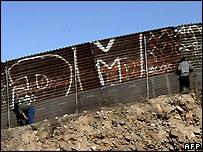


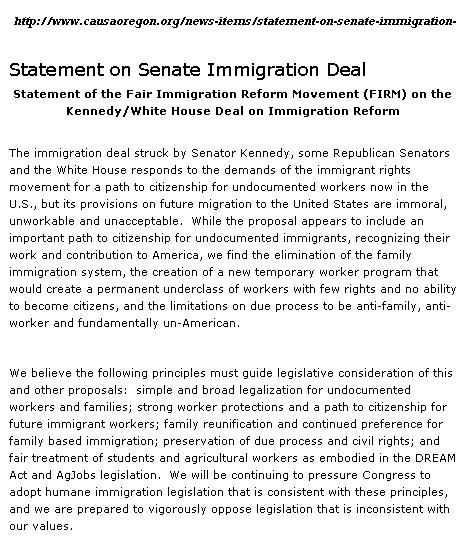


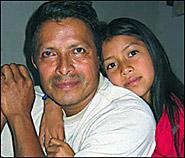






19 Comments:
Dear Mr.Torres,
Please inform your readers why your agents in the San Jose office assured the owners of a company in Santa Clara that has many illegal workers that they would do nothing. They just had to take a look because the directive came from the managers. They did tell the owners the truth, they did NOTHING. Now is that enforcement? or turning a blind eye? What do you say to Citizen standing in the unemployment line?
If you are interested the illegal workers are still there. If you correct the oversight by your department, we will praise your action in this forum to inform the public.
By Anonymous, At February 4, 2009 5:25 PM
Dear Sir,
Fully agree on the below. Please inform your agents at the San Jose ICE office of the below
"It is not good public safety policy to wait until immigration fugitives--who have already defied U.S. laws--commit a violent crime before we target them for arrest and removal."
The ones they ignored have already committed crimes.
Looking forward to your leadership.
By Anonymous, At February 4, 2009 9:12 PM
As you know, there are more than 11 million unemployed Americans and the number is increasing by the hour. It is vital to the stability and well being of our nation that you protect employment opportunities for American workers
By Anonymous, At February 4, 2009 11:09 PM
Mr. Torre, ICE has repeatedly misrepresented the Fugitive Operations Program to Congress. You have sold Congress and the public on the idea that these teams - on which hundreds of millions of taxpayer dollars have been spent - were focused on picking up dangerous criminal aliens. And they used to do that. No one is challenging that picking up criminal aliens is a laudable goal.
However.
Under your direction and leadership, the Fugitive teams have instead been picking up thousands of aliens who do not have criminal records, and selling their detentions and deportations to the public as removal of "dangerous" aliens. You offer the straw man of a person who did not adhere to his removal order, then went on to commit a heinous crime as "proof" that removing individuals who skipped out on removal orders is an effective defense to crime. Do you honestly believe that every person who doesn't follow a deportation order goes on to commit major felonies? Despite the fact that numerous studies have shown that aliens (both legal and illegal) are LESS likely to commit crimes than US citizens?
Again, no one questions the merits of removing criminals, or even picking up persons who have a removal order outstanding. What the NY Times is questioning, and what I am questioning as a taxpayer and citizen, is why we are spending millions of dollars to arrest only a handful of dangerous people - the vast majority of people your teams are picking up have NO criminal records, have NO outstanding deportation orders, and have been bullied or tricked by ICE agents who come to their homes on the premise of finding a person who has an outstanding deportation order.
We need less grandstanding by ICE, and more smart policework by ICE, as well as compassion and consideration for the individuals and families your agency has targeted.
By Anonymous, At February 6, 2009 12:30 PM
Sir,
see the linked press release below
http://www.ice.gov/pi/nr/0901/090123seattle.htm
so why is Visa Fraud committing owners of the Santa Clara business still walking free and Laughing at your department.
A quote from the above article states
"Conspiracy to commit visa fraud is punishable by a maximum term of imprisonment of five years in prison; visa fraud is punishable by a maximum term of imprisonment of fifteen years in prison; conspiracy to commit money laundering and money laundering are punishable by a maximum term of twenty years in prison; and concealing an illegal alien is punishable by a maximum term of five years in prison."
When can we see the laws enforced in this case ?
By Anonymous, At February 6, 2009 9:48 PM
Right on JT, glad to have you at the helm.
By Anonymous, At February 7, 2009 12:33 AM
You delayed the E-Verify Rule once agian, showing us you are NOT serious about Homeland Security! HOW COULD YOU?!
You are supposed to be enforcing our current immigration laws, not looking for ways to turn a "blind-eye" to what citizens are demanding from you!
ENFORCE THE LAW! CRACK DOWN ON ILLEGAL IMMIGRATION!
YOUR GIVING OUR JOBS AWAY TO ILLEGAL ALIENS!
By Anonymous, At February 7, 2009 11:31 AM
ICE should be enforcing g the law wherever it is broken! All illegal aliens have broken our laws, by the sheer fact they are indeed VERY “illegal!” They don’t belong here for any reason.
When ICE does their job by arresting all illegal aliens that sends a message that the United States will not put up with “Law breaking”! Americans expects YOU, Homeland Security, to keep using ICE raids to enforce our laws. It’s a good thing! Keep it up.
YOU NEED TO ENFORCE THE LAW, EVERYWHERE.
I live at the border, and I want more raids! It helps!
By Anonymous, At February 7, 2009 11:39 AM
All illegal aliens are illegal and should be arresrted and removed. They are illegal!
By Anonymous, At February 7, 2009 11:40 AM
Dear Mr. Torres,
We US citizens keep hunting for work, the illegal Alien workers are GLEEFULLY openly STILL working at the Santa Clara company. (At this very moment as well) This is the company to whose owners your AGENT’s assured they would do nothing for breaking US law and continuing to break US laws.
When can we see the picture of them like the one above? When a person is killed?
Waiting for your leadership to correct this matter
By Anonymous, At February 7, 2009 3:50 PM
Don't be a roadblock to aggressive enforcement of immigration laws.
We are sick of the old "wink and nod" that resulted in rampant illegal immigration in this country!
Do more raids! Increase aggressive enforcement! We want to see big results that produce a large decline of illegal aliens.
By Anonymous, At February 9, 2009 7:00 PM
Illegal aliens are lawbreakers and make a mockery of the U.S. government. ICE should be allowed to uphold the law! Illegal aliens should be returned to their home countries NOT just felon illegal aliens!
By Anonymous, At February 10, 2009 5:40 PM
Just for clarification, many people don't realize that there are two types of illegal immigrants: one, those who crossed the border illegally, and are thus breaking criminal laws by being here; the other, however, is of people who came to the country legally but overstayed their visas. This latter group is also breaking the law, but it's administrative law, not criminal law.
Separately, you can't blame illegal immigrants for being unemployed, no matter how easy a target they are. Calm down, please.
By Anonymous, At February 10, 2009 5:40 PM
UPHOLD OUR LAWS!!!!
By Anonymous, At February 10, 2009 7:43 PM
Enforcement is down we hear - but still we see our communities filled to the brim with Mexicans who don't speak English. Why is that? Could it be more likely that ICE and the Border Patrol are just CATCHING less illegal aliens? That would also reflect "less apprehensions" but it would reflect a failure of this department and this government.
By Anonymous, At February 10, 2009 7:47 PM
I fully support ICE, I want to see the raids continue.
These people are in our country illegally and needs to be prosecueted to the fullest extent of the law. They are not above the law and should be treated like any other criminal that chooses to break the law.
By Anonymous, At February 11, 2009 12:25 PM
I expect you, the DHS, to enforce the E-Verify Rule, and to aggressively enforce all immigration laws!
We are seeing increased violence and mayhem here at the border, and it will spread further to the interior of the United States I have no doubt in this world.
It scares me everyday, living near the border; I have to look over my shoulder because I do not feel my own government does enough to keep me safe from the violence that is spilling over.
You must crackdown and get tougher on illegal aliens and you must become more vocal about doing so to discourage illegal aliens from entering this country and taking our jobs!
By Anonymous, At February 11, 2009 1:30 PM
Even when pointed to were the illegal workers are they ignore!
By Anonymous, At February 11, 2009 1:47 PM
E-Verify has now been stripped from the Stimulus Bill; this despite President Obama's campaign promise that he was going to vigorously pursue employers who hire undocumented immigrants.
President Obama lied to us.
By Anonymous, At February 12, 2009 9:43 AM
Post a Comment