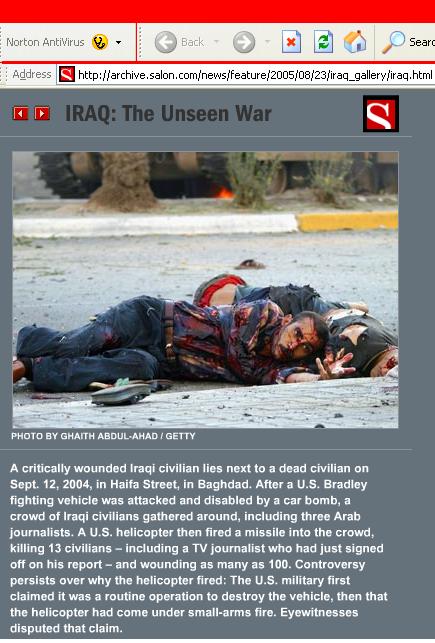
The Independent research organisation Iraq Body Count
has called for a full judicial enquiry in Britain into the number of people killed and wounded in the Iraq War.
The organisation says the Iraq War Inquiry in London chaired by Sir John Chilcot failed to address
the issue.
The BBC's Owen Bennett-Jones has been looking at the research that has been carried out into how many
civilians died as a result of the Iraq war.
The lowest number of all came in December 05, from President Bush.
One person has been shot dead by police as hundreds of protesters took to the streets in eastern Afghanistan, accusing
Nato-led forces of killing civilians during an overnight raid near the city of Jalalabad.
(AP Photo/Rahmat Gul)
Local residents take out a procession as they accuse NATO forces of killing civilians in an overnight raid, at Surkh Rod,
Afghanistan, Friday, May 14, 2010. More than 500 people poured into the streets in the Surkh Rod district of Nangahar province
to protest the raid by international forces that they claim killed at least nine civilians.
Angry Afghans set fire to tyres and blocked roads in the Surkh Road district of Nangahar province on Friday, demanding
an explanation for the deaths.
Witnesses told Al Jazeera that between nine and 15 civilians had been killed in the Nato attack.
Mohammed Arish, a government administrator in Surkh Rod, said a father and his four sons and four members of another family
were among the dead.
"They are farmers. They are innocent. They are not insurgents or militants," Arish told The Associated Press by phone.
Arish said the protesters had tried to march toward the provincial capital of Jalalabad before being turned back by
police.
The Nangahar governor's office said at least three people were injured during a clash with police.
'Taliban firefight'
A Nato spokesman confirmed foreign and Afghan forces had conducted some operations in the area but said he was not aware
of any civilian deaths and the alliance was checking the incident.
Colonel Wayne Shanks said eight Taliban fighters were killed in a firefight, adding that fighters fired rocket-propelled
grenades at Nato forces.
Two other people were captured during the operation, and weapons and communications gear were confiscated at the targeted
compound, Shanks said.
Al Jazeera's Hoda Abdel Hamid reporting from Kabul said international forces and Afghan troops were flown to the area by
helicopters overnight and carried out the raid.
"According to a Nato and Isaf [International Security Assistance Force] statement they were targeting Taliban sub-commanders
and some fighters which their intelligence said were hiding in a compound outside a village.
"But the villagers said none of those killed had anything to do with the Taliban, that all of them were innocent civilians
and members of two different families."
Sensitive issue
Civilian deaths at the hands of US and Nato forces are a highly sensitive issue in Afghanistan.
Last year public outrage over such deaths led General Stanley McChrystal, the Nato commander, to tighten the rules on combat
if civilians are at risk.
He also ordered allied forces to avoid night raids when possible and bring Afghan troops with them if they do enter homes
after dark.
Hamid Karzai, the Afghan president, discussed the issue in meetings with US officials in Washington this week. He has previously sought
a complete ban on night raids.
"Civilian casualties is not only a political problem ... I don't want civilian casualties," Barack Obama, the US president,
said on Wednesday after meeting Karzai.
"I take no pleasure in reading a report where there is a civilian casualty. That's not why I am president, that's not why
I am commander in chief."
Last year was the deadliest for Afghan civilians since the war started in 2001, according to the United Nations.
Afghan officials say about 170 Afghan civilians were killed between the months of March and April this year alone, an increase
of 33 per cent compared to the same period last year.
Doctors in the Iraqi city of Fallujah are reporting a high level
of birth defects, with some blaming weapons used by the US after the Iraq invasion.
heard about this last evening on PBS/BBC -- Depleted Uranium -- in
the massive assault in Fallujah Iraq and what about the whole region being polluted with toxic/caustic
airborne deadly chemicals by these insane invasion / occupation?
'Systematic investigation' needed on Falluja birth defects
Professor Alastair Hay says a systematic study is needed to determine the cause of child
deformity in Falluja
BBC world affairs editor John Simpson has discovered is a high incidence of deformities among children in Falluja, the
Iraqi city which was the scene of fierce fighting during the 2003 invasion.
Toxicologist and an expert in chemical weaponry at the University of Leeds, Prof Alastair Hay, talks about the possible
connection between these deformities and the presence of phosphorous in the weapons used US forces in the area.
When
is the killing of children not a crime? Take to the streets on March 20! Join the IndictBushNow contingent
To whom it may concern,
Yesterday, Karl Rove was all over the news with the release of his book congratulating himself,
George W. Bush and Dick Cheney for the invasion of Iraq.
Rove is getting richer by the day.
Yesterday, too, there was another news item that, unlike Rove's book, has received scant attention.
It speaks directly to the legal culpability of Bush, Rove and the other criminals who should be arrested rather doing book
tours.
CBS News reports, “Doctors and parents in the Iraqi city of Fallujah are blaming a sharp
increase in the number of birth defects on the highly sophisticated weapons U.S. troops have used in the city during the war.
“The BBC reported Thursday the staggering statistic from doctors in the city that the
number of heart defects found in newborn babies is 13 times the number of similar birth defects in Europe.”
Bush ordered Fallujah to be essentially destroyed in 2004.
The CBS story states: “British-based Iraqi researcher Malik Hamdan told the news organization
that one doctor compared the number of birth defects from before 2003 to today. Before the war began, she saw about one case
every two months. Now she sees cases every day.
“Her research shows that as of January, the rate of congenital heart defects was 95 per
1,000 births or 13 times Europe's rate.” Bush is guilty of war crimes and crimes against humanity.
Many tens of thousands of children have died directly as a consequence of Bush's war that was
based exclusively on lies and deceit. In addition to the spike in birth defects, a whole generation of Iraqi children will
face a lifetime of physical and emotional wounds. Seventy percent of children are suffering from trauma-related symptoms reports
the Iraqi Society of Psychiatrists and the World Health Organization. That conclusion was based on a survey of 10,000 primary
school students.
On March 20, 2010 supporters of the IndictBushNow movement are forming a contingent in the national
anti-war March on Washington protesting the Iraq and Afghanistan war.
We owe it the people of Fallujah and all the still suffering people in Iraq to let them know
that "We The People" in the United States, like they, recognize that a government that spoke in our name committed some of
the worst atrocities in modern times.
US military
occupation forces in Iraq under Commander-in-Chief Obama suffered five combat casualties in the week ending January 12, 2010*
as the official total since the 2003 invasion rose to at least 73,729. The total includes 35,098 dead and wounded from what
the Pentagon classifies as "hostile" causes and more than 38,631 (as of Jan 5, 2010) dead, injured and sick from "non-hostile"
causes requiring medical evacuation.
The actual
total is over 100,000 because the Pentagon chooses not to count as "Iraq casualties" the more than 30,000 veterans whose injuries
- mainly brain trauma from explosions - were diagnosed only after they had left Iraq.** In addition, Iraq Coalition Casualties
names eight service members who died of wounds after they left Iraq but are not counted by the Pentagon.
US media divert attention from the actual cost in American life and
limb by occasionally reporting only the total killed (4,377 as of Jan 12, 2010) but rarely mentioning the 31,620 wounded in
combat. To further minimize public perception of the cost, they cover for the Pentagon by ignoring the 37,732
(as of Jan 2, 2010)*** military victims of accidents and illness serious enough to require medical air evacuation, although
the 4,377 reported deaths include 899 (up two) who died from those same causes, including at least 18 from faulty electrical
work by KBR and 197 suicides through Jan. 2, 2010.***
according to the Wall Street Journal, Iraqi insurgents have been regularly using
the satellite-snooping software to monitor live
Predator video feeds.
Apparently the Predator transmits video over an unencrypted link, so there's no
major hacking or security breach going on here, but it's obviously a huge issue -- and we'd say the bigger problem is that
Pentagon officials have known about this flaw since the 1990s, but they didn't think insurgents would figure out how to exploit
it.
Way to underestimate, guys.
The WSJ says the military is working to encrypt all Predator feeds from Iraq, Afghanistan,
and Pakistan, but it's slow going because the Predator network is more than a decade old
and based on proprietary tech.
Too bad it's not proprietary enough to keep prying eyes out of it. http://tiny.cc/wXL6I
Hidden Cost of War video posted on 11.30.09
1. 1775-1783 revolution war against Great Britain
2. 1775-1776 Canada
3. 1798-1800 Seawar with France (without declaration of war)
4. 1801-1805 Tripoli, first Berberwar
5. 1806 Mexico (Spanish area)
6. 1806-1810 gulf of Mexico
7. 1810 west Florida (Spanish area)
8. 1812 occupation of the island
Melia (Spanish area)
9. 1812-1815 Great Britain (declaration of war takes place)
10. 1812-1815 Canada
11. 1813 west Florida (Spanish area)
12. 1813-1814 Marquesas islands
13. 1814 Spanish Florida
14. 1814-1825 Kariben
15. 1815 Algiers, second Berberwar
16. 1815 Tripoli
17. 1816 Spanish Florida, first Seminolenwar
18. 1817 island Amelia (Spanish area)
19. 1818 Oregon
20. 1820-1823 Africa (fight of the slave trade)
21. 1822 Cuba
22. 1823 Cuba
23. 1824 Cuba
24. 1824 Puerto Rico (Spanish area)
25. 1825 Cuba
26. 1827 Greece
27. 1831-1832 Falkland Islands
28. 1832 Sumatra
29. 1833 Argentina
30. 1835-1936 Peru
31. 1836 Mexico
32. 1838-1839 Sumatra
33. 1840 Fiji islands
34. 1841 Samoa
35. 1841 Drummond islands, Kingsmillgroup
36. 1842 Mexico
37. 1843 Africa
38. 1844 Mexico
39. 1846-1848 Mexico
40. 1849 Smyrna
41. 1851 Turkey
42. 1851 Johanna island (eastern of Africa)
43. 1852-1853 Argentina
44. 1853 Nicaragua
45. 1853-1854 Riukio and in islandisland in islands (Japan)
46. 1854 China
47. 1854 Nicaragua
48. 1855 China
49. 1855 Fiji islands
50. 1855 Uruguay
51. 1856 Panama, republic of again
Granada
52. 1856 China
53. 1857 Nicaragua
54. 1858 Uruguay
55. 1858 Fiji islands
56. 1858-1859 Turkey
57. 1859 Paraguay
58. 1859 Mexico
59. 1859 China
60. 1860 Angola, Portugisisch Portugisisch-Westafrika
61. 1860 Colombia, gulf of Panama
62. 1863 Japan
63. 1864 Japan
64. 1864 Japan
65. 1865 Panama
66. 1866 Mexico
67. 1866 China
68. 1867 island Formosa
69. 1868 Japan
70. 1868 Uruguay
71. 1868 Colombia
72. 1870 Mexico
73. 1870 Hawaii islands
74. 1871 Korea
75. 1973 Colombia
76. 1873 Mexico
77. 1874 Hawaii islands
78. 1876 Mexico
79. 1882 Egypt
80. 1885 Panama (Colon)
81. 1888 Korea
82. 1889-1889 Samoa
83. 1888 Haiti
84. 1889 Hawaii islands
85. 1890 Argentina
86. 1891 Haiti
87. 1891 Beringmeer
88. 1891 Chile
89. 1893 Hawaii
90. 1894 Brazil
91. 1894 Nicaragua
92. 1894-1896 Korea
93. 1894-1895 China
94. 1894-1895 China
95. 1895 Colombia
96. 1896 Nicaragua
97. 1898-1899 China
98. 1898 Nicaragua
99. 1898 American-Spanish war
100. 1899 Samoa
101. 1899-1901 the Philippines
102. 1900 China
103. 1901 Colombia
104. 1902 Colombia
105. 1902 Colombia
106. 1903 Honduras
107. 1903 Dominican republic
108. 1903 Syria
109. 1903-1914 Panama
110. 1904 Dominican republic
111. 1904-1905 Korea
112. 1904 Tanger, Morocco
113. 1904 Panama
114. 1904-1905 Korea
115. 1906-1909 Cuba
116. 1907 Honduras
117. 1910 Nicaragua
118. 1911 Honduras
119. 1911 China
120. 1912 Honduras
121. 1912 Panama
122. 1912 Cuba
123. 1912 China
124. 1912 Turkey
125. 1912-1925 Nicaragua
126. 1912-1941 China
127. 1913 Mexico
128. 1914 Haiti
129. 1914 Dominican republic
130. 1914-1917 Mexico
131. 1915-1934 Haiti
132. 1917-1918 the First World War
133. 1917-1922 Cuba
134. 1918-1919 Mexico
135. 1918-1920 Panama
136. 1918-1920 Soviet Russia
137. 1919 Honduras
138. 1920-1922 Russia (Siberia)
139. 1920 China
140. 1920 Guatemala
141. 1921 Panama Costa Rica
142. 1922 Turkey
143. 1924 Honduras
144. 1924 China
145. 1925 China
146. 1925 Honduras
147. 1925 Panama
148. 1926-1933 Nicaragua
149. 1926 China
150. 1927 China
151. 1933 Cuba
152. 1940 Newfoundland, Bermuda,
St. Lucia, the Bahamas, Jamaica, Antigua, Trinidad, British Guayana
153. 1941 Greenland [ Danish
area ]
154. 1941 the Netherlands
(Netherlands Guayana)
155. 1941 Iceland
156. 1941 Germany [ attacks
on German ships ]
157. 1941 US entrance into
the Second World War
158. 1941-1945 Germany, Italy, Japan
159. 1942 Labrador
160. 1945-1960 China (CIA)
161. 1946-1947 Italy (CIA)
162. 1947-1955 Greece (CIA)
163. 1945-1955 the Philippines (CIA)
164. 1950-1953 Korea war
165. 1949-1953 Albania (CIA)
166. 1955 Germany (CIA)
167. 1953 Iran (CIA)
168. 1953-1954 Guatemale (CIA)
169. 1955 Costa Rica (CIA)
170. 1956-1957 Syria (CIA)
171. 1957-1958 the middle east
172. 1957-1958 Indonesia (CIA)
173. 1955-1965 Western Europe (CIA)
174. 1945-1965 Soviet Union (CIA)
175. 1955-1975 Italy (CIA)
176. 1945-1975 30 years war in Viet Nam (CIA)
177. 1955-1973 Kambodscha (CIA)
178. 1957-1973 Laos (CIA)
179. 1959-1963 Haiti
180. 1960 Guatemala
181. 1960-1963 Ekuador (CIA)
182. 1960-1964 the Congo (CIA)
183. 1961-1961 Brazil (CIA)
184. 1960-1965 Peru (CIA)
185. 1960-1966 Dominican Republic of (CIA)
186. 1950-1980 Cuba (CIA)
187. 1865 Indonesia (CIA)
188. 1966 Ghana (CIA)
189. 1964-1970 Uruguay (CIA)
190. 1964-1973 Chile (CIA)
191. 1964-1974 Greece (CIA)
192. 1964-1975 Bolivia (CIA)
193. 1962-1985 Guatemala (CIA)
194. 1970-1971 Costa Rica (CIA)
195. 1972-1975 Iraq (CIA)
196. 1973-1975 Australia (CIA)
197. 1975 Indonesia [ CIA ]
198. 1975-1985 Angola (CIA)
199. 1975-1978 Zaire (CIA)
200. 1976-1980 Jamaica (economic war)
201. 1979-1981 Seychelles
202. 1979-1984 Grenada
203. 1983 Morocco (CIA)
204. 1982-1984 Surinam (CIA)
205. 1981-1989 Lybia
206. 1981-1990 Nicaragua [causing the civil war ]
207. 1969-1991 Panama (CIA)
208. 1990 Bulgaria [ CIA ]
209. 1990-1991 Iraq, the second Gulf War + cowardly 'supporting' the Basra Moslims against Saddam
210. 1979-1992 Afghanistan (CIA)
211. 1980-1994 El Salvador [ CIA ]
212. 1986-1994 Haiti (CIA)
213. 1992-1994 Somalia
214. 1979- present Afghanistan
215. 2000 Colombia ("war on drugs")
216. 2001 New York WTR 3000 dead
+ Phillippines ("war against terrorism")
217. 2001 Afghanistan 40 000 dead
218 2003-2006 Iraq
50 000 dead
According to my estimates the USA is directly responsible for 12 million human murders over the past 50 years.
Additionally, if we look at the neoliberal economic policies [the modern method of creating Banana Republics] imposed
upon Third World countries, the number skyrockets. Subcomandante Marcos of the Zapatista movement considers this the fourth
world war: the so-called "Cold War" was hot in the Third World and is the third, and the neoliberal economic policies backed
by militaries are the fourth.
Also, depleted uranium in Iraq & Yugoslavia, and Agent Orange in Vietnam, Laos, and Cambodia continue to
kill thru childhood lukemia and various cancers. We have no idea of the effects of chemical and biological warfare
being waged on Columbia currently. And this estimate and list doesn't include countries such as Mexico where the
US is supplying weapons and training that repress the populations.
"The United States supports right-wing dictatorships in Latin America, Southeast Asia, and the Middle East ...
because these are the rulers who have tied their personal political destiny to the fortunes of the American corporations
in their countries... Revolutionary or nationalist leaders have radically different political constituencies and interests.
For them creating "a good investment climate" for the United States and developing their own country are fundamentally conflicting
goals. Therefore, the United States has a strong economic interest in keeping such men from coming to power or arranging
for their removal if they do."
Anthony Cantrell
From documentary 'Bowling for
Columbine' by Michael Moore
1953 US overthrows Prime Minister Mossadeq of Iran US installs Sjah as
dictator 1954 US overthrows democratically-elected President Arbenz of Guatemala 200.000 civilians killed 1963 US backs assassination of South Vietnamese President Diem 1963-1975 American military kils 4 million
people in Southeast Asia sept 11, 1973 US stages coup in Chile Democratically elected President Salvador
Allende assassinated Dictator Augusto Pinochet installed. 5000 Chileans murdered. 1977 US
backs military rulers of El Salvador 70.000 Salvadorans and four American nuns killed 1980's US trains
Osama bin Laden and fellow terrorists to kill Soviets. CIA gives them $3 billion (miljard) 1981 Reagan
administration trains and funds "contras". 30.000 Nicaraguans die. 1982 US provides billions in aid to Saddam Hussein
for weapons to kill Iranians. 1983 White House secretly gives Iran weapons to kill Iraqis. 1989 CIA
agent Manuel Noriega (also serving as President of Panama) disobeys orders from Washington.
US invades Panama and removes Noriega.3000 Panamanian civilian casualties. 1990 Iraq invades Kuwait with
the allowance and weapons from US. 1991 US enters Iraq.Bush reinstates dictator of Kuwait. 1998
Clinton bombs "weapons factory" in Sudan. Factory turns out to be making aspirin. 1991 to present: American bomb
Iraq on a weekly basis. UN estimates 500000 Iraqi children die from bombing and sanctions. 2000-01 US gives Taliban-ruled
Afghanistan $245 million in "aid". Sept. 11 2001: Illuminati (Bush, Wolfowitz, Cheney, Rumsfeld) kill 3000 people
(Twin Towers) to create a second 'Pearl Harbour'. ----- The problem with this list is that it could
go on and on - Brazil, Guatemala, El Salvador, Ecuador, Uruguay, the Dominican Republic, Cuba, Haiti, Iraq, Iran, Laos, East Timor, Grenada, Greece... All of these and more are countries who have suffered from oppression,
torture, starvation, and death at the hands of American 'intervention,' whether it takes the form of bombs, sanctions,
or our personal favourite, CIA sponsored military regimes.(Schnews)
Since the Second World War, the US government has bombed 21 countries: China in 1945-46 and again in 1950-53, Korea in 1950-53, Guatemala in 1954, 1960, and 1967-69, Indonesia
in 1958, Vietnam in 1961-73, Congo in 1964, Laos in 1964-73, Peru in 1965, Cambodia in 1969-70, El Salvador throughout
the 1980s, Nicaragua throughout the 1980s, Lebanon in 1983-84, Grenada in 1983, Bosnia in 1985, Libya
in 1986, Panama in 1989, Iraq in 1991-20??, Sudan in 1998, Former Yugoslavia in 1999, and Afghanistan in 1998 and
2002.(Schnews)
When asked about the number of Iraqi people who were killed by Americans in the 1991 Desert Storm campaign (200,000 people, incidentally), General Colin Powell said: "It's
really not a number I'm terribly interested in." (http://alt.venus.co.uk/weed/current/schn372.htm)
Yesterday, 30 Republican senators opposed an amendment to the Defense Appropriations bill that would prohibit
federal defense contractors like Halliburton/KBR from getting money "if they restrict their employees from taking workplace
sexual assault, battery and discrimination cases to court."
In other words, 30 GOP
senators want to deny rape victims their day in court.
Think Progress has the story of the woman who prompted this amendment: In 2005, Jamie Leigh Jones was gang-raped
by her co-workers while she was working for Halliburton/KBR in Baghdad. She was detained in a shipping container for at least
24 hours without food, water, or a bed, and "warned her that if she left Iraq for medical treatment, she’d be out of
a job." (Jones was not an isolated case.) Jones was prevented from bringing charges in court against
KBR because her employment contract stipulated that sexual assault allegations would only be heard in private arbitration.
Seven years ago this week the House of Representatives debated
the Iraq War Resolution which was presented by President Bush. I made the case for NOT going to war. I analyzed the
Bush war resolution, paragraph by paragraph, and pointed out "Key Issues" which argued against Congress voting to go to war.
I distributed the attached analysis, personally, to over 200 members of Congress from October 2, 2002 until October 10, 2002
when the vote occurred.
When you hear people say: "If only we had known then what we know now," remember, some did
know of the false case for war against Iraq. And since so many know now that we should not have gone to war against Iraq,
then why are we still there?
Please read this analysis and let me know what you think.
Thanks Dennis J Kucinich 10-6-09
Analysis of Joint Resolution on Iraq by Dennis J. Kucinich October 2, 2002
Whereas in 1990 in response to Iraq's war of aggression against and illegal occupation of Kuwait, the
United States forged a coalition of nations to liberate Kuwait and its people in order to defend the national security of
the United States and enforce United Nations Security Council resolutions relating to Iraq;
KEY ISSUE: In the
Persian Gulf War there was an international coalition. World support was for protecting Kuwait. There is no world support
for invading Iraq.
Whereas after the liberation of Kuwait in 1991, Iraq entered into a United Nations sponsored cease-fire
agreement pursuant to which Iraq unequivocally agreed, among other things, to eliminate its nuclear, biological, and chemical
weapons programs and the means to deliver and develop them, and to end its support for international terrorism;
Whereas
the efforts of international weapons inspectors, United States intelligence agencies, and Iraqi defectors led to the discovery
that Iraq had large stockpiles of chemical weapons and a large scale biological weapons program, and that Iraq had an advanced
nuclear weapons development program that was much closer to producing a nuclear weapon than intelligence reporting had previously
indicated;
KEY ISSUE: UN inspection teams identified and destroyed nearly all such weapons. A lead inspector,
Scott Ritter, said that he believes that nearly all other weapons not found were destroyed in the Gulf War. Furthermore, according
to a published report in the Washington Post, the Central Intelligence Agency has no up to date accurate report on Iraq's
WMD capabilities.
Whereas Iraq, in direct and flagrant violation of the cease-fire, attempted to thwart the efforts
of weapons inspectors to identify and destroy Iraq's weapons of mass destruction stockpiles and development capabilities,
which finally resulted in the withdrawal of inspectors from Iraq on October 31, 1998;
KEY ISSUE: Iraqi deceptions
always failed. The inspectors always figured out what Iraq was doing. It was the United States that withdrew from the inspections
in 1998. And the United States then launched a cruise missile attack against Iraq 48 hours after the inspectors left. In advance
of a military strike, the US continues to thwart (the Administration's word) weapons inspections.
Whereas in 1998
Congress concluded that Iraq's continuing weapons of mass destruction programs threatened vital United States interests and
international peace and security, declared Iraq to be in "material and unacceptable breach of its international obligations"
and urged the President "to take appropriate action, in accordance with the Constitution and relevant laws of the United States,
to bring Iraq into compliance with its international obligations" (Public Law 105-235);
Whereas Iraq both poses a
continuing threat to the national security of the United States and international peace and security in the Persian Gulf region
and remains in material and unacceptable breach of its international obligations by, among other things, continuing to possess
and develop a significant chemical and biological weapons capability, actively seeking a nuclear weapons capability, and supporting
and harboring terrorist organizations;
KEY ISSUE: There is no proof that Iraq represents an imminent or immediate
threat to the United States. A "continuing" threat does not constitute a sufficient cause for war. The Administration has
refused to provide the Congress with credible intelligence that proves that Iraq is a serious threat to the United States
and is continuing to possess and develop chemical and biological and nuclear weapons. Furthermore there is no credible intelligence
connecting Iraq to Al Qaida and 9/11.
Whereas Iraq persists in violating resolutions of the United Nations Security
Council by continuing to engage in brutal repression of its civilian population thereby threatening international peace and
security in the region, by refusing to release, repatriate, or account for non-Iraqi citizens wrongfully detained by Iraq,
including an American serviceman, and by failing to return property wrongfully seized by Iraq from Kuwait;
KEY
ISSUE: This language is so broad that it would allow the President to order an attack against Iraq even when there is
no material threat to the United States. Since this resolution authorizes the use of force for all Iraq related violations
of the UN Security Council directives, and since the resolution cites Iraq's imprisonment of non-Iraqi prisoners, this resolution
would authorize the President to attack Iraq in order to liberate Kuwaiti citizens who may or may not be in Iraqi prisons,
even if Iraq met compliance with all requests to destroy any weapons of mass destruction. Though in 2002 at the Arab Summit,
Iraq and Kuwait agreed to bilateral negotiations to work out all claims relating to stolen property and prisoners of war.
This use-of-force resolution enables the President to commit US troops to recover Kuwaiti property.
Whereas the current
Iraqi regime has demonstrated its capability and willingness to use weapons of mass destruction against other nations and
its own people;
Whereas the current Iraqi regime has demonstrated its continuing hostility toward, and willingness
to attack, the United States, including by attempting in 1993 to assassinate former President Bush and by firing on many thousands
of occasions on United States and Coalition Armed Forces engaged in enforcing the resolutions of the United Nations Security
Council;
KEY ISSUE: The Iraqi regime has never attacked nor does it have the capability to attack the United
States. The "no fly" zone was not the result of a UN Security Council directive. It was illegally imposed by the United States,
Great Britain and France and is not specifically sanctioned by any Security Council resolution.
Whereas members of
al Qaida, an organization bearing responsibility for attacks on the United States, its citizens, and interests, including
the attacks that occurred on September 11, 2001, are known to be in Iraq;
KEY ISSUE: There is no credible intelligence
that connects Iraq to the events of 9/11 or to participation in those events by assisting Al Qaida.
Whereas Iraq continues
to aid and harbor other international terrorist organizations, including organizations that threaten the lives and safety
of American citizens;
KEY ISSUE: Any connection between Iraq support of terrorist groups in the Middle East,
is an argument for focusing great resources on resolving the conflict between Israel and the Palestinians. It is not sufficient
reason for the US to launch a unilateral preemptive strike against Iraq.
Whereas the attacks on the United States
of September 11, 2001 underscored the gravity of the threat posed by the acquisition of weapons of mass destruction by international
terrorist organizations;
KEY ISSUE: There is no connection between Iraq and the events of 9/11.
Whereas
Iraq's demonstrated capability and willingness to use weapons of mass destruction, the risk that the current Iraqi regime
will either employ those weapons to launch a surprise attack against the United States or its Armed Forces or provide them
to international terrorists who would do so, and the extreme magnitude of harm that would result to the United States and
its citizens from such an attack, combine to justify action by the United States to defend itself;
KEY ISSUE:
There is no credible evidence that Iraq possesses weapons of mass destruction. If Iraq has successfully concealed the production
of such weapons since 1998, there is no credible evidence that Iraq has the capability to reach the United States with such
weapons. In the 1991 Gulf War, Iraq had a demonstrated capability of biological and chemical weapons, but did not have the
willingness to use them against the United States Armed Forces. Congress has not been provided with any credible information,
which proves that Iraq has provided international terrorists with weapons of mass destruction.
Whereas United Nations
Security Council Resolution 678 authorizes the use of all necessary means to enforce United Nations Security Council Resolution
660 and subsequent relevant resolutions and to compel Iraq to cease certain activities that threaten international peace and
security, including the development of weapons of mass destruction and refusal or obstruction of United Nations weapons inspections
in violation of United Nations Security Council Resolution 687, repression of its civilian population in violation of United
Nations Security Council Resolution 688, and threatening its neighbors or United Nations operations in Iraq in violation of
United Nations Security Council Resolution 949;
KEY ISSUE: The UN Charter forbids all member nations, including
the United States, from unilaterally enforcing UN resolutions.
Whereas Congress in the Authorization for Use of Military
Force Against Iraq Resolution (Public Law 102-1) has authorized the President "to use United States Armed Forces pursuant
to United Nations Security Council Resolution 678 (1990) in order to achieve implementation of Security Council Resolutions
660, 661, 662, 664, 665, 666, 667, 669, 670, 674, and 677";
KEY ISSUE: The UN Charter forbids all member nations,
including the United States, from unilaterally enforcing UN resolutions with military force.
Whereas in December 1991,
Congress expressed its sense that it "supports the use of all necessary means to achieve the goals of United Nations Security
Council Resolution 687 as being consistent with the Authorization of Use of Military Force Against Iraq Resolution (Public
Law 102-1)," that Iraq's repression of its civilian population violates United Nations Security Council Resolution 688 and
"constitutes a continuing threat to the peace, security, and stability of the Persian Gulf region," and that Congress, "supports
the use of all necessary means to achieve the goals of United Nations Security Council Resolution 688";
KEY ISSUE:
This clause demonstrates the proper chronology of the international process, and contrasts the current march to war. In 1991,
the UN Security Council passed a resolution asking for enforcement of its resolution. Member countries authorized their troops
to participate in a UN-led coalition to enforce the UN resolutions. Now the President is asking Congress to authorize a unilateral
first strike before the UN Security Council has asked its member states to enforce UN resolutions.
Whereas the Iraq
Liberation Act (Public Law 105-338) expressed the sense of Congress that it should be the policy of the United States to support
efforts to remove from power the current Iraqi regime and promote the emergence of a democratic government to replace that
regime;
KEY ISSUE: This "Sense of Congress" resolution was not binding. Furthermore, while Congress supported
democratic means of removing Saddam Hussein it clearly did not endorse the use of force contemplated in this resolution, nor
did it endorse assassination as a policy.
Whereas on September 12, 2002, President Bush committed the United States
to "work with the United Nations Security Council to meet our common challenge" posed by Iraq and to "work for the necessary
resolutions," while also making clear that "the Security Council resolutions will be enforced, and the just demands of peace
and security will be met, or action will be unavoidable";
Whereas the United States is determined to prosecute the
war on terrorism and Iraq's ongoing support for international terrorist groups combined with its development of weapons of
mass destruction in direct violation of its obligations under the 1991 cease-fire and other United Nations Security Council
resolutions make clear that it is in the national security interests of the United States and in furtherance of the war on
terrorism that all relevant United Nations Security Council resolutions be enforced, including through the use of force if
necessary;
KEY ISSUE: Unilateral action against Iraq will cost the United States the support of the world community,
adversely affecting the war on terrorism. No credible intelligence exists which connects Iraq to the events of 9/11 or to
those terrorists who perpetrated 9/11. Under international law, the United States does not have the authority to unilaterally
order military action to enforce UN Security Council resolutions.
Whereas Congress has taken steps to pursue vigorously
the war on terrorism through the provision of authorities and funding requested by the President to take the necessary actions
against international terrorists and terrorist organizations, including those nations, organizations or persons who planned,
authorized, committed or aided the terrorist attacks that occurred on September 11, 2001 or harbored such persons or organizations;
KEY ISSUE: The Administration has not provided Congress with any proof that Iraq is in any way connected to
the events of 9/11.
Whereas the President and Congress are determined to continue to take all appropriate actions
against international terrorists and terrorist organizations, including those nations, organizations or persons who planned,
authorized, committed or aided the terrorist attacks that occurred on September 11, 2001, or harbored such persons or organizations;
KEY ISSUE: The Administration has not provided Congress with any proof that Iraq is in any way connected to
the events of 9/11. Furthermore, there is no credible evidence that Iraq has harbored those who were responsible for planning,
authorizing or committing the attacks of 9/11.
Whereas the President has authority under the Constitution to take
action in order to deter and prevent acts of international terrorism against the United States, as Congress recognized in
the joint resolution on Authorization for Use of Military Force (Public Law 107-40); and
KEY ISSUE: This resolution
was specific to 9/11. It was limited to a response to 9/11.
Whereas it is in the national security of the United States
to restore international peace and security to the Persian Gulf region;
KEY ISSUE: If by the "national security
interests" of the United States, the Administration means oil, it ought to communicate such to the Congress. A unilateral
attack on Iraq by the United States will cause instability and chaos in the region and sow the seeds of future conflicts all
other the world.
Now, therefore, be it
Resolved by the Senate and House of Representatives of the United States
of America in Congress assembled,
SEC. 1. SHORT TITLE.
This joint resolution may be cited as the "Authorization
for the Use of Military Force Against Iraq".
SEC. 2. SUPPORT FOR UNITED STATES DIPLOMATIC EFFORTS
The Congress
of the United States supports the efforts by the President to-
(a) strictly enforce through the United Nations Security
Council all relevant Security Council resolutions applicable to Iraq and encourages him in those efforts; and
(b)
obtain prompt and decisive action by the Security Council to ensure that Iraq abandons its strategy of delay, evasion and
noncompliance and promptly and strictly complies with all relevant Security Council resolutions.
KEY ISSUE:
Congress can and should support this clause. However Section 3 (which follows) undermines the effectiveness of this section.
Any peaceful settlement requires Iraq compliance. The totality of this resolution indicates the Administration will wage war
against Iraq no matter what. This undermines negotiations.
SEC. 3. AUTHORIZATION FOR USE OF UNITED STATES ARMED FORCES.
AUTHORIZATION. The President is authorized to use the Armed Forces of the United States as he determines to be necessary
and appropriate in order to
(1)defend the national security of the United States against the continuing threat posed
by Iraq; and
(2)enforce all relevant United Nations Security Council Resolutions regarding Iraq.
KEY ISSUE:
This clause is substantially similar to the authorization that the President originally sought.
It gives authority
to the President to act prior to and even without a UN resolution, and it authorizes the President to use US troops to enforce
UN resolutions even without UN request for it. This is a violation of Chapter VII of the UN Charter, which reserves the ability
to authorize force for that purpose to the Security Council, alone.
Under Chapter VII of the Charter of the United
Nations, "The Security Council shall determine the existence of any threat to the peace... and shall make recommendations
to maintain or restore international peace and security." (Article 39). Only the Security Council can decide that military
force would be necessary, "The Security Council may decide what measures... are to be employed to give effect to its decisions
(Article 41) ... [and] it may take such action by air, sea, or land forces as may be necessary to maintain or restore international
peace and security." (Article 43). Furthermore, the resolution authorizes use of force illegally, since the UN Security Council
has not requested it. According to the UN Charter, members of the UN, such as the US, are required to "make available to the
Security Council, on its call and in accordance with a special agreement or agreements, armed forces..." (Article 43, emphasis
added). The UN Security Council has not called upon its members to use military force against Iraq at the current time.
Furthermore,
changes to the language of the previous use-of-force resolution, drafted by the White House and objected to by many members
of Congress, are cosmetic:
In section (1), the word "continuing" was added to "the threat posed by Iraq".
In
section (2), the word "relevant" is added to "United Nations Security Council Resolutions" and the words "regarding "Iraq"
were added to the end.
While these changes are represented as a compromise or a new material development, the effects
of this resolution are largely the same as the previous White House proposal.
The UN resolutions, which could be cited
by the President to justify sending US troops to Iraq, go far beyond addressing weapons of mass destruction. These could include,
at the President's discretion, such "relevant" resolutions "regarding Iraq" including resolutions to enforce human rights
and the recovery of Kuwaiti property.
PRESIDENTIAL DETERMINATION.
In connection with the exercise of the authority
granted in subsection (a) to use force the President shall, prior to such exercise or as soon thereafter as may be feasible,
but no later than 48 hours after exercising such authority, make available to the Speaker of the House of Representatives
and the President pro tempore of the Senate his determination that
(1) reliance by the United States on further diplomatic
or other peaceful means alone either (A) will not adequately protect the national security of the United States against the
continuing threat posed by Iraq or (B) is not likely to lead to enforcement of all relevant United Nations Security Council
resolutions regarding Iraq, and
(2) acting pursuant to this resolution is consistent with the United States and other
countries continuing to take the necessary actions against international terrorists and terrorist organizations, including
those nations, organizations or persons who planned, authorized, committed or aided the terrorists attacks that occurred on
September 11, 2001.
(c) WAR POWERS RESOLUTION REQUIREMENTS. -
(1) SPECIFIC STATUTORY AUTHORIZATION. - Consistent
with section 8(a)(1) of the War Powers Resolution, the Congress declares that this section is intended to constitute specific
statutory authorization within the meaning of section 5(b) of the War Powers Resolution.
(2) APPLICABILITY OF OTHER
REQUIREMENTS. - Nothing in this resolution supersedes any requirement of the War Powers Resolution.
SEC. 4. REPORTS
TO CONGRESS
(a) The President shall, at least once every 60 days, submit to the Congress a report on matters relevant
to this joint resolution, including actions taken pursuant to the exercise of authority granted in section 2 and the status
of planning for efforts that are expected to be required after such actions are completed, including those actions described
in section 7 of Public Law 105-338 (the Iraq Liberation Act of 1998).
(b) To the extent that the submission of any
report described in subsection (a) coincides with the submission of any other report on matters relevant to this joint resolution
otherwise required to be submitted to Congress pursuant to the reporting requirements of Public Law 93-148 (the War Powers
Resolution), all such reports may be submitted as a single consolidated report to the Congress.
(c) To the extent
that the information required by section 3 of Public Law 102-1 is included in the report required by this section, such report
shall be considered as meeting the requirements of section 3 of Public Law 102-1.
Benjamin Tupper was a frequent contributor to The Sandbox during his 2006-2007 deployment
to Afghanistan, and he has continued to write for the site since he returned home. We
are pleased to help spread the word that he has just published a book, WELCOME TO
AFGHANISTAN SEND MORE AMMO: The Tragicomic Art of Making War as an Embedded
Trainer in the Afghan National Army.
While he was deployed, Tupper's audio-posts were often
featured on National Public Radio, and "Morning Edition" recently interviewed him about
the book. You can listen to the program here.
Comments:
"A penetrating look at life deep inside Afghanistan
and way outside the wire.Tupper's timing is right, and readers will appreciate the context
he provides for the news stories we will be reading soon."
-- G.B.
Trudeau, creator of Doonesbury and The Sandbox
"Captain Benjamin Tupper has
produced a series of compelling commentaries for 'Morning Edition,' raw, direct and powerful
reports on what it's like to serve along the Pakistani border. This work is vitally important
to our 31 million listeners nationwide." --
Ken Stern, former CEO of National Public Radio
"A keen and sympathetic observer,
and a fine writer. His vignettes describing combat and the people involved in it are
insightful and poignant, offering vivid and moving pictures of the realities of war." -- former Ambassador Goodwin Cooke, Professor Emeritus, Syracuse University
Introduction:
ETTs: The Tip Of The Counterinsurgency Spear
Forget what you know about the American Army. Strip from your mind the familiar
images of U.S. soldiers fighting their way through Germany, Korea,or Vietnam. The essays
you are about to read reveal another side of the American soldier's experience at war:
Individual soldiers removed from the comfort and familiarity of their Army units and
placed into the ramshackle, newly formed Afghan National Army.
An average ETT
team is sixteen American soldiers, embedded into an Afghan Battalion of about five hundred
soldiers. These ETTs are separated into teams of two, each team assigned to its own individual Afghan National Army Company of about one hundred Afghan soldiers. They are embedded into these foreign ranks with little knowledge of Afghanistan's language, history, or culture, and they are forced, often in the heat of battle, to abandon the American doctrine of warfare and embrace creativity, patience,
and primitive war-fighting techniques.
These
American soldiers are the ETTs, the Embedded Training Teams, and these essays are my personal
stories as a member of this force in Afghanistan. ETTs are Marines, Army, and most often Army
National Guard officers and NCOs assigned to the fledgling Afghan National Army (ANA), where they are tasked with the daunting mission of training it in garrison, leading it in combat, and mentoring it to a final victory against a thriving and brutal Taliban insurgency.
These essays provide an introduction to the Afghan war as seen through the partnership
of the ANA and the ETTS, forming
the literal "tip of the spear" in the counterinsurgency fight. They chronicle the personal experiences of two ETTs: myself, Captain Benjamin Tupper (Infantry) and my partner, Corporal Radek Polanski, also an infantryman. The stories vary in their scope, from personal war stories of our successes and failures in combat, to observations of day-to-day life inside the Afghan Army; the humorous moments, the culture clashes, the voice-raising arguments, and the differing role that religion, women, and politics play in the lives of Afghans and the American soldiers assigned to train them.This collection of essays also explores the injuries inflicted during war; from the slow but steady
degradation of healthy minds by combat stress, to treating the physical wounds of
combat, to the permanent, and final mortal death of our comrades and enemies.
To understand Afghanistan's culture, its potential for
modernization and democracy, and its remaining military challenges, one must walk in
the shoes of the Afghan people and its army. From May 2006 to May 2007, I walked
in those shoes. These essays are the footprints of my journey.
This explains a lot: Little league teams
have more players than the Defense Contract Management Agency (DCMA)
has staffers overseeing how military contractors are spending the government's money. Contract transactions have spiked 328
percent since 2000, but there are presently a mere 14 contracting officials monitoring them.
It wasn't always this way. As of 1994,
the military's contracting agency had 102 staffers reviewing the purchases, subcontracts, and other expenditures by the companies
on the Pentagon's payroll. These numbers are contained in the latest report [PDF] by the congressionally chartered Commission on Wartime Contracting, which investigated how the primary agencies responsible for Pentagon contracting—the DCMA
and the Defense Contract Audit Agency—are handling their oversight responsibilities.
The report, which also found the DCAA is "under-resourced," blasts the agencies for their lackluster
performance on this front, concluding that the lack of personnel "has resulted in a spiraling down of business-system oversight
in contingency contracting." The commission is puzzled how it got to this point: "The wars in Iraq and Afghanistan have been going on for many years and the Commission
is at a loss to understand why leadership has not aggressively pursued additional staffing until recently."
The problems the commission identified
go well beyond manpower: Not only do Pentagon contractors lack adequate "internal controls" to insure they are billing the
government correctly, resulting in billions in costs that auditors can't verify, but the DCMA and
DCAA "are not effectively working together to protect" the government from getting bilked. Like
feuding siblings, the agencies can't seem to agree on much and wind up sending "mixed signals" to military contractors. For
instance, when, the DCAA has previously issued "negative audit findings" concerning a massive KBR logistics contract, "DCMA contracting officials generally contradicted" the findings.
According to the commission, the agencies routinely come to divergent opinions. Meanwhile, contract problems have gone "uncorrected
for years because the government failed to insist that the contractor make the necessary corrections." And there's this:
These two agencies and the contractors have often spent
years arguing over whether corrective actions must be accomplished or have been satisfactorily completed in specific cases
under dispute. This creates an environment in which contractors can exploit the agencies’ mixed messages and game the
system to their advantage.
When it comes to the DCAA-DCMA dynamic, the commission's co-chair, Michael Thibault, is an expert. He spent 32 years at the DCAA, retiring in 2005 as the agency's deputy director. The commission offers a withering critique of
Thibault's former agency, concluding that certain of its policies are actually "undermining the significance of" audit findings
"and weakening their effectiveness."
The commission is calling for the government
to promptly address the flaws it has indentified: "These findings would be important in peacetime; in wartime
they are critical."
Iraq Death Toll Rivals Rwanda Genocide, Cambodian Killing Fields
According to a new study, 1.2 million Iraqis have met violent deaths since the 2003 invasion, the highest estimate of war-related fatalities yet.
The study was done by the British polling firm ORB, which conducted face-to-face interviews with a sample of over 1,700 Iraqi
adults in 15 of Iraq's 18 provinces. Two provinces -- al-Anbar and Karbala -- were too dangerous to canvas, and officials
in a third, Irbil, didn't give the researchers a permit to do their work. The study's margin of error was plus-minus 2.4 percent.
Field
workers asked residents how many members of their own household had been killed since the invasion. More than one in five
respondents said that at least one person in their home had been murdered since March of 2003. One in three Iraqis also said
that at least some neighbors "actually living on [their] street" had fled the carnage, with around half of those having left
the country.
In Baghdad, almost half of those interviewed reported at least one violent death in their household.
Before
the study's release, the highest estimate of Iraqi deaths had been around 650,000 in the landmark Johns Hopkins' study published in the Lancet, a highly respected and peer-reviewed British medical journal. Unlike that study, which measured the difference in deaths
from all causes during the first three years of the occupation with the mortality rate that existed prior to the invasion,
the ORB poll looked only at deaths due to violence.
The poll's findings are in line with the rolling estimate maintained on the Just Foreign Policy website, based on the Johns Hopkins' data, that stands at just over 1 million Iraqis
killed as of this writing.
These numbers suggest that the invasion and occupation of Iraq rivals the great crimes of
the last century -- the human toll exceeds the 800,000 to 900,000 believed killed in the Rwandan genocide in 1994, and is
approaching the number (1.7 million) who died in Cambodia's infamous "Killing Fields" during the Khmer Rouge era of the 1970s.
While
the stunning figures should play a major role in the debate over continuing the occupation, they probably won't. That's because
there are three distinct versions of events in Iraq -- the bloody criminal nightmare that the "reality-based community" has
to grapple with, the picture the commercial media portrays and the war that the occupation's last supporters have conjured
up out of thin air. Similarly, American discourse has also developed three different levels of Iraqi casualties. There's the
approximately 1 million killed according to the best epidemiological research conducted by one of the world's most prestigious
scientific institutions, there's the 75,000-80,000 (based on news reports) the Washington Post and other commercial
media allow, and there's the clean and antiseptic blood-free war the administration claims to have fought (recall that they
dismissed the Lancet findings out of hand and yet offered no numbers of their own).
Here's the troubling thing,
and one reason why opposition to the war isn't even more intense than it is: Americans were asked in an AP poll conducted earlier this year how many Iraqi civilians they thought had been killed as a result of the invasion and occupation,
and the median answer they gave was 9,890. That's less than a third of the number of civilian deaths confirmed by U.N. monitors
in 2006 alone.
Most of that disconnect is probably a result of American exceptionalism -- the United States
is, by definition, the good guy, and good guys don't launch wars of choice that result in over a million people being massacred.
Never mind that that's exactly what the data show; acknowledging as much creates intolerable cognitive dissonance for most
Americans, so as a nation, we won't.
But there's more to it than that. The dominant narrative of Iraq is that most
of the violence against Iraqis is being perpetrated by Iraqis themselves and is not our responsibility. That's wrong morally
-- we chose to go into Iraq despite the fact that public health NGOs warned in advance of the likelihood of 500,000 civilian deaths due to "collateral damage." It's also factually incorrect -- as Stony Brook University scholar Michael Schwartz noted a few months ago, the Johns-Hopkins study looked at who was responsible for the violent deaths it measured and found that coalition forces
were directly responsible for 56 percent of the deaths in which the perpetrator was known. According to Schwartz's number
crunching, based on the Lancet data, coalition troops were responsible for at least 180,000 and as many as 330,000
violent deaths through the middle of last year. There's no compelling reason to think the share attributable to occupation
forces has decreased significantly since then.
Like the earlier study in the Lancet -- one that relied on widely accepted methodology for its results -- this new research is already being dismissed out of hand. The strange thing is that common
sense alone should be enough to conclude that the United States has killed a huge number of Iraqi civilians. After all, it's
become conventional wisdom (based on several studies) that about 90 percent of all casualties in modern warfare are civilians.
We know that the military, in addition to deploying 500 missiles and bombs in the first six months of this year alone, has
had trouble keeping up with the demand for bullets in the Iraqi theater. According to a 2005 report by Lt. Col. Dean Mengel
at the Army War College, the number of rounds being fired off is enormous (PDF):
[One news report] noted that the Army estimated it would need 1.5 billion small arms rounds per year, which was
three times the amount produced just three years earlier. In another, it was noted by the Associated Press that soldiers were
shooting bullets faster than they could be produced by the manufacturer.
1.5 billion rounds per year … more
bullets fired than can be manufactured. Given that the estimated number of active insurgents in Iraq has never exceeded 30,000
-- and is usually given as less than 20,000 -- that leaves a lot of deadly lead flying around. Everyone agrees that the U.S.
soldier is the best-trained fighter on earth, so it's somewhat bizarre that war supporters believe their shots rarely hit
anybody.
If it weren't for the layers of denial that have been dutifully built up around the American strategic class,
these figures might put to rest the notion that U.S. troops are preventing more deaths than they cause.
Recall that
the stated reason for the invasion was to reduce the number of countries suspected of having an illicit WMD program from 36
to 35. Amid all the talk of troop deaths and the billions of dollars being thrown away in Iraq, it's important to remember
that it is the Iraqis that are paying such a dear price for achieving that modest goal.
With a Congress frozen into
inaction, all that remains to be seen is what the final death toll from the Iraq war will be. The sad truth is that we may
never know the full scope of the carnage.
Editor's note: much of the ammunition used in Iraq is for training purposes.
That was unclear from the article.
The Congress and Afghanistan: Rubber-Stamping Yet Another War?
by Howard Friel
On August 7, 1964, the United States House of Representatives voted 416-0, and the U.S. Senate voted 88-2, to support President
Lyndon Johnson's decision to bomb North Vietnam in response to the alleged attacks three days earlier on two U.S. war ships—the
Maddox and Turner Joy—in the Gulf of Tonkin. The congressional resolution also authorized the "Commander
in Chief to take all necessary measures to repel any armed attack against the forces of the United States and to prevent further
aggression." The nearly unanimous "Gulf of Tonkin Resolution" marked the start of the U.S. commitment to large-scale U.S.
military involvement in Vietnam.
On September 14, 2001, the House of Representatives voted 420-1, and
the Senate voted 98-0, to authorize the president "to use all necessary and appropriate force against those nations, organizations,
or persons he determines planned, authorized, committed, or aided the terrorist attacks that occurred on September 11, 2001,
or harbored such organizations or persons." This congressional authorization of the "war against terrorism" was signed by
President Bush on September 18, 2001.
In October 2002, while stating that Iraq's supposed weapons of mass destruction posed a "threat to the national security
of the United States," the House of Representatives voted 296-133, and the Senate voted 77-23, to authorize President Bush
to use the armed forces of the United States "as he determines to be necessary and appropriate" in order "to defend the national
security of the United States against the continuing threat posed by Iraq." President Bush signed this de-facto congressional
authorization to invade Iraq on October 16, 2002.
What is wrong, primarily, with this series of congressional authorizations is that the Congress failed in each instance
to exercise a fundamental constitutional obligation to check—rather than rubber-stamp—the president's authority
to take the country to war. Under the U.S. Constitution, the Congress has the power to declare war, while the president
has authority to conduct war once declared. In modern practice, the Congress has simply consented to the president's
wars, as reflected in the resolutions cited above, which the president then conducted with funds rubber-stamped (again) by
Congress. The disasters of the U.S. wars in Indochina and Iraq, in addition to the unending war against terrorism, should
speak for themselves as to the wisdom of Congress's abrogation of arguably its most important constitutional powers—the
power to declare war and the power of the purse.
Like the Congress, the press also has self-annulled a key constitutional power. In the 1971 Pentagon Papers case, U.S.
Supreme Court justice Hugo Black famously exhorted the press to be vigilant of the government's reasons for going to war:
"Paramount among the responsibilities of a free press is the duty to prevent any part of the government from deceiving the
people and sending them off to distant lands to die of foreign fevers and foreign shot and shell." With the exception of the
New York Times' publication of excerpts and analysis of the Pentagon's secret history of the U.S. war in Indochina
(the "Pentagon Papers"), elite news organizations have been far more inclined to publish the president's false show of facts
as grounds for war, including reporting as fact President Johnson's false claim that the Maddox and Turner Joy
were attacked by North Vietnam on August 4 in the Gulf of Tonkin, and President George W. Bush's unsubstantiated assertions
that Iraq possessed weapons of mass destruction.
Likewise, since the beginning of the Cold War between the United States and the former Soviet Union, the federal courts
have been reluctant to check the growing war powers of the president, ruling in the clashes that have developed between the
Congress and the president that a war powers dispute is a "political question" that should be resolved by the political branches
of government, or that a clash wasn't "ripe" enough for the courts to intervene, given the relatively small numbers of congressional
members suing the president.
In short, as things stand, the president is essentially unchecked by the Congress, the courts, and the press when he seeks
to go to war. It further seems that the president's generals—who, as uniformed members of the military, have far too
much access to TV and radio to lobby the American public on behalf of policies they support—have more power and influence
than the Congress and the courts about when and where the United States should go to war.
Though one could argue that the nation's top generals seem far more responsible than the right-wing radicals that now dominate
the Republican Party, it is nevertheless the case that the Democrats currently control both the House and Senate, should invoke
Congress's constitutional authority to make decisions concerning war, and, beyond that, should deny funding for any request
by President Obama to send additional U.S. troops to Afghanistan.
Doing so would have the support of an apparent majority of the American public, given the most recent poll results (CNN,
September 1) which show that 57 percent oppose the U.S. war in Afghanistan. The Democrats' refusal to fund more troops would
also prevent President Obama from irreversibly escalating a war that (according to the CNN poll) is opposed by Democrats (75
percent) and Independents (57 percent) and supported only by Republicans (70 percent).
The Democrats in Congress should now oppose the war in Afghanistan, before any additional escalation, and, as Senator Russ
Feingold suggested, require President Obama to set a timetable for withdrawal. This would not only ensure against any additional
congressional complicity in yet another disastrous U.S. war in a far-off land, it would go a long way in taking back the decision
to go to war from one elected official and his generals.
Howard Friel is coauthor with Richard Falk of The Record of the Paper: How The New York Times Misreports
US Foreign Policy (Verso, 2004), and with Falk of Israel-Palestine on Record: How The New York Times Misreports Conflict in
the Middle East (Verso, 2007). Both volumes argue that U.S. news organizations should incorporate international law and human
rights as a standard of coverage of major foreign-policy issues.
This is one Christmas gift U.S. taxpayers don't need. Construction of a $30 million dining facility
at a U.S. base in Iraq is scheduled to be completed Dec. 25. But the decision to build it was based on bad planning and botched
paperwork.
The project is too far along to stop, making the mess hall a future monument to the waste and inefficiency
plaguing the war effort, according to an independent panel investigating contracting in Iraq and Afghanistan.
In its first report to Congress, the Wartime Contracting Commission presents a bleak assessment of
how tens of billions of dollars have been spent since 2001. The 111-page report, obtained by The Associated Press, documents
poor management, weak oversight, and a failure to learn from past mistakes as recurring themes in wartime contracting.
The report is scheduled to be made public Wednesday at a hearing held by the House Oversight and Government
Reform's national security subcommittee.
U.S. reliance on contractors has grown to "unprecedented proportions," says the bipartisan commission,
established by Congress last year. More than 240,000 private sector employees are supporting military operations in Iraq and
Afghanistan. Thousands more work for the State Department and U.S. Agency for International Development.
But the government has no central data base of who all these contractors are, what services they provide,
and how much they're paid. The Pentagon has failed to provide enough trained staff to watch over them, creating conditions
for waste and corruption, the commission says.
In Iraq, the panel worries that as U.S. troops depart in larger numbers, there will be too few government
eyes on the contractors left to oversee the closing of hundreds of bases and disposal of mountains of federal property.
At Rustamiyah, a seven-acre forward operating base turned over to the Iraqis in March, the military
population plunged from 1,490 to 62 in just three months. During the same period, the contractor population dropped from 928
to 338, leaving more than five contractors for every service member.
In Afghanistan, where President Barack Obama has ordered a large increase of U.S. troops, existing
bases will have to expand and new ones will be built — without proper oversight unless the Pentagon rapidly changes
course.
One commander in Afghanistan told the commission he had no idea how many contractors were on and off
his base on a daily basis. Another officer said he had property all over his installation but didn't know who owned it or
what kind of shape it was in.
There are questionable construction projects in Afghanistan, too. The commission visited the New Kabul
Compound, a building intended to serve as headquarters for U.S. forces in Afghanistan. But members saw cracks in the structure,
broken and leaking pipes, sinking sidewalks and other defects.
"The Army should not have accepted a building in such condition," the report says.
The commission cites concerns with a massive support contract known as "LOGCAP" that provides troops
with essential services, including housing, meals, mail delivery and laundry.
Despite the huge size and importance of the contract, the main program office managing the work for
both Afghanistan and Iraq has only 13 government employees. For administrative help, it must rely on a contractor.
KBR Inc., the primary LOGCAP contractor in Iraq, has been paid nearly $32 billion since 2001. The commission
says billions of dollars of that amount ended up wasted due to poorly defined work orders, inadequate oversight and contractor
inefficiencies.
In one example, defense auditors challenged KBR after it billed the government for $100 million in
costs for private security even though the contract prohibited the use of for-hire guards.
KBR has defended its performance and criticized the commission for making "biased" statements against
the company.
"As we look back on what we've done, we're real proud of being able to go into a war theater like that
as a private contractor and support 200,000 troops," William P. Utt, chairman of the Houston-based KBR, said in May interview
with AP reporters and editors.
KBR is also linked to the dining hall construction snafu, although the commission faults the military's
planning and not the contractor. With American forces scheduled to be out of Iraq by the end of 2011, the U.S. will use the
new facility for two years at most.
In July 2008, the Army said a new dining facility was badly needed at the Camp Delta forward operating
base because the existing one was too small, had a saggy ceiling, poor lighting and an unsanitary wooden floor.
KBR was awarded a contract in September. Work began in late October as American and Iraqi officials
were negotiating the agreement setting the dates for the U.S. troop withdrawal
But during an April visit to Camp Delta, the commission learned that the existing mess hall had just
been renovated. The $3.36 million job was done by KBR and completed in June 2008. Commission staff toured the renovated hall
"without seeing or hearing of any problems or shortfalls," the report says.
The decision to push ahead with the new hall was based on paperwork that was never updated and a failure
to review the need for the project after the security agreement was signed. Most of the materials have been ordered and construction
is well under way. That means canceling the project would save little money because KBR would have a legitimate claim for
payment based on the investment it has already made.
The commission urges commanders in Iraq to review thoroughly all ongoing construction and improvement
projects and only continue those essential to the life, health and safety of U.S. troops.
How Obama has voted for War Funding in 2009
Major war-funding legislation while Barack Obama was in the Senate, and how he voted:
_May 2005: Congress approved an $82 billion bill to fund the wars in Iraq and Afghanistan and international anti-terrorism
efforts. Obama voted yes.
_June 2006: Congress cleared a $94.5 billion bill to fund the wars in Iraq and Afghanistan as well
as provide aid to hurricane victims. Obama voted yes.
_September 2006: Congress cleared a $448 billion Pentagon
funding bill that included $70 billion for U.S. military operations in Iraq
and Afghanistan. Obama voted yes.
_April 2007: Congress cleared a $124 billion spending
bill that provided $90 billion for war costs but mandated the withdrawal of U.S. troops within six months. Obama voted yes,
but President George W. Bush vetoed the legislation.
_May 2007: Congress approved a roughly $100 billion spending measure to fund the wars in Iraq and Afghanistan
and domestic projects, including hurricane relief. Obama voted no.
_December 2007: Congress cleared a $555 billion catchall
spending bill that included $70 billion for U.S. military action in Iraq
and Afghanistan. Obama did not vote.
_June 2008: Congress approved a measure to spend $162 billion for war costs as well as provide a 13-week
extension of unemployment benefits and emergency relief for the flood-ravaged
Midwest. Obama voted yes.
Since the start of the Iraq War, Halliburton and their former subsidiary Kellogg Brown Root
have come under fire for receiving billions of dollars in no-bid contracts, and then failing to perform their duties adequately.
And now they're facing a major lawsuit for some of these shoddy services, most notably for providing tainted supplies of food
and water to American troops serving in Iraq. Robert F. Kennedy, Jr. talks with Elizabeth Burke, one of the attorneys handling
the newest lawsuit against the two companies.
By Penny Coleman, AlterNet. Posted November 26, 2007.
Earlier this year, using the clout that only major broadcast networks seem capable of mustering, CBS
News contacted the governments of all 50 states requesting their official records of death by suicide going back 12 years.
They heard back from 45 of the 50. From the mountains of gathered information, they sifted out the suicides of those Americans
who had served in the armed forces. What they discovered is that in 2005 alone -- and remember, this is just in 45 states
-- there were at least 6,256 veteran suicides, 120 every week for a year and an average of 17 every day.
As the widow of a Vietnam vet who killed himself after coming home, and as the author of a book for
which I interviewed dozens of other women who had also lost husbands (or sons or fathers) to PTSD and suicide in the aftermath
of the war in Vietnam, I am deeply grateful to CBS for undertaking this long overdue investigation. I am also heartbroken
that the numbers are so astonishingly high and tentatively optimistic that perhaps now that there are hard numbers to attest
to the magnitude of the problem, it will finally be taken seriously. I say tentatively because this is an administration that
melts hard numbers on their tongues like communion wafers.
Since these new wars began, and in spite of a continuous flood of alarming reports, the Department
of Defense has managed to keep what has clearly become an epidemic of death beneath the radar of public awareness by systematically
concealing statistics about soldier suicides. They have done everything from burying them on official casualty lists in a
category they call "accidental noncombat deaths" to outright lying to the parents of dead soldiers. And the Department of
Veterans Affairs has rubber-stamped their disinformation, continuing to insist that their studies indicate that soldiers are
killing themselves, not because of their combat experiences, but because they have "personal problems."
Active-duty soldiers, however, are only part of the story. One of the well-known characteristics of
post-traumatic stress injuries is that the onset of symptoms is often delayed, sometimes for decades. Veterans of World War
II, Korea and Vietnam are still taking their own lives because new PTSD symptoms have been triggered, or old ones retriggered,
by stories and images from these new wars. Their deaths, like the deaths of more recent veterans, are written up in hometown
newspapers; they are locally mourned, but officially ignored. The VA doesn't track or count them. It never has. Both the VA
and the Pentagon deny that the problem exists and sanctimoniously point to a lack of evidence they have refused to gather.
They have managed this smoke and mirrors trick for decades in large part because suicide makes people
so uncomfortable. It has often been called "that most secret death" because no one wants to talk about it. Over time, in different
parts of the world, attitudes have fluctuated between the belief that the act is a sin, a right, a crime, a romantic gesture,
an act of consummate bravery or a symptom of mental illness. It has never, however, been an emotionally neutral issue. In
the United States, the rationalism of our legal system has acknowledged for 300 years that the act is almost always symptomatic
of a mental illness. For those same 300 years, organized religions have stubbornly maintained that it's a sin. In fact, the
very worst sin. The one that is never forgiven because it's too late to say you're sorry.
The contradiction between religious doctrine and secular law has left suicide in some kind of nether
space in which the fundamentals of our systems of justice and belief are disrupted. A terrible crime has been committed, a
murder, and yet there can be no restitution, no punishment. As sin or as mental illness, the origins of suicide live in the
mind, illusive, invisible, associated with the mysterious, the secretive and the undisciplined, a kind of omnipresent Orange
Alert. Beware the abnormal. Beware the Other.
For years now, this administration has been blasting us with high-decibel, righteous posturing about
suicide bombers, those subhuman dastards who do the unthinkable, using their own bodies as lethal weapons. "Those people,
they aren't like us; they don't value life the way we do," runs the familiar xenophobic subtext: And sometimes the text isn't
even sub-: "Many terrorists who kill innocent men, women, and children on the streets of Baghdad are followers of the same
murderous ideology that took the lives of our citizens in New York, in Washington and Pennsylvania," proclaimed W, glibly
conflating Sept. 11, the invasion of Iraq, Islam, fanatic fundamentalism and human bombs.
Bush has also expressed the opinion that suicide bombers are motivated by despair, neglect and poverty.
The demographic statistics on suicide bombers suggest that this isn't the necessarily the case. Most of the Sept. 11 terrorists
came from comfortable middle- to upper-middle-class families and were well-educated. Ironically, despair, neglect and poverty
may be far more significant factors in the deaths of American soldiers and veterans who are taking their own lives.
Consider the 25 percent of enlistees and the 50 percent of reservists who have come back from the war
with serious mental health issues. Despair seems an entirely appropriate response to the realization that the nightmares and
flashbacks may never go away, that your ability to function in society and to manage relationships, work schedules or crowds
will never be reliable. How not to despair if your prognosis is: Suck it up, soldier. This may never stop!
Neglect? The VA's current backlog is 800,000 cases. Aside from the appalling conditions in many VA
hospitals, in 2004, the last year for which statistics are available, almost 6 million veterans and their families were without
any healthcare at all. Most of them are working people -- too poor to afford private coverage, but not poor enough to qualify
for Medicaid or means-tested VA care. Soldiers and veterans need help now, the help isn't there, and the conversations about
what needs to be done are only just now beginning.
Poverty? The symptoms of post-traumatic stress injuries or traumatic brain injuries often make getting
and keeping a job an insurmountable challenge. The New York Times reported last week that though veterans make up only 11
percent of the adult population, they make up 26 percent of the homeless. If that doesn't translate into despair, neglect
and poverty, well, I'm not sure the distinction is one worth quibbling about.
There is a particularly terrible irony in the relationship between suicide bombers and the suicides
of American soldiers and veterans. With the possible exception of some few sadists and psychopaths, Americans don't enlist
in the military because they want to kill civilians. And they don't sign up with the expectation of killing themselves. How
incredibly sad that so many end up dying of remorse for having performed acts that so disturb their sense of moral selfhood
that they sentence themselves to death.
There is something so smugly superior in the way we talk about suicide bombers and the cultures that
produce them. But here is an unsettling thought. In 2005, 6,256 American veterans took their own lives. That same year, there
were about 130 documented deaths of suicide bombers in Iraq.* Do the math. That's a ratio of 50-to-1. So who is it that is
most effectively creating a culture of suicide and martyrdom? If George Bush is right, that it is despair, neglect and poverty
that drive people to such acts, then isn't it worth pointing out that we are doing a far better job?
*I say "about" because in the aftermath of a suicide bombing, it is often very difficult for observers
to determine how many individual bodies have been blown to pieces.
Penny Coleman is the widow of a Vietnam veteran who took his own life after coming home. Her latest
book, Flashback: Posttraumatic Stress Disorder, Suicide and the Lessons of War, was released on Memorial Day, 2006. Her blog
is Flashback.
This
site presents in a simple, nonpartisan pro-con format, responses to the core question "Should the US have attacked Iraq?"
We have divided questions about the topic into the issues and sub-issues listed below.
Thousands of Troops
Are Deployed on
U.S. Streets Ready to
Carry Out "Crowd Control"
author: Naomi
Wolf
Thousands of Troops Are Deployed on U.S. Streets Ready
to Carry Out "Crowd Control"
Members
of Congress were told they could face martial law if they didn't pass the bailout bill. This will not be the last time.
Background: the First Brigade of the Third Infantry Division,
three to four thousand soldiers, has been deployed in the United States as of October 1. Their stated mission is the form
of crowd control they practiced in Iraq, subduing "unruly individuals," and the management of a national emergency. I am in
Seattle and heard from the brother of one of the soldiers that they are engaged in exercises now. Amy Goodman reported that
an Army spokesperson confirmed that they will have access to lethal and non lethal crowd control technologies and tanks.
George
Bush struck down Posse Comitatus, thus making it legal for military to patrol the U.S. He has also legally established that
in the "War on Terror," the U.S. is at war around the globe and thus the whole world is a battlefield. Thus the U.S. is also
a battlefield.
He also led change to the 1807 Insurrection Act to give him far broader powers in the event of a loosely
defined "insurrection" or many other "conditions" he has the power to identify. The Constitution allows the suspension of
habeas corpus -- habeas corpus prevents us from being seized by the state and held without trial -- in the event of an "insurrection."
With his own army force now, his power to call a group of protesters or angry voters "insurgents" staging an "insurrection"
is strengthened.
U.S. Rep. Brad Sherman of California said to Congress, captured on C-Span and viewable on YouTube,
that individual members of the House were threatened with martial law within a week if they did not pass the bailout bill:
"The only way they can pass this bill is by creating and sustaining a panic atmosphere. ... Many of us were told in
private conversations that if we voted against this bill on Monday that the sky would fall, the market would drop two or three
thousand points the first day and a couple of thousand on the second day, and a few members were even told that there would
be martial law in America if we voted no." If this is true and Rep. Sherman is not delusional, I ask you to consider that
if they are willing to threaten martial law now, it is foolish to assume they will never use that threat again. It is also
foolish to trust in an orderly election process to resolve this threat. And why deploy the First Brigade? One thing the deployment
accomplishes is to put teeth into such a threat.
I interviewed Vietnam veteran, retired U.S. Air Force Colonel and
patriot David Antoon for clarification:
"If the President directed the First Brigade to arrest Congress, what could
stop him?"
"Nothing. Their only recourse is to cut off funding. The Congress would be at the mercy of military leaders
to go to them and ask them not to obey illegal orders."
"But these orders are now legal?'"
"Correct."
"If
the President directs the First Brigade to arrest a bunch of voters, what would stop him?"
"Nothing. It would end
up in courts but the action would have been taken."
"If the President directs the First Brigade to kill civilians,
what would stop him?"
"Nothing."
"What would prevent him from sending the First Brigade to arrest the editor
of the Washington Post?"
"Nothing. He could do what he did in Iraq -- send a tank down a street in Washington and
fire a shell into the Washington Post as they did into Al Jazeera, and claim they were firing at something else."
"What
happens to members of the First Brigade who refuse to take up arms against U.S. citizens?"
"They'd probably be treated
as deserters as in Iraq: arrested, detained and facing five years in prison. In Iraq a study by Ann Wright shows that deserters
-- reservists who refused to go back to Iraq -- got longer sentences than war criminals."
"Does Congress have any
military of their own?"
"No. Congress has no direct control of any military units. The Governors have the National
Guard but they report to the President in an emergency that he declares."
"Who can arrest the President?"
"The
Attorney General can arrest the President after he leaves or after impeachment."
[Note: Prosecutor Vincent Bugliosi
has asserted it is possible for District Attorneys around the country to charge President Bush with murder if they represent
districts where one or more military members who have been killed in Iraq formerly resided.]
"Given the danger do
you advocate impeachment?"
"Yes. President Bush struck down Posse Comitatus -- which has prevented, with a penalty
of two years in prison, U.S. leaders since after the Civil War from sending military forces into our streets -- with a 'signing
statement.' He should be impeached immediately in a bipartisan process to prevent the use of military forces and mercenary
forces against U.S. citizens"
"Should Americans call on senior leaders in the Military to break publicly with this
action and call on their own men and women to disobey these orders?"
"Every senior military officer's loyalty should
ultimately be to the Constitution. Every officer should publicly break with any illegal order, even from the President."
"But
if these are now legal. If they say, 'Don't obey the Commander in Chief,' what happens to the military?"
"Perhaps
they would be arrested and prosecuted as those who refuse to participate in the current illegal war. That's what would be
considered a coup."
War has intensified in Iraq; hundreds of thousands civilians, military and Iraqis have been killed, but the
American army is pleased with the report of year 2005 because of the stabilization of the official figures with regard to
its contingent’s losses. In fact, if we check the Pentagon’s figures published on Sunday, January 22, 2006,
we again can seriously question the openly said goals of the Bush Administration regarding Iraq. We found out that the amount
of attacks launched by the resistance went from 26 496 in 2004 to 34 131 in 2005, that is, a 30% increase. With regard to
car bombs, attacks doubled to reach the figure of 870 last year; the Pentagon described half of them as suicide attacks and
provocations by the resistance. Despite this increase of violence in the country, the number of officially-murdered American
soldiers remained stable, that is 845 (vs. 844 in 2004) and the number of wounded went from 7 990 to 5 939.
The Pentagon is pleased because of the decrease of casualties among American troops when the number of attacks
have been increased. This is explained by the fact that the 227 000 Iraqi soldiers that are now part of the occupation forces
are the ones who suffer the losses. But counting the Iraqi dead people, civilians or military, is not useful. Once American
troops are better protected, the shares of Exxon, BP and Shell are doing better thanks to the annexed Iraqi oil reserves. Petro-euros are forbidden in the country. The rest can be considered
as part of the Iraqi private affairs.
Marine Corporal
James Jenkins, a decorated veteran of the Iraq invasion and
the Battle of Najaf, took his
life after serving for 22 months.
His mother shares his story with
ANP - a tragedy repeated 15 times
a day in the US.
When Jordan Fox was serving in Iraq, his mother helped organize Operation Pittsburgh Pride, which sends thousands of care
packages to U.S. troops from his hometown, which prompted a personal "thank you" from the White House. When Fox was seriously
injured in Iraq, the president sent what appeared to be personal note, expressing his concerns to the Fox family.
The U.S. Military is demanding that thousands of wounded service personnel give back signing
bonuses because they are unable to serve out their commitments.
To get people to sign up, the military gives enlistment bonuses up to $30,000 in some cases.
Now men and women who have lost arms, legs,
eyesight, hearing and can no longer serve are being ordered to pay some of that money back.
I watched the report from the CBS affiliate in Pittsburgh, and I kept thinking, "This can't be right." Apparently, it is.
In Jordan Fox's case, he was seriously injured when a roadside bomb blew up his vehicle, causing back injuries and blindness
in his right eye. He was sent home, unable to complete the final three months of his military commitment.
Last week, the Pentagon sent him a bill: Fox owed the government nearly $3,000 of his signing bonus.
"I tried to do my best and serve my country. I was unfortunately hurt in the process. Now they're telling me they want
their money back," Fox said.
Look, if a soldier signed a contract, collected a signing bonus, and then quit, I can understand the military asking for
the signing bonus back.
But we're talking about troops who volunteered, served, and were seriously injured. It's not their
fault they got hurt. How on earth is the Pentagon justified in asking for a refund?
In Jordan Fox's case, he doesn't have $3,000 lying around to give the government, and his injuries are such that he had
to give up on his goal of becoming a police officer.
For what it's worth, Fox's congressman, Democrat Jason Altmire, has introduced a bill to prohibit the Bush administration from asking the troops for refunds.
Mr. Altmire, D-McCandless, held a news conference yesterday at the Ross municipal building with Spc. Kaminski
and other veterans to tout legislation he has authored to aid wounded soldiers.
At the forefront was a bill introduced last week and sent to committee that targets a Defense Department policy
preventing eligible soldiers from receiving their full bonuses if discharged early because of combat-related injuries.
"Hard as it may be to believe, the Department of Defense has been denying injured servicemen and women the bonuses
that they qualified for," Mr. Altmire said.
He said he drafted the legislation after hearing "outrageous" examples of bonuses being denied.... Mr. Altmire's
legislation, the Veterans Guaranteed Bonus Act, would require the Defense Department to pay bonuses in full within 30 days
to veterans discharged because of combat-related wounds.
The Neoconservative Agenda
to Sacrifice the Fifth Fleet
The New Pearl Harbor
By Michael
E. Salla, M.A., Ph.D.
11/08/07 "ICH" -- -- -The Bush administration has covered up and ignored dissenting Pentagon war games analysis that suggests
an attack on Iran’s nuclear or military facilities will lead directly to the annihilation of the Navy’s Fifth
Fleet now stationed in the Persian Gulf. Lt. General Paul Van Riper led a hypothetical Persian Gulf state in the 2002
Millennium Challenge wargames that resulted in the destruction of the Fifth Fleet. His experience and conclusions regarding
the vulnerability of the Fifth Fleet to an assymetrical military conflict with Iran have been ignored. Neoconservatives within
the Bush administration are currently aggressively promoting a range of military actions against Iran that will culminate
in it attacking the US Navy’s Fifth Fleet with sophisticated cruise anti-ship missiles. They are ignoring Van Riper’s
experiences in the Millennium Challenge and how it applies to the current nuclear conflict with Iran.
Iran has sufficient quantities of cruise missiles to destroy much
or all of the Fifth Fleet which is within range of Iran’s mobile missile launchers strategically located along its mountainous
terrain overlooking the Persian Gulf. The Bush administration is deliberately downplaying the vulnerability of the Fifth Fleet
to Iran’s advanced missile technology which has been purchased from Russia and China since the late 1990’s. The
most sophisticated of Iran’s cruise missiles are the ‘Sunburn’ and ‘Yakhonts’. These are missiles
against which U.S. military experts conclude modern warships have no effective defense. By deliberately provoking an Iranian
retaliation to U.S. military actions, the neoconservatives will knowingly sacrifice much or all of the Fifth Fleet. This will
culminate in a new Pearl Harbor that will create the right political environment for total war against Iran, and expanded
military actions in the Persian Gulf region.
The Fifth Fleet’s Vulnerability to Iran’s Anti-Ship
Missile Arsenal
The U.S. Navy Fifth Fleet is headquartered in the Gulf State of
Bahrain which is responsible for patrolling the Persian Gulf, Arabian Sea, Suez Canal and parts of the Indian Ocean. The Fifth
Fleet currently comprises a carrier group and two helicopter carrier ships. Its size peaked at five aircraft carrier groups
and six helicopter carriers in 2003 during the invasion of Iraq. Presently, it is led by the USS Enterprise (CVN-65), the
first nuclear powered aircraft carrier commissioned in 1961. It is the oldest of the Navy’s nuclear powered class carriers
and scheduled to be decommissioned in 2015 when the first of the new Ford Class carriers enters service. The Enterprise has
over 5000 Navy personnel, and on November 2, began participating in a Naval exercise in the Persian Gulf. http://www.reuters.com/article/latestCrisis/idUSL02134242 .
The Fifth Fleet is part of Central Command which is responsible
for military operations in the Middle East and Central Asia, including the military campaigns in Iraq and Afghanistan. Central
Command is led by Admiral William Fallon, the first naval officer to head Central Command. His appointment reflected widespread
opinion that Naval forces would be central in the evolution of missions and goals in the Persian Gulf region. Robert Gates,
the U.S. Secretary of Defense explained: “As you look at the range of options available to the United States, the use
of naval and air power, potentially, it made sense to me for all those reasons for Fallon to have the job.” http://www.commondreams.org/archive/2007/05/15/1212/ It would be Central Command and the Fifth Fleet that would be directly responsible for carrying out a new war against
Iran. As a result, it would be the Fifth Fleet that would be most vulnerable of all U.S. military assets to Iran’s arsenal
of anti-ship cruise missiles.
The Fifth Fleet’s base in Bahrain, is only 150 miles away
from the Iranian coast, and would itself be in range of Iran’s new generation of anti-ship cruise missiles. Also, any
Naval ships in the confined terrain of the Persian Gulf would have difficulty in maneuvering and would be within range of
Iran’s rugged coastline which extends all along the Persian Gulf to the Arabian sea.
Iran began purchasing advanced military technology from Russia soon
after the latter pulled out in 2000 from the Gore-Chernomyrdin Protocol, which limited Russia’s sales of military equipment
to Iran. http://english.pravda.ru/russia/politics/03-12-2005/9334-iran-0 . Russia subsequently began selling Iran military technology that could be used in any military conflict with the U.S.
This included air defense systems and anti-ship cruise missiles in which Russia specialized to offset the U.S. large naval
superiority. One researcher of Russia’s missile technology explains its focus on anti-ship technologies:
Many years ago, Soviet planners gave up trying to match the
US Navy ship for ship, gun for gun, and dollar for dollar. The Soviets simply could not compete with the high levels of US
spending required to build up and maintain a huge naval armada. They shrewdly adopted an alternative approach based on strategic
defense. They searched for weaknesses, and sought relatively inexpensive ways to exploit those weaknesses. The Soviets succeeded:
by developing several supersonic anti-ship missiles, one of which, the SS-N-22 Sunburn, has been called "the most lethal missile
in the world today." http://www.rense.com/general59/theSunburniransawesome.htm
The SS-N-22 or ‘Sunburn” has a speed of Mach 2.5
or 1500 miles an hour, uses stealth technology and has a range up to 130 miles. It contains a conventional warhead of 750
lbs that can destroy most ships. Of even greater concern is Russia’s SSN-X-26 or ‘Yakhonts’ cruise missile
which has a range of 185 miles which makes all US Navy ships in the Persian Gulf vulnerable to attack. http://www.fas.org/man/dod-101/sys/missile/row/ss-n-26.htm .
More importantly the Yakhonts has been specifically developed for
use against Carrier groups, and has been sold by Russia on the international arms trade.
Both the Yakhonts and the Sunburn missiles are designed to defeat
the Aegis radar defense currently used on U.S. Navy ships by using stealth technology and low ground hugging flying maneuvers.
In their final approaches these missiles take evasive maneuvers to defeat anti-ship missile defenses. The best defense the
Navy has against Sunburn and Yakhonts cruise missiles has been the Sea-RAM (Rolling Actionframe Missile system) anti-ship
missile defense system which is a modified form of the Phalanx 20 mm cannon gun . The Sea-RAM has been tested with a 95% success
rate against the ‘Vandal’ supersonic missile capable of Mach 2.5 speeds but does not have the radar evading and
final flight maneuvers of Russian anti-ship missiles. http://www.navybuddies.com/launcher/ram.htm Naval ships are having their anti-ship missile defense fitted with the new Sea-RAM http://www.strategypage.com/htmw/htada/articles/20060412.aspx. However, the Sea-RAM has not yet been tested in actual battle conditions nor against the Sunburn or Yakhonts missiles
which out-perform the Vandal. The Vandal is currently scheduled for replacement by the ‘Coyote’ which replicates
many of the evasive maneuvers of the Russia anti-ship missiles necessary for developing an effective defense. http://www.globalsecurity.org/military/systems/munitions/gqm-163.htm .
So great is the threat posed by the Sunburn, Yakhonts and other
advanced anti-ship missiles being developed by Russia and sold to China, Iran and other countries, that the Pentagon’s
weapons testing office in 2007 moved to halt production on further aircraft carriers until an effective defense was developed.
http://www.bloomberg.com/apps/news?pid=20601070&sid=a5LkaU0wj714&refer=home . Iran has purchased sufficient quantities of both the Sunbeam and Yakhonts to destroy much or all of the Fifth Fleet anywhere
in the Persian Gulf from its mountainous coastal terrain.
Millennium Challenge Wargames and GAO Report
In 2000, the Government Accountability Office (formerly General
Accounting Office – GAO) conducted a study on the US Navy’s preparedness for anti-ship cruise missiles http://fas.org/man/gao/nsiad-00-149.htm . Subtitled, Comprehensive Strategy Needed to Improve Ship Cruise Missile Defense, the study pointed out that
the “threat to surface ships from sophisticated anti-ship cruise missiles is increasing. Nearly 70 nations have deployed
sea- and land-launched cruise missiles, and 20 nations have air-launched cruise missiles.” The study found that although
“the Navy has made some progress in improving surface ship self-defense capabilities, most ships continue to have only
limited capabilities against cruise missile threats.” A subsequent military study in 2003 found that only 27 Naval ships
were fitted with the Sea-RAM anti-missile defense which had performed well in tests. http://www.jfsc.ndu.edu/current_students/documents_policies/documents/jca_cca_awsp/Cruise_Missile_Defense_Final.doc . The GAO study found that while “Navy leaders express concern about the vulnerability of surface ships, that concern
may not be reflected in the budget [1997-2005] for ship self-defense programs.” Most importantly, the GAO study found
that Navy assessments “overstates the actual and projected capabilities of surface ships to protect themselves from
cruise missiles.” The GAO study’s criticism of the Navy’s capacity to satisfactorily deal with cruise missile
threats was vividly illustrated in the Millennium Challenge wargames held in the summer of 2002.
The “Millennium Challenge” was one of the largest wargames
ever conducted and wargames involved 13,500 troops spread out at over 17 locations. The wargames involved heavy usage of computer
simulations, extended over a three week period and cost $250 million. http://en.wikipedia.org/wiki/Millennium_Challenge_2002 Millennium Challenge involved asymmetrical warfare between the U.S military forces, led by General William Kernan,
and an unnamed state in the Persian Gulf. According to General Kernan, the wargames “would test a series of new war-fighting
concepts recently developed by the Pentagon.” http://www.rense.com/general64/fore.htm . Using a range of asymmetrical attack strategies using disguised civilian boats for launching attacks, planes in Kamikaze
attacks, and Silkworm cruise missiles, much of the Fifth Fleet was sunk. The games revealed how asymmetrical strategies could
exploit the Fifth Fleet’s vulnerability against anti-ship cruise missiles in the confined waters of the Persian Gulf.
In a controversial decision, the Pentagon decided to simply ‘refloat’
the Fifth Fleet to continue the exercise which led to the eventual defeat of the Persian Gulf state. The sinking of the Fifth
Fleet was ignored and the wargames declared a success for the “new war-fighting concepts” adopted by Gen. Kernan.
This led to Lt General Paul Van Riper, the commander of the mythical Gulf State, calling the official results “empty
sloganeering”. In a later television interview, General Riper elaborated further:
"There were accusations that Millennium Challenge was rigged.
I can tell you it was not. It started out as a free-play exercise, in which both Red and Blue had the opportunity to win the
game. However, about the third or fourth day, when the concepts that the command was testing failed to live up to their expectations,
the command at that point began to script the exercise in order to prove these concepts. This was my critical complaint.”
http://www.rense.com/general64/fore.htm
Most significant was General Riper’s claims of the effectiveness
of the older Cruise missile technology, the Silkworm missile which were used to sink an aircraft carrier and two helicopter-carriers
loaded with marines in the total of 16 ships sunk. When asked to confirm Riper’s claims, General Kernar replied: “Well,
I don’t know. To be honest with you. I haven’t had an opportunity to assess what happened. But that’s a
possibility… The specifics of the cruise-missile piece… I really can’t answer that question. We’ll
have to get back to you” http://www.rense.com/general64/fore.htm
The Millennium Challenge wargames clearly demonstrated the vulnerability
of the US Fifth Fleet to Silkworm cruise missile attacks. This replicated the experience of the British during the 1980 Falklands
war where two ships were sunk by three Exocet missiles. Both the Exocet and Silkworm cruise missiles were an older generation
of anti-ship missile technology that were far surpassed by the Sunburn and Yakhonts missiles. If the Millennium Challenge
was a guide to an asymmetrical war with Iran, much of the U.S Fifth Fleet would be destroyed. It is not surprising Millennium
Challenge was eventually scripted so that this embarrassing fact was hidden. To date, there has been little public awareness
of the vulnerability of the US Fifth Fleet while stationed in the Persian Gulf. It appears that the Bush administration had
scripted an outcome to the wargames that would promote its neoconservative agenda for the Middle East.
The Neo-Conservative Strategy to Attack Iran
Neoconservatives share a political philosophy that US dominance
of the international system as the world’s sole superpower needs to be extended indefinitely into the 21st
century. Part of the neoconservative agenda is to identify and overthrow states that are opposed to the current U.S. dominated
international system. After the 911 attacks, rogue states viewed as supporters of international terrorism were elevated into
what President Bush called in his 2002 State of the Union speech the “Axis of Evil” . http://www.whitehouse.gov/news/releases/2002/01/20020129-11.html These originally included Iraq, Iran and North Korea. Neoconservatives view forceful diplomacy backed by military intervention
as the price to pay for reigning in rogue states that support terrorism. Up until the 2003 invasion, Iraq had been the principal
rogue state that was a targeted by neoconservatives. Subsequent to the US overthrow of Saddam Hussein and forceful multilateral
diplomacy on North Korea, neo-conservative attention has firmly shifted to Iran.
In early 2006 neoconservatives within the Bush administration began
vigorously promoting a new war against Iran due to the alleged threat posed by its nuclear development program. Iran has consistently
maintained that its nuclear development is lawful and in compliance with the Nonproliferation Treaty (NPT). Article IV.1 of
the NPT states: “Nothing in this Treaty shall be interpreted as affecting the inalienable right of all the Parties to
the Treaty to develop research, production and use of nuclear energy for peaceful purposes…” http://www.un.org/events/npt2005/npttreaty.html . The only constraint on this “inalienable right” is that states must agree not to pursue a nuclear weapons program
as identified in Articles I and II of the NPT. Since 2004, The Bush administration has been citing intelligence data that
Iran is secretly developing nuclear weapons and must under no circumstances be allowed to do this.
Much of Iran’s nuclear development has occurred in underground
facilities built at a depth of 70 feet with hardened concrete overhead that protect them from any known conventional attack.
This led to the Bush administration arguing in early 2006 that tactical nuclear weapons would need to be used to take out
Iran’s nuclear facilities. http://www.newyorker.com/archive/2006/04/17/060417fa_fact This culminated in a fierce debate between leading neo-conservatives such as Dick Cheney and Donald Rumsfeld, with
the Joint Chiefs of Staff which remained adamantly opposed. Seymour Hersh in May 2006, reported the opposition of the Joint
Chiefs of Staff.
In late April, the military leadership, headed by General
Pace, achieved a major victory when the White House dropped its insistence that the plan for a bombing campaign include the
possible use of a nuclear device to destroy Iran's uranium-enrichment plant at Natanz, nearly two hundred miles south of Tehran.
…. "Bush and Cheney were dead serious about the nuclear planning," the former senior intelligence official told me.
"And Pace stood up to them. Then the world came back: 'O.K., the nuclear option is politically unacceptable.' http://www.newyorker.com/archive/2006/07/10/060710fa_fact .
.
Subsequent efforts by the neo-conservatives to justify a conventional
military attack have been handicapped by widespread public skepticism by the threat posed by Iran’s nuclear program,
and Iran’s compliance with the Nonproliferation Treaty. The International Atomic Energy Agency (IAEA) has stated that
Iran is complying with its inspection requirements. In a statement on October 8, 2007, Mohamed ElBaradei, the head of the
IAEA, dismissed the main argument used by the Bush administration when he said "I have not received any information that there
is a concrete active nuclear weapons program going on right now." http://www.metimes.com/storyview.php?StoryID=20071028-114627-4645r . ElBaradei went on to cite U.S. military assessments that Iran is a few years away from developing weapons grade nuclear
fuel that could be used for nuclear weapons. The Bush administration, frustrated by the determined opposition both within
the U.S bureaucracy, military and the international community to its plans has adopted a three pronged track strategy for
its goal of ‘taking out’ Iran.
First Attack Strategy
The first strategy is to drive up public perceptions of an international
security crisis by warning of a Third World War if Iran’s nuclear program is not stopped. In a Press Conference speech
on October 17, President Bush declared:
I've told people that, if you're interested in avoiding World
War III, it seems like you ought to be interested in preventing them [Iranians] from having the knowledge necessary to make
a nuclear weapon. I take the threat of Iran with a nuclear weapon very seriously. And we'll continue to work with all nations
about the seriousness of this threat. http://www.whitehouse.gov/news/releases/2007/10/20071017.html
Bush’s startling rhetoric was followed soon after by Vice
President Cheney on October 23 who warned in a speech before the Washington Institute for Near East Studies: ''Our country,
and the entire international community, cannot stand by as a terror-supporting state fulfills its grandest ambitions.”
http://www.cnn.com/2007/POLITICS/10/21/cheney.iran.ap/ Cheney went on to allude in his speech to military action where
the US and its allies were "prepared to impose serious consequences." He then declared: “We will not allow Iran to have
a nuclear weapon.''
Bush’s and Cheney’s alarming rhetoric provides political
cover for Israel, which is also adamantly opposed to Iran’s nuclear developments plans, to bomb its nuclear facilities.
On September 6, 2007 an elite Israeli Air Force Squadron launched a daring air raid and destroyed a secret Syrian facility
that had allegedly received nuclear material from North Korea. According to a Sunday Times report, the “Israelis proved
they could penetrate the Syrian air defense system, which is stronger than the one protecting Iranian nuclear sites.”
http://www.timesonline.co.uk/tol/news/world/middle_east/article2461421.ece The Syrian raid was a test run for what Israel could do against Iran’s nuclear facilities. The Bush administration
has been encouraging a covert Israeli military strike against Iran given determined opposition to a U.S. led military strike.
An earlier Sunday Times report from January 2007 exposed Israeli plans for airstrikes against Iran using nuclear armed bunker
busting weapons in the event the U.S. did not move forward: http://www.timesonline.co.uk/tol/news/world/article1290331.ece . However, the U.S. military is also opposed to a unilateral attack by Israel which would result in a furious Iranian
retaliation against American forces.
There were unconfirmed reports that the U.S. denied Israel the flight
codes to fly over Iraqi airspace for an early 2007 air raid sanctioned by neoconservatives within the Bush administration.
Currently, Admiral Fallon, the Commander of Central Command, is opposed to U.S. military strikes against Iran. During his
confirmation hearing in February 2007, Fallon privately confided that an attack on Iran “will not happen on my watch”
http://www.commondreams.org/archive/2007/05/15/1212/ . It is highly likely that Fallon would veto any Israeli attack on Iran, and deny it the flight codes it requires for flying
over Iraqi airspace.
Second Attack Strategy
The second strategy has been shift emphasis from removing Iran’s
nuclear facilities, to emphasizing its support for terrorism. Given widespread military and political opposition to attacks
on Iran’s nuclear facilities, the Bush administration is now depicting Iran as a supporter of terrorism in Iraq. Seymour
Hersh described the shift as follows:
“Now the emphasis is on “surgical” strikes
on Revolutionary Guard Corps facilities in Tehran and elsewhere, which, the Administration claims, have been the source of
attacks on Americans in Iraq. What had been presented primarily as a counter-proliferation mission has been reconceived as
counterterrorism.” http://www.newyorker.com/reporting/2007/10/08/071008fa_fact_hersh .
The change in strategy was given a powerful boost by the passage
of the Kyle-Lieberman amendment by the U.S. Senate on September 26 which designated “the Iranian Revolutionary Guards
Corps as a foreign terrorist organization” http://thomas.loc.gov/cgi-bin/bdquery/z?d110:SP3017: . This would enable the Bush administration to authorize strikes against Iranian Revolutionary Guard facilities inside Iran
on the basis that they are supporting Iraqi terrorist groups targeting U.S. military forces. According to Hersh the shift
in strategy is gaining support from among the American military. While Admiral William Fallon has privately expressed opposition
to military action against Iran, the commander of U.S. forces inside Iraq, General Petraeus, supports the Bush administration’s
Iran policies. Petraeus has declared: “None of us, earlier this year, appreciated the extent of Iranian involvement
in Iraq, something about which we and Iraq’s leaders all now have greater concern”. http://www.newyorker.com/reporting/2007/10/08/071008fa_fact_hersh?currentPage=2 Petraeus went on to claim that Iran was fighting “a proxy war against the Iraqi state and coalition forces in Iraq.”
Consequently, limited surgical strikes against Revolutionary Guards facilities might be authorized by the Bush administration.
Third Attack Strategy
The third and most dangerous strategy used by the Bush administration
is to sanction a covert mission that would create the necessary political environment for a war against Iran. This is arguably
best evidenced in the infamous B-52 ‘Bent Spear’ incident on August 30, 2007 where five (later changed to six)
nuclear armed cruise missiles were found en route to the Middle East for a covert mission. http://www.opednews.com/articles/opedne_michael__071020_the_b_52_incident__96_.htm The nuclear warheads had adjustable yields of between 5 to 150 kilotons, and would have been ideal for use against
Iran’s underground nuclear facilities or in a false flag operation that would be blamed on Iran. According to confidential
sources, the covert mission involving the B-52 was to coincide with Israel’s September 6 military strike against a Syrian
military facility http://www.opednews.com/articles/opedne_wayne_ma_070928_news_of_b_52_nukes_l.htm . However, Air Force personnel stood down ‘illegal’ orders that most likely came from the White House, and averted
what could have been the detonation of one or more nuclear devices in the Persian Gulf region. There is much evidence to believe
that ultimate responsibility for the B-52 incident can be traced to the office of the Vice President. http://www.opednews.com/articles/opedne_michael__070907_was_a_covert_attempt.htm Due to the Bush administration’s authority directly order military units to participate in covert missions regardless
of their legality, the possibility that a covert mission will be used to provoke a war with Iran remains high.
Consequences of Iran being Attacked
In an effort to intimidate Iran, the Bush administration has regularly
placed two aircraft carrier group formations in the Persian Gulf http://www.worldtribune.com/worldtribune/WTARC/2007/ss_gulf_11_04.asp . In the naval exercises that began on Novembers 2, the USS Enterprise (CVN 65) and a helicopter carrier, the USS Kearsarge
(LHD 3), are in the Persian Gulf simulating “a quick response to possible crises” http://www.cusnc.navy.mil/articles/2007/228.html . The size and timing of possible U.S. military attacks on Iran’s nuclear and/or military facilities, will influence
the speed and scale of an Iranian response. Iran’s response will predictably result in a military escalation that culminates
in Iran using its arsenal of anti-ship cruise missiles on the U.S. Fifth Fleet and closing off the Strait of Hormuz to all
shipping. Iran’s ability to hide and launch cruise missiles from mountainous positions all along the Persian Gulf will
make all Fifth Fleet ships in the Persian Gulf vulnerable. The Fifth Fleet would be trapped and unable to escape to safer
waters. The Millennium Challenge wargames in 2002 witnessed the sinking of most of the Fifth fleet. Less advanced Silkworm
cruise missiles, when compared to Iran’s stock of Sunburn and Yakhonts missiles, were used in a simulated asymmetric
warfare that would resemble what would occur if Iran and the U.S. went to war. The sunk ships included an aircraft carrier,
two helicopter carriers in the total of 16 ships that were ‘refloated’ in the exercise to produce a scripted outcome.
If an attack on Iran were to occur before the end of 2007, it would
lead to the destruction of the USS Enterprise with its complement of 5000 personnel on board. Further losses in terms of support
ships and other Fifth Fleet naval forces in the Persian Gulf would be catastrophic. An Iranian cruise missile attack would
replicate losses at Pearl Harbor where the sinking of five ships, destruction of 188 aircraft and deaths of 2,333 quickly
led to a declaration of total war against Imperial Japan by the U.S. Congress.
The declaration of total war against Iran by the U.S. Congress would
lead to a sustained bombing campaign and eventual military invasion to bring about regime change in Iran. Military conscription
would occur in order to provide personnel for the invasion of Iran, and to support U.S. troops in Iraq and Afghanistan that
would come under greater pressure. Tensions would rapidly escalate with other major powers such as Russia and China who have
supplied Iran with sophisticated weapons systems that could be used against U.S. military assets. The closing of the Strait
of Hormuz to all shipping and total war conditions in the U.S. would lead to a collapse of the world economy, and further
erosion of civil liberties in a U.S. engaged in total war.
Conclusions
The above scenario is very plausible given the military capacities
of Iran’s anti-ship cruise missiles and the U.S. Navy’s vulnerability to these while operating in the Persian
Gulf. The Bush administration has hidden from the American public the full extent of the Fifth Fleet’s vulnerability,
and how it could be trapped and destroyed in a full scale conflict with Iran. This is best evidenced by the controversial
decision to downplay the real results of the Millennium Challenge wargames and the dissenting views of Lt. General Van Riper
over the lessons to be learned. The Bush administration is also downplaying the significance of the 2000 GAO report on US
Navy vulnerability to cruise missile attacks.
Neo-conservatives within the Bush administration are fully aware
of the vulnerability of the Fifth Fleet, yet have at times tried to place up to three carrier groups in the Persian Gulf which
would only augment U.S. losses in any war with Iran. Yet the Bush administration has still attempted to move forward with
plans for nuclear, conventional and/or covert attacks on Iran which would precipitate much of the terrible scenario described
above.
A reasonable conclusion to draw is that neoconservatives within
the Bush administration are willing to sacrifice much or all of the U.S. Fifth Fleet by militarily provoking Iran to launch
its anti-ship cruise missile arsenal in order to justify ‘total war’ against Iran, and force regime change. An
immediate solution is to expose the neo-conservative agenda to sacrifice the Fifth Fleet and to make accountable all those
responsible for it.
On April 24, 2007 Congressman Dennis Kucinich began circulating
articles for impeachment proceedings against Vice President Dick Cheney which included among his “high crimes and misdemeanors”
his advocacy of aggression against Iran. http://kucinich.house.gov/UploadedFiles/int3.pdf . The relevant section in the Kucinich bill states:
“With respect to Article III, that in his conduct while
vice president of the United States, Richard Cheney openly threatened aggression against the Republic of Iran, absent any
real threat to the United States, and has done so with the United States's proven capability to carry out such threats, thus
undermining the national security interests of the United States.”.
After gaining additional support from 21 members of Congress as
co-sponsors, Kucinich introduce his articles of impeachment as a privileged resolution on November 6 to force a vote
in the House of Representatives. http://kucinich.house.gov/News/DocumentSingle.aspx?DocumentID=77985 . His privileged resolution was voted on and referred to the House Judiciary Committee for further study.
In addition to Vice President Cheney, President Bush also is culpable
for the neo-conservative agenda to sacrifice the Fifth Fleet by militarily provoking Iran into launching hostilities that
culminates in total war with the Islamic Republic of Iran. Impeachment proceedings also need to be launched against President
Bush for “high crimes and misdemeanors” for approving neoconservative plan to sacrifice the U.S. Fifth Fleet through
an unnecessary military provocation of Iran. A new Pearl Harbor can be averted by making accountable Bush administration officials
willing to sacrifice the Fifth Fleet in pursuit of a neoconservative agenda.
***
About the Author
Dr. Michael Salla is an internationally recognized scholar in
international politics, conflict resolution, US foreign policy and the new field of 'exopolitics'. He is author/editor of
five books; and held academic appointments in the School of International Service& the Center for Global Peace, American
University, Washington DC (1996-2004); the Department of Political Science, Australian National University, Canberra, Australia
(1994-96); and the Elliott School of International Affairs, George Washington University, Washington D.C., (2002). He has
a Ph.D in Government from the University of Queensland, Australia, and an M.A. in Philosophy from the University of Melbourne,
Australia. He has conducted research and fieldwork in the ethnic conflicts in East Timor, Kosovo, Macedonia, and Sri Lanka,
and organized peacemaking initiatives involving mid to high level participants from these conflicts.
"Just what am I supposed to do with this patient?"
"It's not my call to make. Don't know what
I can tell you beyond circumstance and treatment."
"Well, was he doing anything before he was
intubated?"
"He came in intubated, so we don't have
much of a baseline to go on. He seemed to have some upper extremity movement and looked like he was miming a fish's mouth
when we lightened anesthesia to attempt to wake him up. I think he's got some outside chance of a recovery, so we wanted to
give him that chance."
"Alright. Well I know it's not your fault.
I just wonder what we are going to do with this guy."
This was part of the conversation I had
last night with an ER physician in Balad. Our patient was an Iraqi civilian who decided to gun towards an IP checkpoint, holding
heavily armed men in low regard. For some reason, this is a common occurence. Civilians really like to speed close to convoys,
get their vehicles lodged into convoys, and just plain not pay attention to big signs that read "STOP, CHECKPOINT AHEAD" or
"STAY BACK, DEADLY FORCE AUTHORIZED" in Arabic.
From what I gathered from our interpreter,
this guy was unarmed, not suspected of being an insurgent, and just wasn't very good at following instructions while wielding
a two-ton weapon on wheels.
As he barreled towards the checkpoint, he
was shot in the neck and subdued. We heard about him when it happened, because he was originally supposed to come to Charlie
Medical. We aren't really sure what transpired over the course of the afternoon, but we knew that instead he was bound for
Ramadi General. Case closed. Or so we thought...
We had commandeered an entire table for
dinner, and the surgical team was sitting down to chow. Up runs one of the surgical techs looking for us. He was told by Charlie
Medical that indeed the patient was again coming to us, but Ramadi General had him in surgery. Well, this didn't make much
sense. But we'll roll with whatever comes, so we finished up and started back to medical to wait for his arrival.
Our detachment commander gets a call on
his cell. The patient just arrived, is intubated with gastric contents in the breathing tube, and he is obtunded (not arousable).
Bob sprints ahead now to assess the airway situation and find out why a previously stable and "in surgery" patient has mysteriously
shown up at the door a sudden train wreck.
He quickly assesses that somehow the patient
was improperly intubated. The breathing tube was inadvertently introduced down his esophagus instead of the trachea. However
this happened, we now have a patient with a stomach and bowels filled with a whole lot of air, and none to very little in
his lungs. How did it happen? Don't know. How long has he been deprived of oxygen? Don't know.
He still has the gunshot wound to the neck
that hasn't been explored or repaired yet, so we rush him to the OR. All major structures are intact except some cervial vertebra
damage. Martin does the exploration, cleanout, and is closing the wound within an hour.
Which now leaves us with a huge dilemma
to sort out. With a superficial and seemingly easily recoverable neck wound, we now have a patient on our hands who is one
big question mark. He seems to have been deprived of oxygen for some length of time. It is obvious that he currently has deficits;
we tried to wake him up after surgery, but it wasn't happening. With these types of injuries, it is impossible to know what
the outcome will be. What function and cognitive ability will he regain? 50% ? 80% ?
The only way to realize what the outcome
will be is to give it time. Weeks to months of time. And that is why we made the decision that I would fly him to a bigger
hospital. Somewhere with CT scanners and a neurosurgeon on staff. The only place in the Country where he has any chance whatsoever.
So we were asking a lot of Balad last night, asking them to accept the burden of initial and secondary care, giving up limited
resources, to a patient that may or may not recover. They accepted, as all of the caregivers out here would, and have the
patience to see him through, no matter the outcome. Like us, every day they press the "I believe" button and just go with
it.
Like my patient, Iraq is a wounded Country.
As with a brain injury, there's no quick prognosis and no quick fix for Iraq, either. Standing where we stand, there is no
crystal ball to gaze into and get all the answers. You'd be better off looking for starfish in the Mississippi River.
So we have to ask ourselves, what will give
us the best chance for a secure Iraq? Citizens free to go to the marketplace without wondering if they just palmed their last
pomegranate, waiting for the place to go up in a fireball. Without Iran and Syria squeezing it from the borders, like a nerfball
in a vice. I don't purport to have all the answers, but I'm intimately aware of how all wounds heal. With time and patient
support.
The Death of a Pro-War Conservative -or- The Day I got Away with Murder
Vividly I remember the 15th of May, 2004. It had been business as usual and we were heading home from FOB Warhorse in Baquba.
By "home" I mean FOB Normandy in the small town of Muqdadiyah, and by "we" I mean Support Platoon, 2-2 Infantry. Ramrods!
We had gone to Warhorse to fill our fuel trucks and pick up a two-day supply of food. We did this every other day for almost
the entire year we were in Iraq and so that day was nothing new. Improvised explosive devices (IED) were the norm, as was
small-arms fire. It had been two months since we started our convoy operations and we had learned how to avoid, or at least
minimize, the damage done to our vehicles by IED.
Our strategy was to drive as fast as possible down the center of the road. Ok, so we had to force the local drivers off
the road at times. We weren't concerned about them, just ourselves.
And for the record, I still credit this technique for the survival of everyone in the platoon, but I'm digressing.
I was driving the rearmost vehicle with the convoy commander, my platoon leader, and I was dozing off behind the wheel
again (those of you who were drivers in Iraq can probably empathize) when
Because my little brother,
who it is my job to protect,
decided to join the California
National Guard
to get some money for college
and
they promised he wouldn’t
go to Iraq.
instead three months after
enlisting
he was sent to Iraq for one
year.
Since he has been home for
the last six months, he refuses to talk to anyone, he lives by himself. The only person he associates with is a friend
of his, the one other man out of his squad of thirteen men who made it home alive.
He called me a few weeks
ago for the first time and told me he’s having nightmares. I asked what they were about and he said they’re
about picking up the pieces of his fellow soldiers after a car bomb hit them.
Because every single one of the Marines
I served with, the really brave warriors, even when some friends and people they looked up to got killed or lost an
arm or leg, they wouldn’t cry, they just kept fighting. They completed their mission.
Every one of them I have
spoken to since we got home has broken down crying in front of me, saying all they can do since they got back is
bounce from job to job, drink and do drugs, and contemplate suicide to end the pain.
Because I’m tired of
drinking, bouncing from job to job and contemplating suicide to end the pain.
Because every time I see
a child, I think of the thousands I’ve slaughtered. Because every time I see a young soldier, I think of the
thousands Bush has slaughtered.
Because every time
I look in the mirror I see a casualty of the war.
Because I have a lot of lives
I have to make up for, the lives I have taken and because it’s right.
That’s
why I fight. Because of soldiers with wounds you can’t see.
Bush's wars on Afghanistan and Iraq are consistent with this strategy,
as are his appointments of Wolfowitz, architect of the Iraq war and "preemptive war" doctrine, as head of the World Bank,
and John Bolton, avowed U.N.-hater, as U.S. Ambassador to the United Nations.
After NATO conquered Yugoslavia, Halliburton's
Brown and Root constructed Camp Bondsteel in Kosovo, the largest foreign U.S. military base built since the Vietnam War. Besides the Great Wall of China, the only other earthly thing visible from outer space is Camp Bondsteel.
Brown and Root is also building the 14 permanent U.S. military bases in Iraq. (more)
American
foreign policy dominated by the idea of
military supremacy? Has the military become too important in American life? Jarecki's ...all »shrewd and intelligent
polemic would seem to give an affirmative answer to each of these questions
What are the forces that shape and
propel American militarism? This award-winning film provides an inside look at the anatomy of the American war machine.









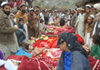
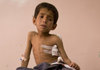

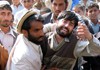



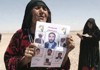




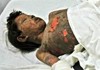

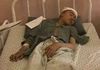

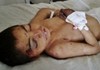

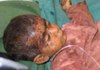


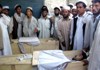






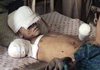




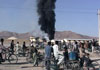












![[Local residents take out a procession as they accuse NATO forces of killing civilians in an overnight raid, at Surkh Rod, Afghanistan, Friday, May 14, 2010. More than 500 people poured into the streets in the Surkh Rod district of Nangahar province to protest the raid by international forces that they claim killed at least nine civilians. (AP Photo/Rahmat Gul) ]](http://www.commondreams.org/files/article_images/protestcivilian_afghanistan.jpg "protestcivilian_afghanistan.jpg")